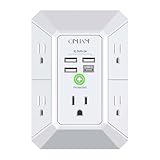
I remember staring at my surge protector, the cheap one with maybe six outlets, wondering if I was going to have to choose which electronic lifeblood to unplug to make room for the new gadget. It felt like a constant game of Tetris for my desk.
This whole decision of are 8 outlets okay or buy 11 outlets isn’t as simple as just grabbing the one with more holes. It boils down to what you’re actually plugging in and how much you value sanity and safety down the line.
Let’s be honest, we’ve all got more cords than we know what to do with these days. So, how do you pick the right power strip without ending up in the same tangled mess?
Eight Outlets: When Less Is More (sometimes)
Look, for a lot of people, especially those who aren’t running a full-blown home studio or a gamer’s paradise, eight outlets on a surge protector is plenty. Think about it: your laptop charger, your phone charger, a desk lamp, maybe a monitor, and your Wi-Fi router. That’s five, maybe six right there. You’ve still got a couple of spares for your wireless mouse charging pad or a rechargeable battery station. It’s not about the raw number as much as the type of devices you’re powering.
I used to think more was always better. I bought this monster power strip once, the kind with like 12 outlets, and half of them were wasted because they were too close together. My bulky power bricks for my external hard drives and my audio interface just choked the whole thing. I ended up having to use an extension cord to plug another power strip into it, which is a recipe for disaster and looks like a rat’s nest.
The real trick with an eight-outlet strip is spacing. Some manufacturers are smart about this. They’ll put a couple of widely spaced outlets on the ends for those chunky adapters. If you’ve got a standard setup – just the usual suspects for work or casual computer use – eight good ones, with decent spacing, will serve you well. It keeps things tidy and prevents that feeling of being power-starved. The key is to assess your current and near-future needs. Are you adding a second monitor? A new gaming console? A smart home hub? If the answer is no and your current needs are met, eight might just be the sweet spot.
The Case for Eleven (or More): When Space Is the Real Luxury
Alright, let’s talk about the eleven-outlet beasts. When do you actually need that many? My friend Dave, who’s a musician, has a setup that looks like a circuit board exploded. He’s got preamps, audio interfaces, MIDI controllers, monitors, keyboards, computers, lights… the list goes on. For him, an eight-outlet strip would be a cruel joke. He needs options, and he needs them spaced out because, just like me, he’s got gear with those ridiculously oversized power bricks that eat up three slots on a normal strip.
I’ve been there myself when I was working from home during the pandemic. I had my work laptop, my personal laptop, two external monitors, a printer, a scanner, a webcam, a ring light, a small fan, and of course, the ever-present phone charger. Trying to cram all that onto an eight-outlet strip was just not happening. I ended up with a power strip daisy-chained to another, which is honestly terrifying from a fire safety perspective.
That’s when I finally bit the bullet and got a longer strip with more, and importantly, better spaced, outlets. It was a big deal for my sanity. The surge protector I ended up with had 12 outlets, and it was like a breath of fresh air.
The sheer convenience of having enough ports, and the ability to plug in even the clunkiest of power bricks without blocking everything else, is worth its weight in gold.
People Also Ask: ‘How many devices can be plugged into a surge protector?’ and ‘What is the difference between a surge protector and a power strip?’
A surge protector is a type of power strip that includes circuitry to protect your electronics from voltage spikes. A standard power strip just gives you more outlets. The number of devices you can plug in depends on the total wattage the strip can handle and the wattage of your individual devices. Overloading a strip, regardless of the number of outlets, is a fire hazard. For an 11-outlet strip, you’re looking at a higher likelihood of needing it for multiple high-draw devices, which means you need to be even more mindful of the total power draw. Don’t just plug everything in willy-nilly. Check the amperage and voltage ratings. (See Also: Are American Outlets Ac Or Dc )
What to Look for: Beyond the Outlet Count
So, we’ve established that more isn’t always better, but sometimes it’s absolutely necessary. But here’s the thing: not all outlets are created equal, and neither are the strips they’re attached to. Forget the number for a second and let’s talk features. First off, surge protection. If you’re plugging in anything even remotely valuable – a computer, a TV, a gaming console – you want surge protection. Look for a Joule rating. The higher, the better. I saw a lightning strike once that fried a perfectly good TV because it was plugged into a basic power strip with no surge protection. That lesson cost me $800.
Then there’s the spacing of the outlets. As I’ve ranted about, some strips have outlets packed so tightly you can barely get a standard plug in, let alone a wall wart or a brick. Look for those wider-spaced outlets, often marked with a different color or slightly larger gap.
These are lifesavers for AV equipment, power supplies, and anything with a large plug. Another thing people overlook is the cord length. Do you need to run power across the room? Get a longer cord.
Is it just sitting behind your desk? A shorter one might be cleaner. USB ports are also a big plus these days.
Having a couple of built-in USB-A or USB-C ports can free up wall outlets that would otherwise be occupied by phone chargers.
Here’s a quick breakdown of what I prioritize:
| Feature | My Verdict | Why |
|---|---|---|
| Surge Protection (Joule Rating) | Must Have | Protects expensive electronics from power surges. |
| Outlet Spacing | Highly Recommended | Prevents bulky adapters from blocking other outlets. |
| USB Ports (Type & Quantity) | Nice to Have | Convenient for charging phones, tablets, etc. |
| Cord Length | Depends on Setup | Needs to reach your power source without strain. |
| Mounting Options (Keyhole Slots) | Useful | Allows for wall or under-desk mounting. |
| Indicator Lights (On/Off, Surge Protection) | Good to Have | Lets you know it’s working and protected. |
Common Mistakes and What Not to Do
Here’s where I see people really mess up. The biggest one?
Overloading. It’s like trying to shove a whole Thanksgiving dinner into your stomach at once – it’s not going to end well. Every power strip has a maximum wattage or amperage rating.
Plug in too many high-draw devices (like space heaters, hair dryers, or power-hungry computers) and you risk overheating, tripping breakers, or even starting a fire. I once saw a coworker’s setup where they had a computer, two monitors, a printer, and a desk fan all plugged into a cheap six-outlet strip.
The thing was warm to the touch constantly. That’s a no-go. Check the specs on your devices and the power strip. If you’re unsure, err on the side of caution.
Another mistake is ignoring the type of protection. A basic power strip is just that – a strip with more plugs. (See Also: Are All Power Outlets Ac )
It offers zero protection against power surges. If you live in an area with frequent thunderstorms or unreliable power grids, investing in a good surge protector is a must. I’ve had a laptop charger get fried by a minor surge that wasn’t even strong enough to flicker the lights.
Cost me $100 for a replacement charger. Another one I encountered was the old ‘one strip to rule them all’ mentality.
People will plug a power strip into another power strip, and then maybe another. This is called daisy-chaining, and it’s a huge fire risk.
It puts undue stress on the cords and can easily overload the primary strip.
The ‘People Also Ask’ question ‘Is it safe to plug a power strip into another power strip?’ is a resounding NO. Don’t do it. It’s unsafe, it’s a fire hazard, and it’s just a bad idea all around. Stick to plugging your devices directly into the wall or into a single, appropriately rated surge protector. Also, don’t buy the absolute cheapest option you can find. A few extra bucks can get you significantly better build quality, more solid surge protection, and outlets that aren’t going to wiggle loose after a few months.
Real-World Scenarios: Where 8 vs. 11 Shines
Let’s paint some pictures. Scenario one: The Bedroom Oasis. You’ve got your bedside lamp, your phone charger, maybe an e-reader, and a white noise machine. Eight outlets? More than enough. In fact, you could probably get away with a four-outlet strip and still have spares. The risk of a surge here is relatively low, and the power draw is minimal. Buying an 11-outlet monster would be overkill, taking up unnecessary space and costing more than you need to spend.
Scenario two: The Home Office Hustle. This is where things get interesting. You’ve got a desktop computer, one or two monitors, a printer, a scanner, a webcam, a desk lamp, your phone charger, and maybe a small fan or a coffee warmer. Suddenly, eight outlets are looking tight.
If your monitor has a bulky power brick, your printer is a power hog, and you’ve got multiple chargers, you’re going to struggle. This is where an 11-outlet strip, especially one with good spacing and USB ports, becomes a lifesaver. It keeps your workspace organized and makes sure you’re not constantly unplugging things to swap them out.
I remember when I first transitioned to full-time remote work, my desk became a spaghetti junction of wires because I was trying to fit everything onto a small strip. It was stressful and inefficient. Upgrading to a longer, multi-outlet strip with better spacing made a huge difference in my productivity and my peace of mind.
Scenario three: The Entertainment Hub. Think TV, soundbar, game console, streaming device, Blu-ray player, and maybe a smart plug for mood lighting. This can also rack up the outlet count quickly, especially if each component has its own power brick. While a lot of modern TVs and consoles have relatively efficient power management, the collective draw can be significant. If you’re running a high-end gaming PC with multiple monitors and peripherals, you’re definitely in 11+ outlet territory. For a simpler setup, eight might suffice, but if you’re adding a new console or a second streaming device, you might find yourself wishing you had just a few more slots.
Practical Tips for Power Strip Peace of Mind
Okay, let’s get down to brass tacks. Beyond just picking the right number of outlets, how do you make sure you’re powering your life safely and efficiently? First, label your outlets. Seriously. Use a label maker or even just a piece of tape and a pen. Label which outlet is for your computer, which is for your monitor, which is for your phone charger, and so on. This makes it SO much easier to know what’s what, especially if you have multiple devices with similar-looking plugs. It also helps when you need to troubleshoot – “Okay, the printer isn’t working, is it plugged into the printer outlet?” (See Also: Are Arc Trip Outlets Required In Hillsborough County )
Second, understand your power draw. Most electronics have a label somewhere that tells you their wattage or amperage. You can usually find the total wattage capacity of your surge protector printed on the unit itself or in its manual. A general rule of thumb: don’t exceed 80% of the strip’s maximum capacity for continuous use. So, if your strip is rated for 1800 watts, aim to stay under 1440 watts. This leaves a buffer and reduces the risk of overheating. For those of you eyeing an 11-outlet behemoth, this becomes even more important because it’s easier to just keep plugging things in without thinking.
Third, regularly inspect your power strips and cords. Are the cords frayed?
Are the outlets loose? Is there any sign of melting or discoloration?
If you see any damage, get rid of it. Don’t try to save a few bucks by keeping a damaged power strip. It’s a fire hazard waiting to happen. I had a cord on an old surge protector that got pinched by a desk leg.
It looked fine, but after a few months, it started to smell funny. I replaced it immediately. Better safe than sorry.
Finally, and this is a bit of a contrarian take: don’t always go for the most expensive option. While you don’t want the cheapest, bargain-basement model, you also don’t need the $100+ audiophile-grade power strip for your computer setup. Focus on reputable brands, adequate surge protection (look for that Joule rating!), and the outlet configuration that best suits your needs. For instance, the APC brand is generally reliable for surge protection, and they offer a good range of configurations that aren’t going to break the bank.
Faq: Your Power Strip Questions Answered
How Many Devices Can Be Plugged Into a Surge Protector?
The number of devices you can safely plug into a surge protector depends on the total wattage the surge protector can handle and the individual wattage of each device. Always check the surge protector’s maximum wattage rating and compare it to the combined wattage of your devices. Do not exceed 80% of the maximum rating for continuous use to prevent overheating and potential hazards. Overloading is a common mistake that can lead to damage or fire.
What Is the Difference Between a Surge Protector and a Power Strip?
A power strip simply provides multiple outlets from a single wall socket. A surge protector is a type of power strip that includes additional circuitry designed to protect connected electronics from sudden voltage spikes, often caused by lightning strikes or power grid fluctuations. While all surge protectors are power strips, not all power strips are surge protectors. For valuable electronics, a surge protector is highly recommended.
Is It Safe to Plug a Power Strip Into Another Power Strip?
No, it is generally not safe to plug a power strip into another power strip (daisy-chaining). This practice can overload the primary power strip, leading to overheating, damage, or fire. It also increases the risk of electrical faults and can reduce the effectiveness of surge protection. Always plug power strips directly into a wall outlet.
Are 8 Outlets Okay or Buy 11 Outlets?
Whether 8 outlets are okay or if you should buy 11 outlets depends entirely on your specific needs. If you have a minimalist setup with few devices, 8 outlets with good spacing might be sufficient. However, if you have multiple high-draw electronics, a gaming rig, a home office with several peripherals, or a lot of charging needs, an 11-outlet strip (or more) with well-spaced outlets and USB ports will likely be a much better and more convenient choice.
Final Thoughts
So, to wrap this up, the question of are 8 outlets okay or buy 11 outlets isn’t a one-size-fits-all answer. It’s about looking at your desk, your entertainment center, or wherever you’re plugging things in and being brutally honest about what you actually use. Don’t just grab the one with the most holes if you’re only going to fill half of them, and definitely don’t try to cram a dozen things onto a strip designed for six.
My biggest takeaway from years of wrestling with cords and dodgy power strips is that a little foresight goes a long way. Invest in decent surge protection, pay attention to outlet spacing, and for heaven’s sake, don’t daisy-chain power strips. It’s not worth the risk, and frankly, it’s a fire hazard waiting to happen.
Before you buy your next power strip, take five minutes to count your current plugs and think about what you might add in the next year or two. Then, make an informed decision based on real needs, not just the number of outlets advertised. Your future self, and your electronics, will thank you.