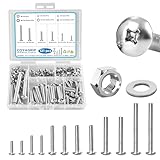
I remember a buddy, fresh out of trade school, trying to rig up a temporary engine mount for a mower engine he was swapping. He’d seen something online, some guy bragging about using whatever he had lying around. So, he grabbed four M8 1.25 bolts and went to town. Fast forward about twenty minutes into the first test run, and… well, let’s just say that engine didn’t stay mounted for long. It was a mess of scraped knuckles and a shattered ego. It made me wonder, can 4 M8 1.25 bolts hold an engine? The short answer is: it depends, but mostly, no, not the way you’re probably thinking.
It’s tempting to think that if a bolt looks decent and screws in, it’s good enough. We see these tiny bolts holding things together all the time, right? But an engine is a whole different beast. It vibrates, it shakes, it’s heavy, and it’s under constant stress. Trying to save a few bucks or a few minutes by skimping on fasteners is a recipe for disaster, and often ends up costing you way more in the long run.
Why Using Tiny Bolts for Serious Loads Is a Bad Idea
Let’s cut to the chase. Asking if 4 M8 1.25 bolts can hold an engine is like asking if four garden gnomes can hold up your roof. The answer is a resounding NO. I’ve seen people try to cut corners on hardware for all sorts of projects, and nine times out of ten, it comes back to bite them. This isn’t just about static weight, either. An engine is a dynamic, vibrating, powerful piece of machinery. The forces it exerts are far more than just its own weight pulling down. There are shear forces, torque, and constant vibration that will rattle even the tightest nuts loose if the bolt isn’t up to the task.
When we talk about M8 1.25 bolts, we’re talking about a metric thread size. ‘M8’ refers to the major diameter of the thread, which is 8 millimeters. ‘1.25’ is the pitch, meaning there are 1.25 millimeters between each thread crest. These are common, small-to-medium fasteners, often found in electronics, small appliances, or light-duty automotive trim. They are NOT designed for the kind of sustained load and vibration an engine produces. Think about it this way: the main mounting bolts for a typical car engine are usually much larger, often 10mm, 12mm, or even 14mm, and made of high-strength steel. They’re not just there to prevent the engine from falling; they’re there to keep it securely in place under extreme stress.
The strength of a bolt isn’t just about its size. It’s also about the material it’s made from. Bolts are graded based on their strength, with higher numbers indicating greater tensile strength and hardness. Standard bolts are often Grade 4.6 or 5.8.
High-strength bolts can be Grade 8.8, 10.9, or 12.9. An M8 bolt, even a high-strength one, simply doesn’t have the surface area or the inherent material strength to handle the shear and tensile forces an engine generates, especially when multiplied by vibration and torque.
I once had a buddy try to mount a heavy-duty winch motor onto a custom bracket with what he thought were ‘beefy’ M10 bolts. He didn’t check the grade, and after a few uses, the bolts started stretching and bending. He ended up having to re-weld the bracket and use proper, higher-grade, larger diameter bolts. Lesson learned the hard way.
The Math (and Physics) Behind Bolt Strength
Let’s get a little more into the weeds, because this is where the ‘no’ becomes crystal clear. When you’re talking about holding an engine, you’re not just dealing with static weight.
You’re dealing with shear stress (forces trying to slice the bolt), tensile stress (forces trying to pull the bolt apart), and the constant fatigue caused by vibration. An M8 bolt, even if it’s a high-strength Grade 10.9 or 12.9, has a limited tensile strength. For a Grade 10.9 M8 bolt, the proof load (the maximum stress it can withstand without permanent deformation) is around 51.7 kN (kilonewtons), and the ultimate tensile strength is around 67.3 kN. That sounds like a lot, but engines are heavy.
A small four-cylinder car engine can weigh anywhere from 250 to 400 pounds (about 113 to 181 kg). That’s a significant static load, and each bolt would be sharing that load, assuming perfect distribution, which is rarely the case. (See Also: Can I Buy A Full Auto Bolt Carrier )
But the real killer is vibration. Think about how much an engine vibrates.
That constant shaking puts cyclic stress on the bolts. Over time, even if the bolts aren’t technically exceeding their ultimate tensile strength, the repeated stress can cause them to fatigue and fail.
This is why engine mount bolts are not only large and strong but also often made of specific alloys designed for fatigue resistance. Furthermore, the mounting surface and the bracket itself play a huge role. Thin, flimsy brackets will flex and bend, transferring more stress to the bolts.
Even with larger, stronger bolts, a weak mounting system is a recipe for failure. I once saw a picture of a race car engine that had vibrated loose from its mounts; the bolts themselves were intact, but the surrounding aluminum block they screwed into had been completely ripped apart.
It’s a stark reminder that the fastener is only one part of the system.
The number of bolts also matters exponentially. With four bolts, each bolt is theoretically carrying 1/4 of the load. If you increase to six bolts, each bolt carries 1/6. This significantly reduces the stress on each individual fastener. However, this is a theoretical ideal. In reality, due to manufacturing tolerances, uneven surfaces, and the nature of how things tighten, the load distribution is rarely even. One or two bolts might be taking more than their fair share. This is why using the minimum number of fasteners, especially small ones like M8s, for a important application like an engine mount is simply asking for trouble. It’s a risk I’m personally not willing to take, and I wouldn’t advise you to either.
When Might M8 Bolts Be Okay? (spoiler: Not for Holding an Engine)
Alright, let’s be super clear: for holding an actual engine, like in a car, truck, motorcycle, or even a significant piece of industrial equipment, 4 M8 1.25 bolts are absolutely, unequivocally, not enough. End of story. However, to give M8 bolts their due, they are useful fasteners for many other things. They’re great for attaching smaller components, like brackets for accessories, covers, panels, or even some smaller electronic enclosures. For instance, I’ve used M8s extensively when building custom motorcycle fairings or mounting auxiliary lights. The stress on those components is minimal compared to an engine.
Consider the context. If you’re building a lightweight go-kart with a very small, low-power engine, perhaps the vibration and weight are minimal enough that if you were using a solid mounting plate and perhaps eight or more M8 bolts of high-strength grade (like 10.9 or 12.9), and you had properly engineered the entire system, you might get away with it for a short period. But this is an extreme edge case and would still be a gamble. It’s the kind of thing an engineer would have to calculate and test rigorously, not a DIY ‘let’s try this’ situation. For nearly all practical applications involving an engine that needs to run reliably, you need to step up significantly in bolt size and grade.
Here’s a table showing common applications for M8 bolts compared to what you’d typically need for engine mounting. You can see the vast difference in scale and requirement. It’s not just about the bolt; it’s about the entire mounting system, including the material thickness of the engine block, the bracket, and the frame it attaches to. Using M8 bolts for an engine is like using dental floss to tow a semi-truck – it’s just the wrong tool for the job, no matter how many pieces of floss you tie together. (See Also: Are Mercruiser 5 7 Engines Four Bolt Mains )
| Fastener Size & Grade | Typical Application | Opinion/Verdict for Engine Mount |
|---|---|---|
| M8 8.8 (Standard Strength) | Light brackets, covers, interior trim, bicycle components | Absolutely not. Insufficient strength and fatigue resistance. |
| M8 10.9 / 12.9 (High Strength) | Heavier duty brackets, some machinery parts, certain automotive sub-assemblies | Still not suitable for direct engine mounting. Might be okay for very minor accessory brackets attached to the engine, but not holding the engine itself. |
| M10 10.9 / 12.9 | Subframe components, suspension parts, moderate machinery mounts | Getting closer, but likely still undersized and under-serviced for most primary engine mounts. Better than M8, but still not the go-to. |
| M12 10.9 / 12.9 (or larger) | Primary engine mounts for most cars/trucks, heavy machinery | This is the range you should be looking at for secure engine mounting. Larger diameters and appropriate grades are key. |
Real-World Engine Mounting: What Actually Works
When you look under the hood of any car, or the frame of a motorcycle, you’ll see how engines are properly mounted. They are bolted to substantial engine mounts, which are themselves bolted to the vehicle’s chassis or frame. The bolts used are typically large diameter (often 10mm, 12mm, or 14mm) and made of high-strength steel, usually in the 10.9 or 12.9 grade range. These aren’t just random bolts; they are engineered specifically for the job.
Engine mounts themselves are usually made of thick steel or cast aluminum, designed to absorb vibration and distribute the load evenly. They often incorporate rubber or hydraulic dampening to further isolate the engine’s movement from the vehicle’s body. The bolts pass through these solid mounts and thread into either the engine block or a substantial part of the vehicle’s frame. The surfaces where the bolts make contact are important. They need to be flat, clean, and free of any debris or damage to make sure even clamping force. Torque specifications are also vital. Overtightening can strip threads or stretch bolts, while undertightening can lead to loosening under vibration.
I remember a time I was helping a friend rebuild a classic muscle car. The original engine mounts were shot, all cracked rubber and rusty metal. We sourced reproduction mounts, but the bolts that came with them were just… okay. They were M12, which was the right size, but the grade seemed a bit low.
My gut told me something was off. I spent a bit of extra cash – maybe $50 more – and got a set of proper, high-grade M12 bolts from a reputable automotive supplier. When we installed the engine, torqued everything down, and fired it up, the difference was noticeable.
The engine felt solid, no excessive wobble or concerning noises. That small investment in the right fasteners saved potential headaches down the road. It’s a classic case of paying a little now to avoid paying a lot later.
The key takeaway is that engine mounting is a system. It involves the bolts, the mounts, the engine block, and the vehicle structure. All components must be appropriately sized and strong enough to handle the intended loads and stresses. Trying to substitute undersized or low-grade fasteners is a shortcut that will almost certainly lead to failure. If you’re unsure, always err on the side of caution and consult the vehicle’s service manual or a qualified mechanic. Proper fasteners are not a place to compromise.
Common Mistakes and What to Look For
The biggest mistake people make when considering fasteners for any load-bearing application, especially something as important as an engine, is looking at the bolt size and thread pitch and assuming it’s adequate. They see an M8 bolt, it fits, it screws in, and they think, ‘Great, that’ll work.’ They don’t consider the material grade, the shear strength, the tensile strength, or the fatigue life. This is a huge oversight. I’ve seen this mistake manifest in everything from furniture that wobbles apart to, yes, engine components coming loose.
Another common error is buying the cheapest bolts available. You know, the ones in the miscellaneous bin at the corner hardware store that look vaguely like what you need. These are often made from lower-quality steel, have inconsistent thread rolling, and are simply not built to withstand the stresses of automotive or mechanical applications. Always look for bolts from reputable manufacturers, and pay close attention to the markings on the bolt head. The grade markings (like 8.8, 10.9, 12.9) are your best friend. A bolt without clear markings is usually a sign to steer clear for anything important.
Here’s a simple guide on what to look for when choosing fasteners for important applications: (See Also: Can Am Merverick X3 Max Xrs Wheel Bolt Pattern )
- Size and Pitch: Make sure the diameter and thread pitch match the intended hole or nut. For engine mounting, this usually means M10 or M12 minimum, often larger.
- Material Grade: This is most important. For anything subjected to vibration, shock, or significant load, look for high-strength grades. 10.9 is a minimum for many automotive applications, with 12.9 being preferable for important areas like engine mounts. Avoid standard grades (like 4.6, 5.8, 8.8) for engine mounting.
- Condition: Bolts should be straight, with undamaged threads and heads. Rust or visible damage is a red flag.
- Manufacturer Reputation: Stick with known brands like ARP (Automotive Racing Products), though even standard industrial bolt manufacturers have good quality lines. If it’s unbranded, be suspicious.
- Application-Specific Hardware: Whenever possible, use hardware specified by the original equipment manufacturer (OEM) or a reputable aftermarket supplier for your specific vehicle or equipment. They’ve done the engineering.
One specific instance I recall involved a custom motorcycle frame being built. The fabricator used what he called ‘strong M10 bolts’ for the engine cradle. It turned out they were standard 8.8 grade. Within a few hundred miles, the engine started to sag, and the frame began to flex alarmingly. We had to replace all the bolts with 12.9 grade items and reinforce the mounting points. That was a painful $300 lesson for the owner, not to mention the downtime and risk involved.
People Also Ask (faq)
What Is the Correct Size Bolt for an Engine Mount?
The correct size bolt for an engine mount varies significantly depending on the engine’s size, weight, and the vehicle’s design. However, for most automotive applications, you’ll find M10 or M12 diameter bolts being used, often in higher tensile strength grades like 10.9 or 12.9. Smaller engines in go-karts or lawnmowers might use smaller bolts, but important applications demand larger diameters and higher strength grades. Always consult the service manual for your specific vehicle or equipment for the exact specifications.
Can I Reuse Engine Bolts?
Generally, no, it is not recommended to reuse engine bolts, especially those that are subject to high stress, torque, or vibration. Many modern automotive bolts, particularly those used in important areas like engine mounts, cylinder heads, and connecting rods, are torque-to-yield bolts. This means they are designed to stretch to a specific point to achieve optimal clamping force. Reusing them can result in under- or over-tightening, leading to potential failure. Even if not torque-to-yield, repeated stress can weaken standard bolts, making them prone to breaking or loosening. It’s a small cost for a important safety component.
What Grade of Bolt Is Strongest?
In the metric system, the strongest common bolt grades are typically 12.9. Higher grades, like 14.9, exist for very specialized applications but are not commonly found. The grade is indicated by markings on the bolt head. For example, a bolt marked ‘12.9’ signifies a very high-strength bolt. In the imperial (US customary) system, Grade 8 bolts are equivalent in strength to metric Grade 8.8, while Grade 8.2 (often marked with 8 or 8+) is roughly equivalent to metric Grade 10.9, and Grade 9 is equivalent to metric Grade 12.9. Always use the specified grade for the application; using a bolt that is too strong can sometimes cause other components to fail first.
How Much Weight Can an M8 Bolt Hold?
An M8 bolt’s weight-holding capacity depends heavily on its grade and how it’s loaded (tension or shear). A single M8 Grade 8.8 bolt has a tensile strength of around 40 kN (about 9,000 lbs) and a shear strength that is typically less. However, this is a static load test. In dynamic applications with vibration and shock, the effective load capacity is much lower, and fatigue becomes a major concern.
For engine mounting, where forces are dynamic and important for safety, relying on the static tensile or shear strength of even a high-grade M8 bolt (like 12.9, with a tensile strength around 67 kN or 15,000 lbs) is highly inadvisable and unsafe. The collective strength of four M8 bolts is insufficient to guarantee safety for an engine.
Conclusion
So, to circle back to the original question: can 4 M8 1.25 bolts hold an engine? The answer is a definitive and emphatic ‘no’. I’ve hammered this point home because I’ve seen the consequences of using the wrong fasteners firsthand, and it’s never pretty. It’s not just about the weight; it’s about the constant vibration, the torque, and the dynamic forces an engine generates. You need properly sized, high-grade bolts that are designed for the job.
If you’re looking at a project where you think M8 bolts might be an option for engine mounting, please, for your own sake and the sake of anyone who might be around when it fails, reconsider. Look at the OEM specifications for your vehicle or equipment. If you’re fabricating something custom, consult with someone who understands structural engineering and fastener load ratings. It might cost a bit more upfront, but it’s a fraction of the cost of repairing the damage, replacing the engine, or dealing with a catastrophic failure.
My advice? Always oversize and over-spec your fasteners for important applications. It’s better to have a bolt that’s stronger than you need than one that fails when you least expect it. When it comes to holding an engine in place, there is no room for guesswork or cutting corners. Use the right hardware, or don’t do the job at all.