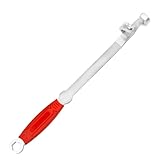
I remember the first time I tried to loosen a stubborn bolt on my old lawnmower. I was convinced my brand new, shiny torque wrench, set to its lowest setting, would be the magic bullet. It wasn’t. In fact, it made things worse, a slippery, frustrating mess. So, can you use a torque wrench to undo bolts? The short answer is yes, technically, but it’s often not the best tool for the job, and you can easily mess things up if you’re not careful.
It’s a question that pops up a lot when you’re wrestling with seized fasteners or just trying to figure out the capabilities of your gear. We spend good money on these precision instruments, and it’s natural to wonder if they have a dual purpose beyond just tightening things down to spec. Let’s cut through the noise and talk about what’s really going on.
Why Your Torque Wrench Isn’t Just a Fancy Breaker Bar
Look, the primary job of a torque wrench is to apply a specific amount of rotational force – torque – to a fastener. It’s all about precision. You set it to, say, 50 foot-pounds, and when you reach that point, it clicks, beeps, or the needle hits a mark. This is invaluable for engine components, wheel lug nuts, and anything where over-tightening or under-tightening can have disastrous consequences. Think about it: overtightened lug nuts can warp brake rotors or even snap studs. Overtightened engine bolts can strip threads or crack housings. That’s why they exist. They are measuring tools, not brute force instruments.
When you’re undoing a bolt, you’re basically applying force in the opposite direction. The torque wrench is designed to measure and limit force on the tightening side.
Most click-type torque wrenches have a clutch mechanism that disengages or signals when a set torque is reached. This mechanism isn’t typically designed to withstand the kind of shock or sustained force you might encounter when breaking a bolt loose, especially if it’s rusted or significantly over-tightened. Using it as a breaker bar can damage that delicate internal mechanism, rendering it inaccurate for its primary, more important function.
I’ve seen guys put a cheater bar on a torque wrench to break loose a bolt, and then they wonder why it’s reading all over the place on the next tightening job. It’s a common, costly mistake.
Some people argue that if you use it very gently, just to feel the initial resistance, it’s okay. And maybe, just maybe, for a bolt that’s only slightly snugged and not seized, this approach might work without immediate damage. But that’s a big ‘if.’ The risk of internal damage is always there, and it’s rarely visible until your next important tightening task. Plus, for truly stuck bolts, you need use and sometimes a good jolt, which is exactly what a torque wrench is trying to prevent you from applying.
So, while the metal parts are solid enough to handle the force of loosening, the internal measuring and signaling mechanisms are the weak points. Think of it like using a very precise scale to weigh a sack of rocks you’re about to throw. The scale might not break immediately, but it’s not designed for that kind of abuse and its accuracy will suffer.
What Happens Under the Hood (and Why It Matters)
Inside a typical click-type torque wrench, you’ll find a spring-loaded mechanism with a cam or roller system. When you apply torque, the force pushes against this system. As you approach the set torque value, the cam is pushed into a position where it releases a detent or lever, creating the ‘click’ you feel and hear. This disengagement is the wrench saying, ‘Stop, you’ve reached the target.’ Now, imagine applying force in the reverse direction, or applying a sudden, jarring force to break a bolt loose. This can put excessive stress on that cam and roller assembly, potentially bending, chipping, or misaligning the parts.
This is especially true for beam-type torque wrenches, which have a needle that moves along a scale. While they might seem more solid because they don’t have a complex disengaging mechanism, the needle assembly and the pointer itself can be bent or damaged by excessive reverse force. Dial-type torque wrenches are similar, with the dial mechanism being susceptible to damage from shock loading.
The common advice from manufacturers is clear: use a torque wrench only for tightening. They are designed for a single purpose, and deviating from that purpose, while often physically possible, can lead to expensive repairs or replacements.
For example, my friend Dave once tried to use his fancy Snap-on torque wrench to loosen a caliper bolt that had been over-torqued by a less experienced mechanic. He managed to get it loose, but the next time he torqued down wheel bearings on his truck, the wrench was off by nearly 20 ft-lbs. (See Also: Do You Need Torque Caliper Bolts )
He ended up having to send it in for recalibration, which cost him nearly $150 and a week without his go-to tool. That’s a hefty price for trying to save a few minutes and avoid grabbing the right tool.
This isn’t just about protecting your investment; it’s about making sure the accuracy of your work. When you’re working on anything important, like your car’s engine or suspension, precise torque values are a must for safety and performance. A damaged torque wrench is a liability, not an asset. So, while you can technically apply force to undo a bolt, you’re rolling the dice on the tool’s accuracy and longevity.
The Right Tool for the Job: What to Grab Instead
If you need to undo a bolt, especially one that might be seized or significantly tightened, reach for the tools designed for that purpose. The most obvious choice is a good old-fashioned breaker bar. These are basically long, sturdy ratchets without the internal ratcheting mechanism that can be damaged by shock loads. The longer handle gives you more use, which is exactly what you need to break a bolt loose. They are built to withstand the forces involved in loosening stubborn fasteners.
For even tougher jobs, consider an impact wrench. These use rotational impacts (hammering action) to shock the bolt loose. They’re incredibly effective for rusted bolts or those that have been overtightened. You can get air-powered or battery-powered versions, and for DIY use, a decent cordless impact wrench is a fantastic investment. I picked up a mid-range DeWalt impact wrench a couple of years ago for about $180, and it has saved me hours of frustration on suspension work and exhaust bolts. It’s a tool that earns its keep quickly.
A regular ratchet can also be used, but if the bolt is really tight, you risk damaging the ratchet mechanism. Some ratchets are more solid than others, but a breaker bar is generally a safer bet for high-torque loosening applications. If you’re working on something where precision is key and the bolt isn’t excessively tight, a standard ratchet might suffice, but always be mindful of the force you’re applying.
Another common scenario is when a bolt is seized due to rust or corrosion. In these cases, brute force alone might not be enough, and you risk snapping the bolt head off. This is where penetrating oil comes into play. Spray a good quality penetrating oil (like PB Blaster or Kroil) liberally on the bolt threads and let it soak for at least 15-30 minutes, or even overnight for really stubborn cases. Tapping the bolt head lightly with a hammer can also help the penetrating oil work its way into the threads. Then, try loosening it with your breaker bar.
When Using a Torque Wrench to Undo Bolts Is (maybe) Okay
Alright, let’s talk about the grey area. Can you use a torque wrench to undo bolts? In very specific, limited circumstances, it might be acceptable, but I’d still advise against it if you have other options. The key is understanding the torque setting and the nature of the fastener.
If you have a fastener that was torqued to, say, 20 ft-lbs, and you want to undo it, and your torque wrench has a range that goes down to 10 ft-lbs, you might be able to use it gently. You’d set it to a slightly higher value than the target loosening torque (perhaps 25-30 ft-lbs), apply smooth, steady pressure, and listen for the click.
If it clicks without excessive force, you’ve likely succeeded without damaging the wrench.
This approach is more about ‘feeling’ the initial break than applying maximum force. It’s about breaking a seal or slight static friction, not overcoming significant resistance. Think of it as using the torque wrench to confirm that a bolt isn’t seized before you go all-out with a breaker bar. If you’re working on a delicate assembly where you absolutely cannot afford to overtighten even slightly on the loosening side (which is a weird scenario, but hypothetically), and you know the fastener isn’t going to be a bear to remove, this might be your only tool.
However, I cannot stress enough that this is risky. The ‘click’ is designed for tightening. Using it for loosening can still jar the internal mechanism. (See Also: Do I Need Special Replacement Bolts For Car Engines )
My own experience and that of many mechanics I know is that it’s just not worth the risk. For every time it might work without issue, there are dozens of times it can damage the tool or, worse, lead to inaccurate torque readings later.
I had a set of aluminum valve covers on a vintage motorcycle that called for a very low torque spec. I was nervous about over-tightening them and stripping the aluminum threads. I used my torque wrench to break them loose, and thankfully, they weren’t seized. But even then, I felt a slight ‘give’ in the mechanism that made me uneasy.
I now keep a dedicated set of small breaker bars for those delicate jobs, just in case.
Here’s a quick comparison of tools you might consider:
| Tool | Primary Use | Pros for Loosening | Cons for Loosening | Verdict for Loosening |
|---|---|---|---|---|
| Torque Wrench | Precise Tightening | Can technically be used if gentle | High risk of damage to mechanism, potential inaccuracy | Avoid if possible; use only as a last resort for very light duty. |
| Breaker Bar | High-Torque Loosening | Designed for it, provides excellent use, durable | Not for precise tightening | Ideal for stubborn or high-torque bolts. |
| Ratchet | General Fastening | Convenient for moderate tightness | Can be damaged by excessive force or shock | Good for less stubborn fasteners; breaker bar is safer for high torque. |
| Impact Wrench | Rapid Loosening/Tightening | Extremely effective for seized or stubborn bolts | Can be overkill for light jobs, requires power source (air/battery) | Excellent for tough jobs, but can also strip threads if not careful. |
Common Mistakes and How to Avoid Them
The biggest mistake, hands down, is using a torque wrench as a primary tool for breaking bolts loose. People see the long handle and the sturdy metal construction and assume it’s just a heavy-duty ratchet. They don’t appreciate the delicate internal calibration mechanism. When a bolt is seized, the force required to break it free can be significantly higher than the torque setting on the wrench. Jamming that much force through the mechanism is a recipe for disaster.
Another common error is not cleaning the bolt threads and the socket before attempting to loosen. Dirt, rust, or debris can add to the resistance, making the bolt harder to turn. Always try to clean around the fastener as best you can. Using a wire brush on the bolt head and surrounding area can help. If the bolt is corroded, a little penetrating oil is your best friend. As I mentioned, letting it soak is key. Don’t just blast it with force immediately.
Some folks also use the wrong size socket or a worn-out socket. This can round off the bolt head, making it even harder to remove. Make sure your socket fits snugly on the bolt head. If it’s a bit loose, try a 6-point socket instead of a 12-point, as they offer better grip. For really stubborn bolts that are starting to round, a bolt extractor socket set can be a lifesaver, though they can be aggressive.
Finally, there’s the ‘muscle’ mistake. Over-applying force without understanding the limits of the fastener or the tool. If a bolt isn’t budging, don’t just keep muscling it. Stop, reassess. Apply more penetrating oil, try a bit of heat (if appropriate for the material), or use a specialized tool like an impact wrench. Snapping a bolt off in a important component is far worse than taking a little extra time to remove it properly. Learning when to apply force and when to back off is a skill developed through experience, and often, through making a few mistakes along the way.
The Real-World Use Case (and When Not To)
In my garage, the torque wrench lives in its case, only coming out when I’m tightening. For loosening, I have a dedicated set of breaker bars in various lengths, a couple of impact sockets for my electric impact wrench, and a can of PB Blaster that’s seen better days. I learned this lesson the hard way after damaging a fairly expensive torque wrench trying to loosen a crankshaft pulley bolt on a car.
The bolt was seized on tight, and I figured my torque wrench, being a quality piece, could handle it. It clicked, and I kept applying pressure, thinking it would eventually break free. It didn’t break free; it just sort of… gave up its internal structure with a sickening crunch. The wrench was toast, and I still had a stuck bolt.
The only time I might even consider using a torque wrench for loosening is on a very lightly fastened bolt that’s not seized, like a small inspection cover or a plastic component’s fastener where over-torqueing on loosening could still cause damage (though again, this is rare). Even then, I usually opt for a small, non-ratcheting wrench or a very gentle touch with a standard ratchet. The risk of internal damage to the torque wrench, and the subsequent loss of accuracy, just isn’t worth the potential convenience. (See Also: Can You Use A Torque Wrench To Break Bolts Loose )
For example, I recently had to remove a decorative bolt from a piece of furniture that was clearly just snugged down. My torque wrench goes down to 10 ft-lbs. I set it to 15 ft-lbs, applied gentle, steady pressure, and it clicked off immediately. No problem. But that was a bolt that likely only needed 5 ft-lbs to begin with, and it wasn’t rusted or thread-locked. If that bolt had been even slightly stubborn, I would have reached for something else.
Ultimately, the goal is to have tools that perform their intended function accurately and reliably. A torque wrench’s intended function is precise tightening. Using it for loosening, especially when significant force is required, compromises its accuracy and lifespan. It’s like using a chef’s knife to chop through a brick – it might work once, but you’ll ruin the knife and probably not get very far.
What Is the Maximum Torque a Torque Wrench Can Break Loose?
There isn’t a specific maximum torque value that applies to all torque wrenches for breaking bolts loose, as it depends heavily on the wrench’s design, construction, and condition. However, the general advice from manufacturers and experienced mechanics is to avoid using them for loosening altogether. The internal mechanisms designed for precise measurement and disengagement are not built to withstand the shock and sustained force often required to break a seized bolt free. Attempting to do so can damage these mechanisms, leading to inaccurate readings during tightening, which is the wrench’s primary and important function.
Can a Torque Wrench Be Used as a Breaker Bar?
While a torque wrench can physically apply force to loosen a bolt, it is strongly advised against using it as a breaker bar. Breaker bars are specifically designed with a simple, solid construction to withstand the high torque and shock loads involved in breaking fasteners loose. Torque wrenches, on the other hand, contain delicate internal mechanisms for measurement and signaling that can be easily damaged by the forces and impacts associated with loosening stubborn bolts. Such damage can render the torque wrench inaccurate for its intended purpose of precise tightening, compromising safety and component longevity.
Will Using a Torque Wrench to Undo Bolts Damage It?
Yes, using a torque wrench to undo bolts, especially if they are seized or require significant force to loosen, can definitely damage it. The internal components, such as cams, springs, and signaling mechanisms, are designed for controlled tightening and can be stressed, bent, chipped, or misaligned by the shock and high torque involved in breaking bolts loose. This damage can lead to inaccurate readings when tightening, making the wrench unreliable for its primary, important function. It’s best to use tools specifically designed for loosening, like breaker bars or impact wrenches.
Is It Bad to Use a Torque Wrench Backwards?
Using a torque wrench backwards, meaning to loosen a bolt, is generally considered bad practice and can be detrimental to the tool. The wrench’s internal calibration and signaling mechanisms are designed to function under tightening forces. Applying significant reverse force or shock loads can damage these delicate parts, compromising the wrench’s accuracy. While it might work without immediate visible damage on very lightly fastened bolts, it significantly increases the risk of internal wear or failure, leading to unreliable torque readings on future tightening jobs.
A Few Practical Tips for Stubborn Fasteners
When you encounter a bolt that just won’t budge, don’t immediately reach for the biggest breaker bar you own and start yanking with all your might. Take a breath. First, make sure you’re using the correct size socket and that it’s fully seated on the bolt head. A loose socket is a recipe for rounding off the fastener. A 6-point socket is almost always preferable to a 12-point for high-torque applications because it grips the flats of the bolt head better, reducing the chance of slippage and damage.
Next, consider penetrating oil. Spray it liberally around the bolt threads and let it soak. Patience is key here; sometimes 15 minutes is enough, but for truly stubborn fasteners, letting it sit for several hours or even overnight can make a world of difference. Tapping the bolt head lightly with a hammer after applying the penetrating oil can help it work its way into the threads. You’re not trying to dent it, just vibrate it a bit.
If penetrating oil and gentle persuasion aren’t working, a bit of controlled heat can be your next step. For most automotive applications, a propane torch can be used to heat the area around the bolt (not the bolt itself directly, if possible). The heat causes the surrounding metal to expand slightly, which can break the bond of rust or thread locker. Be cautious with heat, especially around sensitive components, rubber, or fuel lines. Always have a fire extinguisher handy. Once heated, try loosening it again with your breaker bar while it’s still warm.
Finally, if all else fails, an impact wrench is often the best solution for truly seized bolts. The rapid hammering action can shock the fastener loose when steady force won’t. Just remember to use appropriate impact-rated sockets and avoid excessive force on delicate components. The key takeaway is to have a progression of methods, starting with the least aggressive and escalating as needed, always prioritizing the integrity of both the fastener and your tools.
Final Thoughts
So, to circle back to the original question: can you use a torque wrench to undo bolts? Yes, you can, but it’s like using a scalpel to dig a ditch – technically possible, but incredibly ill-advised. The risk of damaging that precision measuring instrument is high, and the reward is usually minimal compared to the proper tools designed for loosening.
My advice? Keep your torque wrench for tightening, where its accuracy is most important. For those stubborn bolts that need a good yank, grab a breaker bar. If that doesn’t work, a bit of penetrating oil, some heat, or an impact wrench are your next best friends. Investing in the right tool for each job is always cheaper in the long run than replacing a damaged torque wrench or dealing with the consequences of inaccurate torque application.
Next time you’re faced with a tight bolt, remember the tools in your arsenal and choose wisely. Your tools, and your projects, will thank you for it.