I remember the first time I wrestled with a stubborn crank pulley bolt. It was on my old ’98 Civic, trying to do a timing belt job on a sweltering afternoon. I’d watched a dozen YouTube videos, all casually mentioning a torque spec, but none really stressed why it mattered beyond ‘don’t overtighten.’ I figured ‘snug it up good’ was enough. Big mistake. A few months later, I was staring at a seized engine, all because that bolt decided to walk itself out.
So, do you need to torque crank pulley bolt? The short answer is a resounding yes, and I’m going to tell you exactly why that tiny piece of metal is so damn important and why just ‘winging it’ is a recipe for disaster.
Why That Crank Pulley Bolt Is a Bigger Deal Than You Think
Look, I’m all for DIY and saving a buck. I’ve spent more weekends than I care to admit covered in grease, learning the hard way. But some things, some tiny fasteners, hold the entire operation of your engine together. The crank pulley bolt is one of them.
It’s not just some random bolt holding on a pulley; it’s the anchor for the entire front of your engine’s rotating assembly. This bolt is responsible for keeping the crankshaft pulley securely attached to the crankshaft.
The crankshaft pulley is where your serpentine belt (or V-belt on older cars) rides, driving everything from the alternator and power steering pump to the AC compressor and, on some engines, the water pump. If that bolt loosens, even slightly, the pulley can wobble, the belt can slip or jump off, and you’re looking at a cascade of problems.
The real kicker is how much stress this bolt endures. Every time your engine fires, the crankshaft rotates. That rotation creates immense forces, including torsional vibrations.
Think of it like a giant rubber band being twisted and then suddenly released, over and over again. The crank pulley bolt is the one thing holding that pulley against the crankshaft snout, absorbing and transmitting these forces. Without the correct clamping force, achieved through proper torque, this bolt can start to back out.
It’s a slow, insidious process. You might not notice it for weeks or months, but the damage is being done.
The pulley can get out of alignment, chewing up belts. Worse, it can create excessive play on the crankshaft snout itself, leading to premature wear or even damage to the crankshaft journal. I once had a buddy who swore his car was making a weird knocking noise. Turned out his crank pulley bolt had backed out enough to cause the pulley to hit the timing cover with every rotation.
Sounded like a rodent trapped in the engine bay.
The common advice you’ll find online is often a mix of ‘use a torque wrench’ and ‘impact it until it’s tight.’ I’ve seen guys just put a breaker bar on it and lean in with all their might.
That might work sometimes, but it’s pure luck. You’re not applying a measured, repeatable force. You’re just applying a lot of force.
And that’s where the real danger lies. Too little torque, and it’ll loosen.
Too much torque, and you risk stripping the threads on the crankshaft, which is a far more expensive repair than a simple bolt replacement. This isn’t a situation where ‘tighter is better.’ There’s a sweet spot, and the torque spec is designed to find it. It’s the difference between a secure connection and a ticking time bomb. (See Also: Do You Need Torque Caliper Bolts )
What Happens When the Crank Pulley Bolt Comes Loose?
Let’s get real about the consequences of a loose crank pulley bolt. It’s not a minor inconvenience; it can be catastrophic. The first symptom is usually a noise. It might be a chirping, a squealing, or a rhythmic tapping that changes with engine RPM. This is often the pulley itself starting to wobble or the belt slipping erratically. If it gets bad enough, the belt can jump off its pulleys entirely. Suddenly, you’ve lost power steering, your alternator isn’t charging, and your AC is blowing hot air. This is usually when you’ll notice something is seriously wrong and pull over. But the damage might already be done.
The real nightmare scenario is when the bolt backs out far enough that the pulley becomes completely detached or starts to severely damage the crankshaft snout. The crankshaft snout is the end of the crankshaft that the pulley attaches to. It’s a precision-machined surface. If the pulley is allowed to wobble or spin freely on the snout, it can chew up the splines or the keyway (if present), or simply grind down the metal.
Repairing a damaged crankshaft snout often involves welding and re-machining, or in severe cases, replacing the entire crankshaft. This is a massive job, easily costing thousands of dollars. I’ve seen it happen, and it’s gut-wrenching. A $10 bolt and a $30 torque wrench could have prevented a $3,000 repair bill.
I once helped a friend on a project car where we thought we’d tightened the bolt enough. A month later, the pulley was visibly loose, and the snout was starting to show wear. We were lucky we caught it before it became a major issue, but it was a stark reminder of how important that torque spec is.
Another issue is the timing. The crank pulley is often used as a reference point for engine timing. Many timing systems rely on a sensor reading a notch or mark on the pulley.
If the pulley isn’t perfectly seated and secured, this reading can become inconsistent or entirely wrong. This leads to rough running, misfires, and potentially engine damage if the timing is significantly off. Think about it: the engine control unit (ECU) is trying to figure out exactly where the crankshaft is in its rotation to fire the spark plugs and inject fuel at the precise moment.
If the reference point is unstable, the whole system goes haywire. This is why the manual often specifies a very precise torque, and sometimes a specific tightening pattern or even a new bolt. They aren’t just trying to make your life difficult; they’re trying to prevent catastrophic failure and make sure the longevity of your engine.
The ‘good Enough’ Myth and Why You Need a Torque Wrench
Let’s talk about the ‘good enough’ mentality, because it’s rampant in the DIY automotive world, especially when it comes to fasteners. I hear it all the time: ‘Just tighten it till it feels right,’ or ‘An impact wrench is all you need.’
Bullshit. This is one of those areas where ‘feeling’ is a terrible guide. Your ‘feeling’ can be influenced by the length of your wrench, your body weight, how much coffee you’ve had, or even the condition of the threads.
There’s no consistency. And an impact wrench, while great for loosening stubborn bolts, is a terrible tool for precise tightening unless it has a torque-limiting feature.
They deliver a series of hammer blows, and it’s very easy to overtighten or undertighten without realizing it.
I’ll confess, I’ve been guilty of this. On my first engine rebuild, I skipped torquing a few non-important bolts because I was eager to get it running.
Everything seemed fine. A few months later, I developed a mysterious oil leak. Turns out one of those ‘good enough’ bolts had vibrated loose, creating a tiny gap. (See Also: Do I Need Special Replacement Bolts For Car Engines )
It cost me hours of diagnostic time and a new gasket. That’s the problem: you don’t know what ‘good enough’ actually is. A torque wrench takes the guesswork out of it.
It applies a specific, measured amount of rotational force, measured in foot-pounds (ft-lbs) or Newton-meters (Nm). Manufacturers spend millions in R&D to determine the exact torque spec for each fastener. This spec is not arbitrary.
It’s calculated to achieve the optimal clamping force without deforming components, stripping threads, or allowing the fastener to loosen under vibration and thermal expansion.
For the crank pulley bolt, this is especially true. It’s a high-stress application. The torque spec is designed to keep it tight against the constant rotational forces and vibrations. A torque wrench is a relatively inexpensive tool that provides immense peace of mind.
I picked up a decent click-type torque wrench for about $60 a few years ago, and it’s paid for itself a hundred times over in preventing mistakes. If you’re going to be working on your car beyond basic oil changes, a torque wrench should be one of your first tool purchases. It’s not just for the crank pulley bolt; it’s for wheel lug nuts, head bolts, intake manifolds, and countless other fasteners that require precision. Investing in one is investing in the longevity and reliability of your vehicle.
It’s the difference between a repair done right and a repair that will inevitably fail.
How to Properly Torque the Crank Pulley Bolt
Okay, so you’re convinced. You need to torque the crank pulley bolt. Great. Now, how do you actually do it right? First things first, you need the correct torque specification. This is a must. You can find this information in your vehicle’s factory service manual (FSM) or a reputable repair manual like Haynes or Chilton. Sometimes, forums dedicated to your specific car model will have this info, but always cross-reference if possible. Don’t just grab a random number off the internet. The torque spec will be listed in foot-pounds (ft-lbs) or Newton-meters (Nm).
Next, you need the right tools. This means a torque wrench capable of handling the required torque range. Most crank pulley bolts require a fair amount of force, often well over 100 ft-lbs, so a basic 1/4-inch drive torque wrench probably won’t cut it. You’ll likely need a 1/2-inch drive torque wrench. You’ll also need the correct socket size for the bolt. And here’s the trickiest part: you need a way to prevent the crank pulley from spinning while you tighten the bolt. Without this, you’ll just be spinning the engine over. There are several methods:
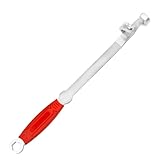
- Crankshaft Pulley Holder Tool: This is the ideal solution. It’s a specialized tool designed to brace the pulley against the engine block, allowing you to apply torque without rotating the crankshaft. They’re often vehicle-specific, so you’ll need to find one for your make and model. I bought a universal-ish one for about $50 that has interchangeable arms and pins to fit different pulley designs.
- Impact Wrench (with caution): While I warned against using an impact wrench for final tightening, it can be used briefly to snug the bolt down initially to hold the pulley in place. But you must follow up with a torque wrench for the final torque setting. Some mechanics use an impact wrench with a torque-limiting socket, which is a safer but still not perfect approach.
- Using the Starter (carefully): On some engines, you can briefly ‘blip’ the starter motor with the transmission in neutral (or park for automatics) and a socket on the bolt. This will give the bolt a short, sharp turn. This is risky because you can easily overtighten or undershorten, and it’s not precise. I’ve seen it done, but I avoid it.
- Wedge or Brace: Some people try to wedge something between the pulley spokes or against the engine block to stop it from turning. This is generally not recommended as it can damage the pulley or the engine.
Once the pulley is held stationary, set your torque wrench to the specified value. Apply smooth, steady pressure to the wrench until it clicks (for a click-type wrench) or indicates the set torque. If the bolt requires a multi-step torque sequence (e.g., torque to X ft-lbs, then rotate an additional Y degrees), follow those instructions precisely. Some manufacturers also recommend using a new bolt, as they can stretch slightly after initial installation, affecting their clamping force. Always check your service manual for this detail.
Common Mistakes to Avoid When Torquing
Let’s be blunt: people mess this up. A lot. The crank pulley bolt is one of those fasteners that seems simple but can cause a world of hurt if done incorrectly. One of the biggest mistakes is using the wrong torque spec. I’ve seen people grab a torque spec for a different engine or even a different manufacturer and use it. They’re all different. The weight of the pulley, the diameter of the bolt, the material of the crankshaft – all these factors influence the required torque. Always, always verify the spec for your exact vehicle and engine.
Another common pitfall is not properly cleaning the threads. If there’s old Loctite, grease, dirt, or rust on the bolt threads or inside the crankshaft snout, it can affect the torque reading. This is called ‘thread friction.’
Clean threads allow the torque wrench to measure the actual clamping force more accurately. Some manufacturers recommend a specific thread locker (like red or blue Loctite) for the crank pulley bolt. If yours does, use it.
If it doesn’t, and you’re worried about it loosening, consult your manual. Some people think that if a little Loctite is good, a lot is better. That’s a mistake. Too much thread locker can act like a lubricant, leading to overtightening, or it can seize the bolt permanently if you use the wrong type. (See Also: Can You Use A Torque Wrench To Break Bolts Loose )
The method used to hold the pulley stationary is another common failure point. If you’re using a flimsy tool or an improper method, you risk damaging the pulley, the engine block, or not achieving the correct torque. I once saw someone try to hold the pulley with a large adjustable wrench.
It slipped, gouged the pulley, and they ended up having to replace it anyway. Also, remember that thermal expansion is a factor. A bolt torqued when the engine is cold might loosen slightly when hot, and vice-versa.
Service manuals account for this, which is why they specify torquing on a cold engine. Finally, and this is a big one: do not reuse an old crank pulley bolt unless the service manual explicitly states it’s okay. These bolts are often designed to be single-use items. They are engineered to stretch slightly to achieve a specific clamping force.
Reusing them can lead to a loss of clamping force and eventual loosening. It’s a cheap part that prevents a very expensive problem.
Do I Need to Replace the Crank Pulley Bolt Every Time?
It depends on the manufacturer’s recommendation for your specific vehicle. Many service manuals will state that the crank pulley bolt is a single-use item and should be replaced. This is because the bolt is often designed to stretch slightly when torqued to achieve the correct clamping force. Reusing it can lead to it not reaching the proper tightness, increasing the risk of it loosening over time.
Can I Just Tighten the Crank Pulley Bolt Really Tight with an Impact Wrench?
No, you absolutely should not rely solely on an impact wrench for the final tightening of a crank pulley bolt. Impact wrenches deliver a series of hammer blows and are very difficult to control for precise torque. It’s easy to either significantly overtighten, potentially stripping threads or damaging the crankshaft, or undertighten, leading to the bolt loosening later. Use an impact wrench for removal or initial snugging, but always finish with a calibrated torque wrench.
What Happens If the Crank Pulley Bolt Is Too Loose?
If the crank pulley bolt is too loose, the pulley can wobble on the crankshaft. This can cause the serpentine belt to slip, jump off, or wear prematurely. In more severe cases, the pulley can come completely off, or the wobbling action can damage the crankshaft snout. This can lead to loss of power steering, alternator failure, and eventually, catastrophic engine damage. It can also throw off engine timing if the pulley is used as a reference for sensors.
What If I Don’t Have a Torque Wrench?
While it’s strongly discouraged, if you absolutely cannot get a torque wrench, you’d be taking a significant risk. The best you could do is try to replicate the tightness of other bolts that you know were torqued correctly, or use an impact wrench with a torque-limiting socket set to the appropriate value, but this is far less accurate. It’s highly recommended to borrow, rent, or purchase a torque wrench. The cost of a torque wrench is a tiny fraction of the potential repair bill from a failed crank pulley bolt.
The Crank Pulley Bolt: A Little Torque Goes a Long Way
The journey of wrestling with that crank pulley bolt has taught me a lot. It’s a stark reminder that in automotive repair, the details matter. Those seemingly insignificant numbers in a service manual, the torque specs, are there for a reason. They represent the culmination of engineering effort designed to make sure reliability and prevent expensive failures. I’ve learned that my ‘gut feeling’ about tightness is often wildly inaccurate and can lead me down a path of costly mistakes. Investing in the right tools, like a torque wrench, and taking the time to follow procedures precisely isn’t just about doing the job right; it’s about doing it right the first time and avoiding future headaches.
The temptation to cut corners is always there, especially when you’re eager to get a project finished or save a few bucks. But when it comes to something as important as the crank pulley bolt, the risk simply isn’t worth it. The long-term costs of a failed bolt – damaged engine components, tow bills, and extensive repair labor – far outweigh the modest investment in a good torque wrench and the time it takes to use it correctly. It’s a principle that applies to many aspects of car maintenance, but for this particular fastener, proper torque is most important.
Final Thoughts
So, to circle back to the main question: do you need to torque crank pulley bolt? The answer is an unequivocal yes. It’s not a suggestion; it’s a requirement for making sure your engine runs smoothly and reliably. Skipping this step is a gamble with potentially devastating consequences.
My own experiences, and those of countless others, have shown that relying on brute force or ‘feel’ is a surefire way to invite trouble. A torque wrench is a small investment for a massive return in peace of mind and preventative maintenance. If you’re performing work that involves this bolt, make sure you have the correct torque spec, the right tools, and the patience to do it properly. Your engine will thank you for it down the road.