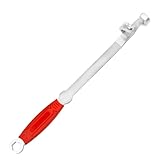
I remember the first time I snapped a bolt head clean off. It was on an old Honda exhaust manifold, and I was maybe 19. Frustrated, I grabbed the nearest tool that looked like it could generate some serious use: a beautiful, shiny torque wrench I’d just bought. Big mistake. That satisfying snap wasn’t the sound of freedom, but the sound of me being stuck, hours from finishing, and facing a much bigger problem.
So, let’s cut to the chase: can you use a torque wrench to break bolts loose? The short answer, and the one everyone in the know will give you, is a resounding no. But why? And what happens when you ignore that advice? Let’s talk about it.
Why Your Torque Wrench Hates Breaking Bolts
Look, I get it. You’ve got this tool that’s designed to apply precise force, and you’ve got a bolt that’s stuck tighter than a politician to a speaking fee.
Naturally, your brain says, ‘More force, right?’ And that torque wrench, with its long handle and satisfying click, seems like the perfect instrument to deliver that extra oomph. But here’s the dirty secret: torque wrenches are delicate instruments. They’re built for accuracy, not brute force.
Think of them like a surgeon’s scalpel – precise, invaluable for specific tasks, but you wouldn’t use it to chop firewood. Trying to break a bolt loose with a torque wrench is like using that scalpel to hammer in a nail; you’re not just going to mess up the job, you’re going to damage the tool itself.
The core issue lies in how torque wrenches work. They are calibrated to measure and limit the rotational force applied. When you exceed their set limit, they’re designed to signal that the torque has been reached – either with a click, a bend, or an electronic alert. Forcing them past that point, especially with the sudden, jarring shock of breaking a seized fastener, can throw off their calibration.
This means they won’t be accurate anymore when you actually need them to torque something down correctly. And inaccurate torque is a one-way ticket to stripped threads, damaged components, or, worst-case scenario, fasteners that come loose at the worst possible moment. I once had a cheap click-type torque wrench that I’d accidentally used to loosen a stubborn lug nut. Later, when I tried to torque the lug nuts on my wife’s car, it clicked way too early.
I ended up over-tightening them, which I only realized when one started to groan ominously on the highway. That was a $50 lesson I didn’t forget.
The sheer mechanical stress involved in breaking a seized bolt is far beyond what these precision instruments are designed to handle. They’re meant for smooth, controlled application of force, not the sudden, violent jolt required to overcome rust, corrosion, or overtightening.
When you try to force it, you’re basically trying to bend the internal spring mechanism past its intended range. This can permanently deform the spring, or damage the internal ratcheting or beam mechanism.
The result? A tool that’s no longer reliable for its intended purpose.
You might get lucky once or twice, but you’re playing a losing game, and the stakes are higher than just a busted tool. There’s a reason they’re called torque wrenches, not ‘break-all-the-things’ wrenches. The common advice you’ll find everywhere is correct: save your torque wrench for torquing.
What You should Be Reaching for Instead
So, if the torque wrench is off the table, what’s the right tool for the job when a bolt is being a real pain? This is where your trusty arsenal of breaker bars and impact wrenches comes into play. A breaker bar is basically a long, heavy-duty handle without a ratcheting mechanism or a built-in torque limiter. Its length provides excellent use, and its solid construction is designed to withstand the high, sudden forces needed to break a bolt loose.
You apply steady, controlled pressure, and if it doesn’t budge, you can lean into it without worrying about damaging the tool itself. The longer the breaker bar, the more use you get, making it easier to break even the most stubborn fasteners. I’ve got a 24-inch, 1/2-inch drive breaker bar that’s saved my bacon more times than I can count. It feels like a different beast entirely compared to a torque wrench when it comes to sheer grunt power.
Now, let’s talk about impact wrenches. These are power tools that deliver rapid rotational impacts, often called ‘hammering,’ which can shock a seized bolt loose. They come in both pneumatic (air-powered) and electric (corded or cordless) varieties.
For serious automotive work or heavy-duty DIY, a good cordless impact wrench is a big deal. I recently invested in a mid-range cordless model, and the difference it made on a rusty trailer axle was astounding. What would have taken me an hour of grunting with a breaker bar took about five minutes, with significantly less physical strain. (See Also: Do You Put Loctite On Torque Converter Bolts )
The key is that the impacts are short, sharp bursts of energy that can overcome the static friction holding the bolt, rather than a continuous, bone-jarring pull.
Here’s a quick rundown of why these tools are superior for breaking bolts loose:
| Tool | Primary Function | Best For | Verdict |
|---|---|---|---|
| Torque Wrench | Precise measurement and application of rotational force. | Tightening fasteners to specific specifications. | DO NOT USE for breaking bolts loose. High risk of damage. |
| Breaker Bar | Applying high use for breaking fasteners. | Stubborn bolts, lug nuts, rusted fasteners. | Excellent choice. Solid and provides ample use. |
| Impact Wrench | Delivering rapid rotational impacts to shock fasteners loose. | Severely rusted or seized bolts, high-volume work. | Excellent choice, especially for tough jobs. Saves time and effort. |
| Standard Ratchet | Quickly tightening or loosening fasteners with a ratcheting mechanism. | General assembly and disassembly where bolts aren’t seized. | Avoid for seized bolts; risk of internal damage if forced. |
While a standard ratchet can get some jobs done, it’s not built for the kind of abuse needed to break a truly stuck bolt. You’ll likely end up damaging the internal gears or pawls long before the bolt gives way. Stick to the tools designed for the job, and you’ll save yourself headaches and money in the long run.
The Anatomy of a Stuck Bolt and How to Fight It
Why do bolts get stuck in the first place? It’s usually a combination of factors, and understanding them helps you choose the right approach. The most common culprit is corrosion – rust.
When steel bolts and nuts are exposed to moisture, they oxidize. This rust expands, creating immense pressure and basically welding the fastener together. It’s like trying to pull two pieces of wood apart that have been glued with expanding foam.
Another major cause is overtightening. If a bolt is torqued beyond its design limit, or if the threads are damaged during installation, it can become jammed. Galling, a form of wear caused by adhesion between sliding surfaces, can also lock up threads, especially with certain metals like stainless steel or aluminum.
So, how do you combat these stubborn fasteners? Before you even think about applying force, preparation is key.
First, clean the area around the bolt head and nut. Get rid of any dirt, grease, or rust flakes that might be in the way. A wire brush is your best friend here. Then, introduce a penetrating oil.
Products like PB Blaster, Kroil, or even a good quality WD-40 (though WD-40 is more of a water displacer than a true penetrant) can work wonders. You want to spray it generously around the threads and let it soak. Patience is vital.
For really stubborn bolts, I’ll spray them down, walk away for an hour, come back and spray again, and let it sit overnight if necessary. Sometimes, giving the bolt head a few light taps with a hammer can help vibrate the penetrating oil deeper into the threads. It’s like giving it a little nudge to let the oil do its magic.
If the penetrating oil and time don’t do the trick, you might need to apply some heat. This is where things get a bit more advanced and potentially dangerous, so always exercise caution.
Heating a bolt causes it to expand. When it cools, it contracts. This expansion and contraction cycle can help break the rust bond. A propane torch is usually sufficient for most DIY tasks, but for really stubborn situations, a MAPP gas torch or even an oxy-acetylene torch (if you have one and know how to use it safely) might be needed.
The trick is to heat the nut or the surrounding material, not the bolt itself, if possible. This way, the outer material expands more than the bolt, loosening its grip.
After heating, let it cool slightly, then apply penetrating oil again. The oil will be wicked into the threads by the heat. Then, try your breaker bar.
Be ready for it to move suddenly if it breaks free. This method, combined with penetrating oil, is incredibly effective, but remember to have a fire extinguisher handy and be aware of any flammable materials nearby. (See Also: Do You Need Torque Caliper Bolts )
Common Mistakes That Make Your Life Harder
One of the biggest mistakes people make, and I’ve been guilty of it myself, is not using the right size socket or wrench. If your tool isn’t fitting snugly, you’re going to round off the bolt head. That’s a far worse problem than a stuck bolt.
You end up with a smooth, useless cylinder that requires drilling out, which is a whole other ballgame. Always make sure your socket or wrench is a good fit. For stuck bolts, a six-point socket is generally preferred over a twelve-point because it provides more contact area with the bolt head, reducing the chance of rounding. I learned this the hard way on a rear brake caliper bracket; I rounded off the head of one of the mounting bolts with a cheap twelve-point socket and spent an entire afternoon drilling it out.
Never again.
Another common error is trying to force a bolt that’s been cross-threaded. This happens when a bolt isn’t started straight into its mating hole, and the threads get mashed up. Trying to brute-force a cross-threaded bolt is a recipe for disaster.
You’ll damage both the bolt and the threads in the hole, and it will likely seize up completely. If you suspect a bolt is cross-threaded, try backing it out a bit (sometimes a quarter or half turn) to see if it frees up. If it still feels tight or binds up, stop.
You might need to chase the threads with a tap or die set, or even drill and re-tap the hole if the damage is severe. It’s always better to back out and try again than to force it and create a bigger problem.
People also often forget about thread locker. Many automotive and mechanical applications use thread-locking compounds – typically blue for general use or red for high-vibration/high-temperature areas.
These compounds are designed to prevent fasteners from vibrating loose, but they also make them harder to remove. If you’re working on something and encounter a bolt that feels unusually difficult to remove, and it has a colored residue around the head, it’s probably got thread locker. In these cases, applying a little heat (again, cautiously) is often the best way to break down the thread locker’s bond before attempting to loosen the bolt with a breaker bar or impact wrench. Ignoring the presence of thread locker and just muscling through will almost certainly lead to a stripped bolt head or a snapped fastener.
When “good Enough” Isn’t Good Enough: Precision vs. Force
This is where the contrarian opinion comes in, or at least, the nuance that people often miss. Everyone says ‘don’t use a torque wrench to break bolts loose,’ and they’re right for the vast majority of situations. However, there are extremely rare, specific circumstances where a torque wrench might be used with extreme caution as a diagnostic tool.
For instance, if you’re trying to determine the exact torque it takes to start moving a bolt that shouldn’t be seized, a low-range torque wrench could theoretically be used. But this is a highly specialized use case, bordering on engineering diagnostics, not standard DIY or even most professional mechanic work. It requires an understanding of what the expected torque should be, and the ability to stop immediately if you hit resistance beyond that.
For 99.9% of us, this isn’t relevant. The risk of damaging the tool or the fastener far outweighs any potential diagnostic benefit. So, while technically possible in a hyper-specific, controlled scenario, it’s practically a ‘no’ for anyone asking this question in the first place.
The fundamental difference boils down to control and intent. A torque wrench is for controlled application of a known force. Breaking a bolt loose is about overcoming an unknown and often excessive resistance. You need a tool that can handle that unknown force without self-destructing.
Breaker bars and impact wrenches are designed for that uncertainty. They are built to take the punishment. Trying to use a torque wrench for this is like asking a sensitive measuring instrument to perform a demolition task.
It’s the wrong tool for the job, and the consequences can be costly, both in terms of tool replacement and the potential for further damage to your project. I once spent $180 on a mid-range click-type torque wrench, and I treated it like gold.
Then, on a project involving some stubborn suspension bolts, I got impatient. The result was a nearly useless wrench and a significant dent in my tool budget. Lesson learned: respect the tool’s purpose. (See Also: Do I Need Special Replacement Bolts For Car Engines )
People Also Ask: Torque Wrench vs. Breaker Bar
The main difference is their function. A torque wrench measures and limits the amount of force applied, making sure fasteners are tightened to a precise specification. A breaker bar, on the other hand, is designed purely for use to apply significant force to loosen stubborn fasteners. You use a torque wrench for tightening and a breaker bar for loosening seized bolts.
People Also Ask: Can You Use a Torque Wrench to Loosen Nuts?
While technically you can rotate a nut with a torque wrench, it is strongly advised against for loosening. Torque wrenches are calibrated to measure applied torque during tightening. Using one to loosen, especially a stuck nut, can damage the internal mechanism and throw off its calibration, rendering it inaccurate for its primary purpose of precise tightening.
People Also Ask: What Happens If You Use a Torque Wrench to Break a Bolt Loose?
If you use a torque wrench to break a bolt loose, you risk damaging its internal calibration mechanism. The sudden, high forces involved can bend or damage the spring or other components, making future torque readings inaccurate. In severe cases, you can permanently break the tool or even strip the bolt head.
Practical Tips for Tackling Stubborn Fasteners
When you’re dealing with a bolt that just won’t budge, don’t just keep cranking. Take a step back and reassess. Is the tool fitting properly? Are you applying force in a straight line? Sometimes, a slight change in angle or a different grip can make all the difference. If you’re using a breaker bar, try a ‘pump’ method: apply steady pressure, release, then reapply. This can sometimes shock the threads loose. If you’re using an impact wrench, vary the speed and duration of the impacts. Short bursts are often more effective than a prolonged blast.
Consider the type of metal you’re dealing with. Aluminum threads are softer and more prone to stripping than steel. Stainless steel can be more prone to galling. Knowing the material can help you adjust your approach. Always have a good penetrating oil on hand, and don’t be afraid to let it soak. I’ve found that reapplying penetrating oil multiple times, with short breaks in between, is more effective than a single heavy application. Also, having a collection of different length breaker bars and extensions can be a lifesaver. Sometimes, the extra length is all you need to get the use required without putting yourself in an awkward or dangerous position.
Finally, and this is important: if a bolt feels like it’s about to snap, stop. A snapped bolt is a much bigger problem than a stuck one. Sometimes, the best course of action is to walk away, get a fresh perspective, or even consult a professional. There’s no shame in admitting a job is beyond your current tools or expertise. It’s better to know your limits than to end up with a broken bolt and a project that’s completely stalled. The goal is to get the job done, not to prove how much force you can apply.
When All Else Fails: The Last Resort Options
There are times when even the best breaker bars, penetrating oils, and heat won’t budge a bolt. This is when you start looking at more aggressive methods. One is using a bolt extractor set. These are specialized tools that you hammer into a drilled hole in the center of the bolt head. As you turn the extractor counter-clockwise, it bites into the bolt and, ideally, unscrews it. However, these can be tricky to use and can sometimes break off inside the bolt, making the problem even worse. I’ve had mixed results with them; they work on moderately stuck bolts but can be a nightmare on severely seized ones. They require careful drilling to avoid damaging the surrounding material.
Another option is to cut a slot in the bolt head with a Dremel or an angle grinder, turning it into a makeshift flathead screw. Then, you can try to use a large flathead screwdriver or even a pry bar to turn it.
This is often effective when the bolt head isn’t completely rounded off. If the bolt head is accessible, you can also try welding a nut onto the bolt head. The heat from welding can help break the rust bond, and the new nut gives you a fresh surface to grip with a socket or wrench.
This is a technique often used by experienced mechanics, but it requires welding equipment and skill. If you’re not comfortable with welding, this is best left to a professional.
The ultimate last resort is drilling out the bolt completely. This involves progressively drilling larger holes through the center of the bolt until you reach the thread diameter. Then, you can use a tap to re-cut the threads in the hole. This is a time-consuming and precise process. If you drill off-center or too aggressively, you can damage the threads in the mating part, requiring re-tapping with a larger size or even using a thread insert like a Heli-Coil. It’s a method that requires patience and a steady hand, and it’s often the final option when all other attempts to remove the fastener have failed. It’s the mechanical equivalent of open-heart surgery on a stubborn bolt.
People Also Ask: Can I Use an Impact Gun to Loosen Torque Wrench Bolts?
It’s generally not recommended to use an impact gun on bolts that are specifically meant to be torqued to a precise specification, like cylinder head bolts or lug nuts after they’ve been initially torqued. The rapid, uncontrolled impacts can easily exceed the intended torque value. However, for breaking loose bolts that are seized or overtightened, an impact gun is an excellent tool precisely because it applies force in a way that can shock them free, often more effectively than a manual breaker bar.
Final Thoughts
So, to circle back to the original question: can you use a torque wrench to break bolts loose? My honest answer, based on years of greasy knuckles and more than a few snapped-off bolt heads, is a hard no. It’s not what they’re designed for, and you’re far more likely to damage your tool or the fastener than to succeed.
Save your torque wrench for the precision work it’s meant to do. For those stubborn, seized, or rusted bolts, reach for a breaker bar, an impact wrench, some good penetrating oil, and maybe a little bit of heat if you’re feeling brave. Understanding the tool’s purpose and the nature of the problem will save you time, money, and a whole lot of frustration.
Next time you encounter a bolt that refuses to budge, resist the temptation to grab that shiny torque wrench. Make the right tool choice, and you’ll be one step closer to a successful repair, not a bigger headache.