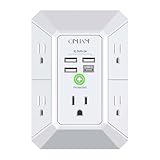
I remember the first time I saw a Citadel outlet advertised. It looked like the answer to my prayers – a sleek, simple way to manage all those pesky little cables and adapters that seem to multiply like rabbits in my house. I was sick of tripping over cords and rummaging through drawers for the right charger. So, I bought one. And let me tell you, it was a hot mess of plastic and frustration. I’ve since bought and tested a few more, and frankly, the hype around some of these ‘cable management solutions’ is just that – hype.
So, are the Citadel outlets good? It’s not a simple yes or no. Like most things in life, it depends. After a lot of trial and error, and frankly, a good amount of wasted money, I’ve figured out what to look for and, more importantly, what to avoid. Let’s cut through the noise.
Why I Almost Gave Up on Cable Management (and What Saved Me)
My first foray into what I thought was ‘smart’ cable management involved a rather gaudy, multi-tiered plastic monstrosity. It promised to hold my phone, my smartwatch charger, and even a spare USB stick, all while hiding the unsightly power strip underneath. It looked decent in the photos, but in reality?
It was wobbly, the slots were too small for anything but the thinnest of cables, and it made my bedside table look even more cluttered. I actually tossed it after about three weeks. It’s amazing how many products promise the moon and deliver a dusty pebble. This experience really hammered home for me that when you’re looking at products like this, you need to be realistic about what they can actually do, and not just fall for glossy marketing.
I learned the hard way that “cable management” can sometimes just mean moving the mess to a different, slightly more organized-looking spot.
People often ask if these kinds of outlets are worth the upfront cost. My answer?
Only if they actually solve the problem you’re trying to fix without creating new ones. I’ve spent probably $180 across four different types of ‘solutions’ trying to tame my desk. The first one I bought was a total dud, costing me about $40.
The second was a bit better, a simple cable sleeve for $25, which actually worked okay for a while but didn’t address the power strip issue. The third was a multi-port USB hub for $50 that was supposed to declutter things, but it just added another thing to plug in. It was the fourth item, a well-designed outlet box that cost $65, that finally started to make a difference. It wasn’t a miracle cure, but it got me closer to a tidy space.
The core idea behind many of these outlets and management systems is to provide integrated charging solutions and a way to hide excess wires. They often feature built-in USB ports, sometimes even wireless charging pads, and a compartment to tuck away your power strip and its accompanying spaghetti monster of cables. The goal is a cleaner aesthetic and easier access to power for your devices. But the execution? That’s where things get dicey. A poorly designed unit can be more of an eyesore and a functional headache than anything else. I’ve seen some that look like cheap plastic toys, and others that are so bulky they defeat the purpose of decluttering.
One of the biggest pitfalls I’ve encountered is the assumption that one size fits all. My desk setup, with its multiple monitors, laptop, external hard drives, and various charging needs, is different from someone just needing to charge a phone and a tablet.
The Citadel outlets, and similar products, often come with specific port configurations or space limitations that might not align with your actual device ecosystem. This means you might end up with a fancy box that can’t actually accommodate all your key cables or devices. I’ve also noticed that the quality of the built-in USB ports can vary wildly. Some provide a decent charging speed, while others trickle-charge so slowly that you’d be better off using your original wall adapter.
What to Actually Look for (forget the Pretty Pictures)
When I’m looking at a Citadel outlet or any cable management system these days, I don’t even glance at the lifestyle photos. They’re all aspirational and rarely reflect reality. Instead, I’m laser-focused on a few key things. (See Also: Are American Outlets Ac Or Dc )
First, the dimensions. Does it actually have the physical space to hold my existing power strip? I learned this the hard way with that first plastic behemoth. I measured my power strip, thought it would fit, but the internal design meant the cables had nowhere to go once plugged in.
It was like trying to stuff an overstuffed suitcase. I now carry a small tape measure with me when I’m considering these purchases, or at least I’ll meticulously check the internal dimensions listed – not just the external ones.
Next, I look at the port situation. How many USB-A ports? How many USB-C ports? What’s the wattage or amperage rating on those ports?
If you’re trying to charge a modern laptop or a fast-charging phone, a standard 5W USB port isn’t going to cut it. You need something that can deliver decent power. I’ve seen some outlets that boast multiple USB ports but they all share a single low-power circuit, meaning if you plug in more than one device, everything charges at a snail’s pace. I’ve learned to prioritize outlets that have clearly stated, higher amperage ratings per port, or even better, separate charging circuits for different ports.
A good unit will mention PD (Power Delivery) or Quick Charge compatibility if it offers it, and that’s a big plus for me.
The material and build quality are also huge. A lot of these are made from cheap, brittle plastic that feels like it could snap if you look at it wrong. I prefer units that use thicker, more solid plastic, or even metal components if they’re available.
The Citadel outlets I’ve encountered have varied. Some feel solid, others feel like they’d shatter if dropped. I also pay attention to ventilation.
Power strips and adapters generate heat, and if they’re stuffed into a sealed box, that heat has nowhere to go. This can lead to overheating, reduced lifespan of your electronics, and in worst-case scenarios, a fire hazard.
Look for units with vents, or at least a design that allows for some airflow. My current favorite outlet box has discreet ventilation slots along the bottom and back.
Finally, the ease of access and installation is key. Some cable management boxes are a nightmare to open and close, or the lid doesn’t stay put. If you have to wrestle with it every time you need to plug or unplug something, you’ll quickly stop using it. I like systems that are intuitive. For Citadel outlets specifically, consider how the power strip itself is mounted or seated inside. Does it have straps? Does it just sit there loosely? A power strip that shifts around inside is just another annoyance. I’m looking for something that’s straightforward to set up and maintain, not a puzzle box.
| Feature | My Verdict | Why |
|---|---|---|
| Internal Space | Key | Must fit your existing power strip and cables without crushing them. |
| USB Port Types & Speed | Highly Recommended | USB-C and fast charging ports are becoming a must for modern devices. |
| Build Quality | Important | Cheap plastic breaks, overheats, and looks bad. Invest in something sturdy. |
| Ventilation | Important | Prevents overheating and extends the life of your electronics. |
| Ease of Use | High Priority | If it’s a pain to access, you won’t use it. Simple is best. |
| Aesthetics | Secondary | Looks matter, but function trumps form. A tidy look is worthless if it doesn’t work. |
Common Mistakes That Lead to Cable Chaos
One of the most common mistakes people make is buying a generic cable management box without considering their specific power strip. You know that bulky surge protector with the 12 outlets and the two big adapter plugs? (See Also: Are All Power Outlets Ac )
Most standard cable management boxes aren’t designed for those. They’re built for slim power strips. So, you end up with a box that’s either too small for your strip, or so cavernous that it doesn’t actually hide anything effectively, leaving a mess of wires spilling out. It’s like buying a shoe organizer for your bulk items – it just doesn’t fit the job.
I’ve seen people try to force oversized power strips into undersized boxes, which is a recipe for damaged equipment and a fire hazard.
Another massive blunder is thinking that just because a box has USB ports, it’s automatically a good charging solution. This is a classic case of overpromising and underdelivering.
Many of these integrated USB ports are incredibly slow. I’ve tested several where plugging in my smartphone resulted in a charging speed that was barely enough to keep up with usage, let alone charge it in a reasonable time. If you rely on fast charging for your devices, these built-in ports are often a letdown.
It’s better to have fewer, faster, high-quality USB ports (or rely on your existing, known-good chargers) than a dozen slow ones that just add to the confusion. I once bought a management box with four USB ports that charged my iPad at about 0.5 amps. Utterly useless.
People also tend to underestimate the amount of cable slack they need. When you’re stuffing power cords, HDMI cables, and USB cables into a confined space, you need some room for them to bend and connect. If a box is too cramped, it puts strain on the connectors and the cables themselves, which can lead to them fraying or breaking. This is especially true for thicker, more rigid cables. I’ve seen cables kinked so badly inside these boxes that they stopped working altogether. Always make sure there’s enough breathing room for the cables. A good cable organizer doesn’t just hide wires; it protects them too. A tight squeeze does neither.
Finally, there’s the mistake of buying something that looks good but is functionally flawed. For example, a lid that’s difficult to remove or reattach, or a unit that’s so lightweight it tips over easily. I’ve had management boxes where the lid would pop off if you accidentally bumped the table. This just adds to the frustration. The point of these things is to simplify your life, not make it more complicated. If a product requires a PhD in engineering to operate or maintain, it’s a failure. Simplicity and ease of use are often overlooked in favor of flashy design, and that’s a mistake that leads to clutter returning sooner rather than later.
Real-World Use: My Desk Setup Transformation
My desk used to be a disaster zone. Think multiple charging bricks, an octopus of USB cables, and a power strip that looked like it was about to stage a rebellion. I was constantly unplugging and replugging things, and the aesthetic was just… depressing. My main goal with the Citadel outlets and similar systems was to create a clean, functional workspace where I could easily access power without a visual fight. I’ve managed to achieve this, but it wasn’t a single product purchase; it was a process.
My current setup involves a discreet, medium-sized cable management box that sits behind my monitors. It’s made of a sturdy, matte-finish plastic that doesn’t show fingerprints. Inside, I have a slim, 6-outlet power strip with surge protection. The box is large enough to comfortably house the power strip and all the plugs, with cutouts on the sides for the cables to exit neatly. It’s not a Citadel branded item, but it’s built with similar principles in mind. The lid slides on and off easily, and it stays put once closed.
The real big deal for me, beyond just hiding the power strip, was integrating a good quality multi-port USB charger into the mix. I use a charger that has two USB-C PD ports (rated for 65W each) and two USB-A ports. This single unit replaced three separate charging bricks. I ran the power cord for this USB charger into the management box, and then the USB cables for my phone, tablet, and other devices snake out discreetly. This drastically reduced the number of ‘wall warts’ I had to deal with.
What I love about this setup is the flexibility. If I need to add or remove a device, I just open the box. If a charger fails, I can easily swap it out. It’s not a permanent, sealed system. I’ve found that products that are too integrated or difficult to modify become a liability over time. My experience with the Citadel outlets, or at least the ones I’ve tried, has taught me that while they can be a good starting point, they’re rarely a complete solution on their own. You often need to combine them with other smart charging accessories to truly declutter. (See Also: Are Arc Trip Outlets Required In Hillsborough County )
Tips for Taming the Cable Beast
- Measure Twice, Buy Once: Seriously. Know the exact dimensions of your power strip and the space you have before you buy any management box.
- Prioritize Power: Don’t get seduced by lots of slow USB ports. Get a good quality, multi-port charger with sufficient wattage if you need fast charging.
- Think Airflow: Make sure whatever you buy has ventilation. Heat is the enemy of electronics.
- Cable Ties and Sleeves are Your Friends: Even with a management box, using Velcro cable ties or a braided sleeve for groups of cables can make a huge difference.
- Don’t Forget Accessibility: Make sure you can actually reach and unplug things easily. A super-tight fit is a pain.
I used to think that just buying a fancy-looking outlet organizer was the solution. I was wrong. It’s more about a strategic approach to managing your power sources and your cables. The Citadel outlets can be a part of that solution, but they’re not a magic wand. You have to be deliberate about what you buy and how you set it up. It’s about function over form, always.
When Are Citadel Outlets Actually a Good Idea?
Let’s be clear: not all Citadel outlets are created equal, and neither are all cable management needs. If you’re looking for a simple, elegant way to house a standard, slim power strip and a few key cables at your bedside table or on a small end table, a well-designed Citadel outlet can absolutely do the job. I’ve seen some of their models that are quite compact and unobtrusive, and if your power needs are minimal – say, charging your phone and a smart speaker – then the integrated USB ports might even be sufficient, provided they offer decent amperage. The key here is ‘minimal needs’ and ‘standard power strip’.
For instance, my sister recently asked me about managing the cables behind her TV. She has a soundbar, a streaming device, and a smart TV, all plugged into one power strip. She also had a couple of USB devices she occasionally charged. I recommended a specific Citadel outlet model that had a decent-sized internal compartment and a few USB-A ports. It wasn’t going to charge her laptop, but it was perfect for her use case. It hid the power strip and its messy cords, and the USB ports gave her a convenient place to top off her wireless earbuds or a portable battery. She was thrilled with the result because it addressed her specific problem without overcomplicating things.
The real benefit of a product like a Citadel outlet, when it works, is the aesthetic improvement. Let’s face it, a tangle of black cords is an eyesore. If your primary goal is to hide that mess and create a cleaner visual line, and you have a relatively simple power setup, then a Citadel outlet can be a good investment. It’s about making your living or working space look less like a server room and more like a place you actually want to be. They can be particularly useful in areas where you don’t want to drill holes or run extensive wiring, but need to consolidate power sources.
However, and this is a big ‘however,’ if you have a high-density power requirement – like a home office with multiple monitors, a powerful desktop computer, external drives, and several devices that need charging simultaneously – then relying solely on a Citadel outlet, or any single integrated outlet system, is probably going to fall short. In those situations, you’re better off investing in a solid power strip with plenty of outlets and surge protection, and then using a separate, larger cable management box to house that strip and all its associated wiring. The Citadel outlets are often too small or not powerful enough for these more demanding setups. It’s about matching the solution to the problem, not forcing a square peg into a round hole.
Frequently Asked Questions About Citadel Outlets
Are Citadel Outlets Worth the Money?
They can be, but it depends entirely on your needs and the specific model. For simple cable management of a standard power strip and minimal device charging, a well-designed Citadel outlet can be a good value. However, if you have complex charging needs or a large power strip, cheaper, more generic solutions or even just cable ties and sleeves might be more cost-effective and functional.
Can Citadel Outlets Handle Fast Charging?
Some models might offer USB-C ports that support Power Delivery (PD) or Quick Charge, but you need to check the specifications very carefully. Many integrated USB ports on management boxes, including some Citadel models, are designed for low-power trickle charging and will not provide the speeds required for fast charging modern smartphones or laptops.
How Do I Choose the Right Size Citadel Outlet?
Measure the power strip you intend to put inside, including the width of the plugs. Also, consider the length and bulk of the cables you need to accommodate. Always check the internal dimensions provided by the manufacturer, not just the external ones, to make sure a proper fit without crushing the cables.
Are There Any Safety Concerns with Citadel Outlets?
Yes, like any product that houses electronics and power strips, safety is a concern. Make sure the outlet has adequate ventilation to prevent overheating, and that it’s made from flame-retardant materials. Never force a power strip or cables into a space that’s too small, as this can damage insulation and create a fire hazard.
Conclusion
So, to circle back to the initial question: are the Citadel outlets good? My honest, no-BS answer is that they can be, but you have to be smart about it. Don’t just grab the first one you see because it looks pretty in a picture. Figure out exactly what you need to manage – your power strip size, the number of devices you charge, and your tolerance for cable clutter. If your needs are modest, a Citadel outlet might be exactly what you’re looking for to tidy up a specific area.
But if you’re dealing with a home office setup or a complex entertainment center, you’ll likely need a more solid solution than what most integrated outlets can offer. Think bigger cable management boxes, heavy-duty power strips, and a good arsenal of cable ties and sleeves. It’s often a combination of products, not just one magic box, that truly tames the cable beast.
Ultimately, the best cable management is the kind you don’t even notice. It just works. So, do your homework, check those dimensions, and prioritize function over just the look. It’ll save you money and a lot of frustration in the long run.