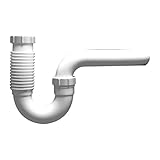
I remember the first time I saw one of those accordion P-traps under a sink. It looked… flimsy. Like a shower curtain that had seen better days, but for your plumbing. My buddy, a seasoned DIYer who swore by them for their supposed ease of installation, had just slapped one into his rental property bathroom. Fast forward six months, and he was ankle-deep in lukewarm, questionable water. So, are accordion P-traps that bad? Let’s just say my skepticism has been pretty well-founded.
The promise is alluring: bendable, no-fuss installation. But plumbing isn’t always about the quick fix. Sometimes, what looks like a shortcut leads you straight to a flooded floor and a hefty plumber’s bill. I’ve been knee-deep in plumbing projects for years, and I’ve learned a few things the hard way. This isn’t going to be corporate-speak; it’s just the straight dope from someone who’s been there.
The Accordion P-Trap: What It Is and Why It Exists
Alright, let’s get down to brass tacks. What exactly is an accordion P-trap, and why would anyone even consider using one? At its core, a P-trap is a plumbing fixture that prevents sewer gases from entering your home through drains. It does this by holding a small amount of water in a U-shaped bend, creating a water seal. You’ve seen the classic rigid PVC or metal ones under most sinks – they’re simple, effective, and frankly, boring.
The accordion trap, on the other hand, is usually made of a flexible plastic. Its defining feature is the series of corrugated rings that allow it to be bent and stretched into various shapes. This flexibility is its supposed superpower. The sales pitch? You can connect pipes that aren’t perfectly aligned, squeeze it into tight, awkward spaces, and generally make a DIYer’s life easier. No need for precise pipe cutting or fancy angled fittings. Just bend it, connect it, and you’re done, right? That’s what they want you to believe.
I’ve seen them used in situations where a standard trap just wouldn’t fit without some serious gymnastics. Think old houses with quirky plumbing layouts, or under pedestal sinks where space is at a premium. The idea is that you can snake the flexible pipe around obstacles and connect it to the wall pipe and the sink tailpiece without fuss. They come in various lengths and diameters, designed to accommodate common sink setups.
The material is typically a softer, more pliable plastic than the rigid PVC you’d find in a standard trap. It feels a bit like a heavy-duty vacuum cleaner hose, but for your drain. It’s this very pliability, however, that raises the most questions about their long-term viability and performance.
The Downsides: Where the ‘easy’ Install Goes Wrong
Here’s where my personal experience kicks in, and where I start to question the sanity of anyone who champions these things. The flexibility, while seemingly a boon, is also their Achilles’ heel. Over time, those corrugated rings can become a magnet for gunk. Hair, soap scum, grease – you name it. It all gets caught in those little nooks and crannies, creating a perfect breeding ground for clogs. Cleaning them out is a nightmare compared to a standard trap, which you can usually unscrew, rinse, and reassemble without too much drama. With an accordion trap, you’re often fighting against its very design to get it clean.
And then there’s the seal. The water seal is important for blocking sewer gases. Because the accordion trap can be bent into odd angles and isn’t as rigid as a standard trap, it’s easier to create low spots or unevenness in the pipe. This can compromise the water seal, allowing those delightful sewer smells to waft up into your home. I once installed one under a utility sink that seemed fine initially, but within a month, the distinct aroma of old sewer was a constant companion. Turns out, the slight sag I’d created in the flexible pipe was enough to let the water evaporate faster than it should have. That’s not a minor inconvenience; it’s a health hazard.
Furthermore, the plastic itself can degrade over time, especially if exposed to harsh drain cleaners or very hot water. I’ve seen them become brittle and crack, leading to leaks. The connections can also be a weak point. While they often use slip-joint fittings like standard traps, the flexibility of the pipe means it can be easier to accidentally put stress on these connections, leading to drips. It’s a cascade of potential problems that, in my book, far outweigh the perceived ease of installation. My friend’s flooded bathroom? That was a direct result of a clog in his accordion trap that backed up and overflowed, because it was harder to clear and therefore neglected for too long.
Common Mistakes When Using Accordion P-Traps
It’s not just the product itself; user error plays a huge role. One of the most common mistakes I see, and one I’ve made myself in a pinch, is over-tightening the slip nuts. Because the plastic is softer, it’s easier to strip the threads or crack the nut if you’re not careful. Another mistake is assuming they can handle any degree of misalignment. While flexible, they aren’t magic. Forcing them into extreme bends can create internal kinks or stresses that will cause problems down the line. You still need some semblance of a gentle curve. (See Also: Are Omega Watch Straps Real Alligator )
People also forget that while they’re flexible, they aren’t meant to be constantly moved or flexed. If you’re constantly reaching under the sink, bumping things, or moving the pipes, you’re putting undue stress on the material and the connections. This wear and tear can accelerate failure. Finally, and this is a big one, people often neglect them until it’s too late. Because they’re not the standard, people don’t know how to properly maintain them. They’re not designed for the heavy-duty use some utility sinks get, or for kitchens where grease buildup is a constant battle. They’re best suited for light-duty, infrequent-use scenarios where a rigid trap is genuinely impossible to fit.
The Contrarian View: When Might They Actually Work?
Okay, I know I’ve been pretty harsh. But is there any scenario where an accordion P-trap isn’t a disaster waiting to happen? I’ve heard arguments, and I’ll admit, there’s a sliver of truth to some of them. The primary argument for them is, as I’ve mentioned, ease of installation in very tight or awkward spaces where a rigid trap would require extensive modification or complex angled fittings. If you’re in a situation where you absolutely cannot cut pipe, or you have a very specific, non-standard offset, an accordion trap might be the only practical solution without calling a plumber.
Think about a small RV sink, or a temporary setup. In these cases, the longevity might not be as important as the immediate functionality. If you can install it correctly, making sure a good water seal and avoiding extreme bends, and you understand that it’s likely a temporary or low-use solution, it could work. It’s also worth noting that some higher-end flexible traps are made from more solid materials and have better-designed corrugations than the absolute cheapest ones you’ll find. I’m talking about brands that put a little more thought into the engineering, rather than just slapping some ribbed plastic together.
However, and this is a big however, I’d still be wary. My contrarian opinion here is that even in these situations, the risk often outweighs the reward. For a few extra bucks and maybe twenty minutes of wrestling with a rigid trap, you gain significantly more reliability. The common advice to just ‘use a rigid trap’ is usually correct because it’s the path of least resistance for long-term peace of mind. The accordion trap is like a fast-food meal: convenient in the moment, but you’ll probably regret it later. I’ve seen firsthand the frustration and the mess when these things fail. It’s rarely a clean break; it’s usually a slow, smelly leak or a sudden, overwhelming clog.
My Experience: The $50 Lesson Learned
Let me tell you about a time I was helping out a friend who had just bought an old fixer-upper. The kitchen sink had this bizarre setup. The drainpipe coming out of the wall was several inches off from where the sink tailpiece was. Installing a standard P-trap would have involved buying all sorts of angled adapters and probably cutting and gluing PVC until my hands were numb.
Being in a rush and wanting to get the kitchen functional quickly, I spotted a pack of accordion P-traps at the hardware store. “Perfect!” I thought. “Flexible, easy, done.” I bought the longest, most solid-looking one I could find for about $18.
It took me maybe ten minutes to install. No cutting, no gluing, just bend and connect. I felt like a plumbing genius.
The sink worked. No leaks, no smells. For about three weeks. Then, the drain started to slow.
I figured it was just kitchen grease, so I poured some hot water down. It got worse. A week later, it was completely backed up. (See Also: Are Traditional Mouse Traps Humane )
I tried plunging, but it was useless. So, I got under the sink, ready to disconnect the trap and clear it. That’s when I realized my genius installation had created a series of miniature dams within the accordion rings. Hair, food particles, and grease had formed a solid, impenetrable mass.
It took me nearly an hour of poking, prodding, and cursing with a bent coat hanger just to break it up enough to get some water through. During that hour, I also noticed a slight dampness around one of the slip-joint connections. I tightened it, but the feeling of unease lingered. It cost me time, a lot of frustration, and eventually, I replaced it with a properly fitted rigid PVC trap.
That was a $50 lesson (including the replacement trap and the drain cleaner I eventually bought) on why you don’t cut corners on plumbing.
What to Look for (if You Must) and Practical Tips
If, despite all my warnings, you find yourself in a bind and absolutely must use an accordion P-trap, here’s what I’d look for and how I’d approach it. First, choose the best quality you can find. This means looking for thicker plastic, deeper and more uniform corrugations (not shallow, uneven ones), and solid slip-joint fittings. Avoid the absolute cheapest options; they are almost guaranteed to be trouble. Check the brand reputation if possible, though for these, it’s often hard to find much info beyond the packaging.
Second, minimal bending is key. Try to get the pipes as aligned as possible before you even start. Use the flexibility to make small adjustments, not to bridge large gaps or create sharp turns. Think gentle curves. If you have to create a significant bend, try to make it as broad and smooth as possible. Imagine you’re guiding a garden hose, not wrestling a snake. Make sure that the trap has a consistent downward slope from the sink tailpiece to the wall drainpipe. There should be no sags or high points where water can pool, as this will create odors and promote clogs.
Third, proper connection is most important. Hand-tighten the slip nuts first. Then, use pliers, but only with a light touch. You want a snug fit, not a crushing grip.
If you feel significant resistance, stop. You might be stripping threads or cracking the plastic. Once installed, run hot water through the drain for a few minutes to test for leaks and make sure the water seal is properly established.
And here’s a tip that applies to any P-trap but is especially important for accordion ones: periodic cleaning. Even if it seems to be draining fine, give it a flush with hot water and a bit of vinegar every few months to help prevent buildup in those corrugated rings. Be prepared to replace it sooner rather than later.
They are not designed for the long haul like their rigid counterparts. (See Also: Are Sticky Mouse Traps Humane )
People Also Ask: Accordion P-Trap Edition
Are Accordion P-Traps Legal?
In many regions, particularly for permanent residential installations, accordion P-traps are not code-compliant. Plumbing codes typically specify materials and designs that make sure proper function, durability, and safety, which often excludes flexible plastic traps due to their propensity for clogging, potential to harbor bacteria, and compromised water seals. Always check your local building codes before installing any plumbing fixture.
Can You Use an Accordion P-Trap in a Kitchen?
While technically possible to install, it’s generally not recommended for kitchen sinks. Kitchen drains are prone to grease, food particles, and other debris that can easily clog the corrugated sections of an accordion trap. The increased risk of clogs, odors, and potential leaks makes a rigid PVC or metal P-trap a much more reliable and hygienic choice for a kitchen environment.
How Do I Clean a Clogged Accordion P-Trap?
Cleaning a clogged accordion P-trap is challenging due to its design. You’ll likely need to disconnect it. Once removed, try flushing it with hot water and a drain snake or a bent coat hanger to dislodge debris. For stubborn clogs, a mild enzymatic drain cleaner might help break down organic matter. However, due to the difficulty and the potential for damage, many people opt to replace the trap entirely when it becomes clogged.
Are Accordion P-Traps Reliable?
Generally, accordion P-traps are considered less reliable than standard rigid P-traps. Their flexible nature makes them more susceptible to clogs, leaks, and the compromise of the water seal that prevents sewer gases from entering. While they offer installation flexibility, their long-term performance and durability are often questionable, especially in high-use or demanding environments.
Accordion P-Trap vs. Rigid P-Trap: A Quick Comparison
To make things crystal clear, here’s a quick rundown of how they stack up. I’ve seen enough of both to have a pretty firm opinion on this.
| Feature | Accordion P-Trap | Rigid P-Trap (PVC/Metal) | My Verdict |
|---|---|---|---|
| Ease of Installation | High (in awkward spaces) | Moderate (requires some fitting/cutting) | Accordion wins for pure ease in weird spots, but at what cost? |
| Durability | Low to Moderate | High | Rigid wins, hands down. These things last. |
| Clog Resistance | Low | Moderate to High | Rigid is far less prone to gunk buildup. |
| Odor Prevention (Water Seal) | Can be compromised by sags/evaporation | Excellent (when installed correctly) | Rigid is the clear winner for consistent seal. |
| Maintenance/Cleaning | Difficult | Easy | Rigid is a breeze to clean. |
| Cost | Low to Moderate | Low to Moderate | Similar upfront cost, but rigid costs less in the long run. |
| Code Compliance | Often Non-Compliant | Generally Compliant | Rigid is the only way to go for proper installation. |
| Overall Reliability | Low | High | If you want it to work for years, go rigid. |
Look, I get it. Sometimes you’re in a jam. But when it comes to your plumbing, especially anything that connects directly to your waste line, reliability is king. The accordion P-trap is a compromise that, in my experience, rarely pays off. It’s the plumbing equivalent of a quick fix that ends up costing you more in the long run.
Final Verdict
So, are accordion P-traps that bad? In my honest opinion, for most applications, yes, they are. The allure of easy installation is a siren song that too often leads to a flooded floor, persistent odors, and a frustrating clog. I’ve learned my lesson, and frankly, I’ve seen the aftermath of others’ experiences too many times to recommend them as a go-to solution.
While they might have a niche use in extremely tight, temporary situations where code compliance isn’t an issue and long-term durability isn’t a concern, for everyday sinks and drains, the risks far outweigh the rewards. The money you save upfront on a potentially easier install will likely be spent tenfold on repairs or replacement down the line. It’s just not worth the gamble when a straightforward, rigid trap is readily available and infinitely more reliable.
My advice? Unless you’re an absolute last resort, skip the accordion P-trap. Invest a little more time and effort into installing a proper, rigid trap. Your nose, your wallet, and your floor will thank you for it. Before you buy one, ask yourself if you’re truly out of options, or just looking for the quickest way out. Usually, the quickest way out leads to the longest, most expensive fix.