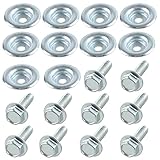
I remember staring at that wobbly bookshelf, a testament to my early DIY disasters. I’d grabbed a handful of what I thought were sturdy bolts, but it turns out, not all hardware is created equal. The question of ‘are 4/8 bolt strong’ isn’t just about a number; it’s about whether you can trust that connection with your stuff, or even your safety.
We’ve all been there, right? You need to fix something, build something, or just hang a shelf, and you reach for what seems like a standard bolt. But the devil is in the details, and with bolts, those details can mean the difference between a job well done and a spectacular failure.
So, let’s cut through the noise. Are 4/8 bolts the real deal, or just another thing you’ll regret buying later?
What Does ‘4/8’ Even Mean for Bolts?
Alright, let’s get down to brass tacks. When you see a bolt labeled ‘4/8’ – or often more commonly, ‘1/4-8’ or ‘4-8’ – it’s not some secret code for superheroes. It’s actually a pretty straightforward way to tell you two key things about the bolt: its diameter and its thread pitch. Think of it as the bolt’s vital statistics.
The first number, the ‘4’ (or ‘1/4’), refers to the nominal diameter of the bolt. For imperial-sized bolts like these, it’s usually given in inches. So, a ‘4’ means approximately a quarter of an inch in diameter. This is the main body of the bolt, the thickest part that determines how much shear force it can take. A thicker bolt generally means more strength, plain and simple. It’s like comparing a skinny noodle to a thick spaghetti strand – the fatter one can handle more weight before snapping.
The second number, the ‘8’, tells you about the thread count, specifically the number of threads per inch (TPI). So, ‘8’ means there are 8 threads packed into every inch of the bolt’s shank. This is what we call the thread pitch. A coarser thread pitch (fewer threads per inch) is generally considered stronger for a given diameter because the individual threads are thicker and have more material. A finer thread pitch (more threads per inch) might give you more precise adjustments or a more secure hold in some applications, but it can also be weaker because the threads themselves are thinner.
Now, here’s where it gets a little confusing for some folks, and it’s a common stumbling block: the standard thread for a 1/4-inch bolt is 20 TPI (coarse thread) or 28 TPI (fine thread). So, a ‘4-8’ bolt is actually a bit of an oddball. Most common 1/4-inch bolts you’ll find at the hardware store will be 1/4-20 (coarse) or 1/4-28 (fine). This ‘1/4-8’ designation usually pops up when you’re dealing with specific types of fasteners, often associated with certain industrial applications or older equipment. Because of this less common thread pitch, it’s vital to double-check what you’re buying and make sure it’s compatible with the nut or threaded hole you’re using.
So, when you ask ‘are 4 8 bolt strong,’ the answer isn’t a simple yes or no. It depends on what you’re comparing it to and the specific application. The 1/4-inch diameter gives it a baseline strength, but the ‘8’ TPI is what makes it a bit of a unique case. It’s not inherently weaker or stronger than a 1/4-20 bolt just because of the thread count; it’s just different, and sometimes, that difference can matter for load-bearing.
Understanding Bolt Strength Ratings: Beyond the Numbers
Just knowing the diameter and thread count isn’t the whole story when it comes to bolt strength. You can have two bolts with the exact same diameter and thread pitch, and one will still be a lot tougher than the other. This is where material and heat treatment come into play, and frankly, it’s where most people go wrong by not paying attention.
Think about it: you can make a bolt out of soft butter or hardened steel, and the difference in strength will be night and day. For standard fasteners, especially in the US, you’ll often see a series of dashes on the head of the bolt. These dashes are part of the SAE (Society of Automotive Engineers) grading system, and they tell you a lot about the bolt’s tensile strength – how much pulling force it can withstand before breaking.
Here’s a quick rundown of common grades:
| Grade Mark | Material & Heat Treatment | Tensile Strength (psi) | Verdict |
| No Mark (or 1) | Low carbon steel. Basic, not meant for heavy loads. | ~60,000 | Weakest. Avoid for anything important. |
| 3 Dashes (Grade 2) | Medium carbon steel. Decent for general use, but not high stress. | ~74,000 | Okay for furniture, light brackets. |
| 6 Dashes (Grade 5) | Medium carbon alloy steel, quenched and tempered. Good all-rounder for many DIY tasks. | ~120,000 | Solid choice for most common projects. |
| 8 Dashes (Grade 8) | Medium carbon alloy steel, quenched and tempered. Significantly stronger. | ~150,000 | For heavy-duty applications where failure is NOT an option. |
So, a 1/4-inch bolt marked as Grade 8 will be vastly stronger than a 1/4-inch bolt marked as Grade 2, even if they both have 20 TPI. The ‘4-8’ designation itself doesn’t tell you the grade. You absolutely must look for those dashes on the bolt head. If there are no dashes, or just one dash, it’s likely a Grade 1 or Grade 2, which are pretty weak. For anything that requires actual load-bearing capacity, you’re looking for at least a Grade 5, and ideally a Grade 8, if you can find them in that specific ‘4-8’ thread configuration. (See Also: Are All Honda Atv Bolt Patterns The Same )
The material composition also plays a role. Steel is the most common, but you’ll find stainless steel (which offers corrosion resistance but can sometimes be slightly less strong than high-carbon steel of the same grade), brass (decorative, not strong), and even titanium (lightweight and strong, but pricey). For typical hardware store bolts, you’re usually dealing with steel.
My personal experience? I once tried to save a few bucks by buying a bulk pack of what I thought were standard 3/8-inch bolts for a deck railing. They looked fine, felt heavy enough. Turns out, they were some generic, low-grade steel. After a few seasons, the railing started looking… wobbly. I had to replace half the bolts with actual Grade 8 hardware. Lesson learned: never skimp on the grade when strength is needed. The few dollars saved upfront cost me time and extra work later. So, when you ask ‘are 4 8 bolt strong,’ the grade is arguably more important than the specific thread count for determining its brute force capability.
Common Mistakes When Choosing Bolts
Look, we’re all human, and when you’re in the middle of a project, it’s easy to make a mistake. But when it comes to bolts, some common errors can turn a simple fix into a major headache or even a safety hazard. I’ve made enough of them myself to become a bit of an expert in bolt-related blunders.
One of the biggest mistakes is mixing up imperial and metric sizes. It’s like trying to fit a square peg in a round hole, but with threads.
If you have a metric nut, you need a metric bolt. If you have an imperial (SAE) threaded hole, you need an imperial bolt. A 10mm bolt will NOT thread properly into a 3/8-inch hole, and vice-versa.
They might feel like they’re going in for a bit, but you’ll quickly strip the threads on one or both, rendering them useless. This is especially tricky with sizes that sound similar, like M10 (metric) and 3/8 inch (imperial). Always measure or, better yet, take the nut or the piece you’re trying to connect to the store with you to make sure a proper match.
Another classic blunder is not considering the environment. Are you working outdoors? Near salt water? In a humid basement? Using plain steel bolts in a wet environment is a recipe for rust. That rust weakens the bolt over time and makes it a nightmare to remove later. For outdoor or high-moisture applications, you need stainless steel, galvanized steel, or a bolt with a specific protective coating. A Grade 8 bolt might be incredibly strong, but if it’s a rusted-out mess, it’s not strong for long.
Then there’s the thread pitch issue, which we touched on with the ‘4-8’ bolt. If you need to replace a bolt and you don’t have the original to match, you might guess the thread pitch. If you get it wrong, the bolt won’t seat properly, or worse, it’ll go in but be loose and weak. This is where a thread gauge can be a lifesaver. They’re cheap and take the guesswork out of matching threads. For our ‘4-8’ bolt, the common mistake would be to assume it’s a standard 1/4-20 or 1/4-28 and try to force it, leading to damaged threads.
Finally, and this is a big one: using the wrong grade for the job. I see people using basic, un-marked bolts for structural elements, car repairs, or anything that carries a significant load. It’s a ticking time bomb. If a bolt fails under load, it’s not just an inconvenience; it can cause damage, injury, or worse. Always match the bolt’s grade to the required strength of the application. If you’re unsure, err on the side of caution and go for a higher grade, like a Grade 5 or Grade 8, if the thread size and type are appropriate. It’s far better to have a bolt that’s stronger than you need than one that’s not strong enough.
Common Bolt Thread Pitch Confusion
It’s easy to get confused about thread pitches, especially with less common sizes like the ‘8’ in a ‘4-8’ bolt. Standard 1/4-inch bolts typically come in 20 TPI (coarse thread) or 28 TPI (fine thread). The ‘8’ TPI for a 1/4-inch bolt is significantly coarser than even the standard coarse thread. This unusual pitch means you need to be very careful about sourcing matching nuts or making sure the threaded hole is indeed designed for this specific pitch. Using the wrong pitch will strip threads and make the connection weak or impossible to secure.
Real-World Applications: Where Do ‘4-8’ Bolts Fit in?
So, we’ve talked about what ‘4-8’ means and the importance of grades. But where do you actually find these bolts in the wild? Are they hiding in plain sight, or are they more of a niche fastener? Honestly, the ‘4-8’ thread configuration isn’t as common in your average home improvement store as, say, a 1/4-20 bolt. This is part of why it can be a bit of a mystery.
You’re more likely to encounter this specific thread pitch in older machinery, certain specialized automotive applications, or industrial equipment. Think of vintage farm equipment, specific types of pumps, or custom-built manufacturing tools. Because the thread pitch is so coarse (8 TPI for a 1/4-inch diameter), it suggests an application where rapid assembly or disassembly might be prioritized, or where the threads need to be solid and less prone to damage from dirt or grit. A coarser thread has deeper valleys and thicker crests, which can be more forgiving in less-than-pristine conditions. (See Also: Are Ak Bolts Interchangeable )
However, the strength of the bolt itself will entirely depend on its grade. A ‘4-8’ bolt that is a Grade 2 will be a relatively weak fastener, suitable only for light-duty applications where vibration is minimal and loads are low. On the other hand, if you find a ‘4-8’ bolt that is a Grade 5 or, more rarely, a Grade 8, it could be a strong fastener for its size. But again, the rarity of this specific pitch means you’d have to be very deliberate in finding compatible nuts or tapping new threads.
I had a situation years ago with an old motorcycle I was restoring. It had a specific bracket that used bolts with a thread I couldn’t immediately identify. They looked like 1/4-inch, but the thread count was way off from standard.
After a lot of head-scratching and using a thread gauge, I discovered it was something unusual, possibly a ‘4-8’ or similar non-standard coarse thread. I ended up having to source specialized nuts from an industrial fastener supplier because no standard hardware store had them. It was a real pain. The strength of those bolts themselves was decent, likely a Grade 5 equivalent, but finding replacements was the real battle.
So, while the question ‘are 4 8 bolt strong’ is technically answerable by looking at its grade, the practical challenge often lies in finding them and matching them to existing parts.
When you’re dealing with a fastener that isn’t in the common 1/4-20 or 1/4-28 range, you have to assume it’s for a specific purpose. Don’t just grab the first 1/4-inch bolt you see. If you’re working on an older piece of equipment, your best bet is to remove the original bolt and its nut (if possible) and take them to a reputable hardware store or industrial fastener supplier. They’ll have the tools and the expertise to help you identify and match it. For most DIY projects around the house, sticking to standard thread sizes (1/4-20, 5/16-18, 3/8-16, etc.) and appropriate grades (5 or 8) will make your life infinitely easier and make sure you have reliable strength.
When Are These Bolts a Bad Idea?
Let’s be blunt: there are times when a ‘4-8’ bolt, or any bolt for that matter, is just the wrong choice. It’s not about the bolt being “weak” in isolation, but about it being inappropriate for the task at hand. I’ve learned this the hard way, and you’re welcome to learn from my mistakes.
First off, if you’re looking for high-precision alignment or a very secure, vibration-resistant connection, a coarse thread like the ‘8’ TPI in a ‘4-8’ bolt might not be ideal. Fine threads (like 28 TPI for a 1/4-inch bolt) offer more turns per inch, meaning you can make finer adjustments and they tend to be more resistant to loosening under vibration. If you’re assembling something that needs to stay perfectly aligned and isn’t going to be shaken to bits, a fine thread might be better. For important structural components in a car or a piece of machinery that experiences a lot of movement or shock, you’re often better off with a finer thread pitch and, of course, a high-strength grade bolt (Grade 8 or higher). The coarse thread might work, but it’s not usually the best tool for the job in those scenarios.
My contrarian take? Everyone obsesses over the grade of a bolt for strength, which is vital, but they often overlook the thread pitch for suitability. I once saw a guy building a high-end, custom-made workbench. He used these massive, thick bolts, but they had a really coarse thread. The bench looked like a tank, but he complained that it was always slightly out of alignment and the drawers kept sticking because the frame flexed. He should have used a finer thread pitch for that kind of precision woodworking, even if the bolt diameter was the same. The coarse thread simply didn’t offer the fine-tuning he needed.
Another time, I was helping a friend fix a gate that kept sagging. He’d already replaced the hinges twice.
I looked at the bolts holding the frame together, and they were standard, un-marked bolts with a coarse thread. They’d probably stretched and loosened over time due to the constant stress and vibration of the gate swinging. We replaced them with 3/8-inch Grade 5 bolts with a standard coarse thread (16 TPI), and the gate was solid as a rock. If the ‘4-8’ bolt is the only option available, but the application is high-stress, high-vibration, or requires extremely precise alignment, it’s probably not the right choice.
You’d be better off finding a bolt with a finer thread pitch and the appropriate grade, even if it means a different diameter altogether.
In essence, a ‘4-8’ bolt, especially if it’s a lower grade, is generally unsuitable for anything that demands high tensile strength, resistance to loosening under vibration, or fine adjustability. Think structural beams, load-bearing connections in vehicles, or anything where failure could lead to serious consequences. For those applications, you’re looking for higher grades (5, 8, or even higher) and often finer thread pitches, or at least more common, solid thread pitches like 1/4-20 or 3/8-16. (See Also: Are All Bolt Patterns The Same )
People Also Ask: Are 4/8 Bolts Strong?
What Does 4 8 Bolt Mean?
A ‘4-8’ bolt typically refers to its nominal diameter and thread count. The ‘4’ (or ‘1/4’) indicates a diameter of approximately one-quarter of an inch. The ‘8’ indicates a thread pitch of 8 threads per inch (TPI). This is a relatively coarse thread for a 1/4-inch bolt, which commonly uses 20 TPI (coarse) or 28 TPI (fine). The strength of the bolt itself is determined by its material grade, not just its size and thread pitch.
What Is the Strength of a 1/4-8 Bolt?
The strength of a 1/4-8 bolt is determined by its SAE grade. A Grade 2 bolt will have a tensile strength of around 74,000 psi, while a Grade 5 will be around 120,000 psi, and a Grade 8 around 150,000 psi. The ‘4-8’ designation only tells you the diameter (1/4 inch) and thread pitch (8 TPI); you must look for markings on the bolt head (like 3 dashes for Grade 5 or 8 dashes for Grade 8) to know its actual strength rating.
What Is Stronger, 1/4-20 or 1/4-8 Bolt?
It’s not about which thread count is inherently stronger, but which is more suitable for the application. A 1/4-20 bolt has a finer thread pitch than a 1/4-8 bolt (20 TPI vs 8 TPI). For a given diameter and grade, the tensile strength of the bolt shank itself is similar. However, the finer thread of the 1/4-20 allows for more precise adjustments and potentially better resistance to loosening under vibration, while the coarser 1/4-8 might be easier to start and less prone to cross-threading in some conditions.
Practical Tips for Using Bolts
Alright, we’ve dissected the ‘4-8’ bolt, talked about grades, and covered common screw-ups. Now, let’s get practical. How do you actually use bolts effectively and avoid turning a simple task into a frustrating ordeal? A few simple habits can save you a ton of grief.
First, always, always, always use the correct tools. This means having a good set of wrenches and sockets that fit the bolt head properly. Using a wrench that’s too big or too small will round off the corners of the bolt head, making it incredibly difficult to tighten or remove later. It’s like trying to unscrew something with a butter knife – it just doesn’t work. Invest in a decent set of metric and imperial sockets and wrenches; it’s one of the best investments a DIYer can make. For those ‘4-8’ bolts, if you can find them, make sure you have a socket or wrench that fits the hex head snugly.
Second, lubrication is your friend. A little bit of anti-seize compound or even just some grease on the threads can make a huge difference, especially when you’re working with steel bolts in environments prone to corrosion or when you might need to disassemble the joint later. It prevents galling (where the threads weld themselves together under pressure) and makes tightening easier and more consistent. For stainless steel bolts, anti-seize is almost a must to prevent galling.
Third, don’t overtighten. This is another common mistake that leads to stripped threads, broken bolts, or deformed parts. Learn to recognize when a bolt is “snug” and then give it a little extra turn if needed, rather than just cranking on it with all your might. The exact torque you need depends on the bolt size, grade, and the materials you’re joining. If you’re working on something important like automotive parts, using a torque wrench is key. For most household projects, a firm hand-tightening followed by a quarter-turn with a wrench is usually sufficient for Grade 5 bolts. Overtightening a ‘4-8’ bolt, especially if it’s a lower grade, could easily snap it.
Fourth, consider the mating surface. The nut or threaded insert you’re using needs to be of the correct size and thread pitch, just like the bolt. And if you’re bolting two pieces of material together, make sure the holes are properly aligned. Sometimes, a little filing or reaming of the hole is necessary to get everything to line up perfectly. You don’t want to force a bolt through misaligned holes, as this can put uneven stress on the bolt and the materials.
Finally, when in doubt, buy a few extra. Bolts are relatively inexpensive, and having a spare or two can save you a trip back to the hardware store if you drop one, misplace it, or, heaven forbid, break one. Keep a small selection of common sizes and grades on hand. For that ‘are 4 8 bolt strong’ question, if you must use them, make sure you have the right nuts and plan to use them with appropriate tools and perhaps a bit of lubrication.
These practical tips apply to all bolts, but they’re particularly relevant when you’re dealing with less common sizes or thread pitches like the ‘4-8’ bolt. By following these simple guidelines, you’ll build stronger, more reliable connections and make your DIY projects a lot smoother.
Final Thoughts
So, to circle back to the main question: are 4/8 bolt strong? The answer is a qualified ‘it depends.’ The ‘4-8’ designation tells you the diameter and a specific, rather coarse thread pitch. What truly dictates its strength is the material grade – look for those dashes on the head. A ‘4-8’ bolt can be weak if it’s a low grade, or reasonably strong if it’s a Grade 5 or Grade 8. However, its non-standard thread pitch makes it less common and potentially harder to find mates for.
For most everyday DIY tasks, sticking to standard thread sizes like 1/4-20 and choosing appropriate grades (5 or 8) will make your life infinitely easier and guarantee reliable strength. If you encounter a ‘4-8’ bolt, treat it with caution. Understand its limitations and make sure you have the correct matching hardware. Don’t assume it’s a direct swap for a more common bolt.
My final word? Unless you’re working on specific vintage equipment or industrial machinery where this thread pitch is standard, you’re probably better off sticking to the usual suspects. Save yourself the headache of sourcing obscure parts and the uncertainty of whether your connection is truly sound.