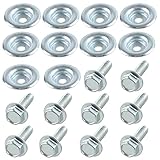
I remember staring at a pile of brand-new head bolts, fresh out of the box, and thinking, ‘These have got to be interchangeable, right? How different can they really be?’ Spoiler alert: very different. It’s a question I hear a lot from folks diving into engine work: are all head bolts the same? The simple, blunt answer is a resounding NO. Trying to swap them out willy-nilly is a fast track to a blown gasket, or worse, a cracked block. Trust me, I’ve learned this the hard way, and I’m here to tell you exactly why you can’t just grab any old bolt for your engine’s most important job.
Why Your Engine Doesn’t Like Generic Bolts
Look, I’ve been wrenching on cars for longer than I care to admit, and one of the most infuriating lessons I ever learned was about head bolts. I was rebuilding an old inline-six, feeling pretty cocky, and ran into a snag. A couple of bolts were a bit chewed up, so I figured, ‘No biggie, I’ve got a box of spares from another engine.’
Big. Freaking. No biggie. I torqued them down, fired it up, and within 20 miles, coolant was seeping past the head gasket like a leaky faucet.
That was a $500 mistake that taught me more than any manual ever could. The key thing to understand is that head bolts aren’t just glorified screws holding two pieces of metal together.
They’re precision components designed to withstand immense pressure, heat, and vibration. They have to maintain a specific clamping force, or tension, on the cylinder head to seal the combustion chamber and coolant passages. If that tension isn’t uniform, or if the bolt material itself can’t handle the strain, you’re asking for trouble.
Different engines use different bolt materials, thread pitches, lengths, and even head designs. They’re engineered for a specific purpose, and a generic bolt just doesn’t have that specificity. It’s like trying to use a kitchen knife to chop down a tree; it might look similar, but it’s not built for the job, and you’re going to end up with a broken tool and a lot of frustration.
The common advice you’ll get is to always use OEM (Original Equipment Manufacturer) bolts or high-quality aftermarket equivalents specifically designed for your engine. And you know what? For once, the common advice is spot on. But why is it so important?
It’s all about the stresses involved. When an engine runs, the combustion process creates thousands of pounds of pressure per square inch inside each cylinder. This pressure is what pushes the piston down, generating power. The cylinder head is bolted down to the engine block with these head bolts, and their job is to keep that seal absolutely perfect.
They’re under constant tension, stretching ever so slightly to maintain that seal. If a bolt isn’t strong enough, or if it stretches unevenly with others, the seal breaks. Then you get oil mixing with coolant, coolant leaking into the cylinders, or exhaust gases blowing past the gasket. It’s a cascade of failures, all starting with a bolt that wasn’t up to snuff.
The Devil Is in the Details: What Makes Bolts Different
So, what exactly makes these bolts different? It’s a combination of factors, and you really need to pay attention to them. First off, material.
Head bolts are typically made from high-strength steel alloys. You’ll see designations like Grade 5 or Grade 8 for standard bolts, but for engines, it’s more about specific alloy compositions and heat treatments. Some are designed for single use (torque-to-yield bolts), meaning they are meant to be stretched to a precise amount and then replaced. Reusing these can lead to improper clamping force or outright failure.
Others are multi-use, but even then, you need to check their condition. Thread pitch and diameter are obvious differences – a metric M10 bolt is not going to thread into an SAE 3/8-inch hole. But even within the same metric or SAE sizes, there can be subtle differences in thread design that affect how they seat and hold.
Length is another big one. A bolt that’s too short won’t engage enough threads in the block, severely weakening its holding power. Too long, and it might bottom out in a blind hole or interfere with other components.
Then there’s the under-head diameter and flange shape. Some bolts have a washer-like flange integrated into the head to distribute the clamping load over a larger area of the cylinder head. Others might use a separate washer.
The angle of the flange, the radius where it meets the shank, and the overall head design all play a role in how the bolt interacts with the cylinder head and the torque wrench. It’s not just about grabbing something that screws in; it’s about grabbing the correct bolt that was designed for that specific engine’s requirements.
I’ve seen people try to get away with using ARP (Automotive Racing Products) head bolts that were designed for a different V8 engine on their inline-four. They looked like they fit. (See Also: Are All Honda Atv Bolt Patterns The Same )
They threaded in. But the tensioning was off because the length was slightly different, and the material properties, while superior, weren’t optimized for that specific application’s head thickness and block design. It’s a gamble, and a bad one.
The metallurgy behind engine bolts is fascinatingly complex. It’s not just about hardness; it’s about tensile strength, yield strength, fatigue resistance, and thermal expansion. A bolt that’s too brittle might snap under the extreme temperature cycles. One that’s too soft will stretch permanently, losing its clamping force.
The engineers who design these engines spend years developing these specifications. Ignoring them is like trying to outsmart a chess grandmaster on your first game. You’re going to get schooled.
The Difference Between ‘good Enough’ and ‘engine Builder Approved’
Let’s talk about what makes a head bolt truly “good enough” for your engine. It boils down to meeting or exceeding the original manufacturer’s specifications. This means using bolts made from the correct material, with the correct tensile strength and yield strength. It means the threads are cut precisely to the specified pitch and depth.
The length has to be exact, and the head design needs to properly mate with the cylinder head surface. For most everyday repairs and rebuilds, going with a reputable aftermarket manufacturer that specializes in engine components is a safe bet. Brands like ARP, Fel-Pro, or Mahle often offer kits that are engineered to match or improve upon OEM specs.
They’ll specify exactly which engine or application their bolts are for. This is the kind of specificity you want. Trying to save a few bucks by buying a generic set from a discount parts store is a false economy. You might save $50 upfront, but you’ll likely spend $500 (plus a lot of your time and sanity) fixing the inevitable problems down the line.
I’ve seen people use bolts from a Ford 302 on a Chevy 350, or even worse, bolts from a different bolt grade entirely. It’s a recipe for disaster. The bolt head itself also matters. Some have a standard hex head, while others have a 12-point flange head.
The flange head distributes the clamping load more evenly across the cylinder head, reducing the risk of imprinting or damage, especially on aluminum heads. A specific bolt is designed with these considerations in mind.
Here’s a little table to illustrate the kinds of things you should be looking at. It’s not exhaustive, but it covers the main points of divergence:
| Feature | Typical OEM/High-Quality Aftermarket | Generic/Incorrect Bolt | My Verdict |
|---|---|---|---|
| Material Strength | Engineered alloy, specific tensile/yield strength | Unknown or insufficient alloy, prone to stretching/snapping | Don’t mess with this. Weak bolts = blown head gasket. |
| Thread Pitch & Depth | Precise, matched to block and head | May be close but not exact, can strip or not seat properly | A mismatch here can ruin the block threads. Bad news. |
| Length | Exact to spec, accounts for head thickness | Too short (poor engagement) or too long (bottoms out, wrong tension) | Important for proper torque and tension. Get it right. |
| Head Design (Flange/Washer) | Engineered for load distribution on specific head material | Standard head or wrong flange size/shape, can damage head surface | Especially important for aluminum heads. Prevents damage. |
| Coating | Often coated for corrosion resistance and friction control | Raw or basic plating, can seize or cause inaccurate torque readings | Lubrication/coating is key for accurate torque. |
I’ve seen people reuse old head bolts because they look okay. That’s a gamble I’m not willing to take on any engine I care about. Even if they’re not torque-to-yield, old bolts can have microscopic fatigue cracks or have been stretched beyond their elastic limit. You won’t see it, but it’s there, and it means they won’t hold the correct tension. Always buy new, quality bolts for a important job like this.
The Torque-to-Yield Conundrum
This is where things get really interesting, and where the ‘are all head bolts the same’ question really hits home. A significant number of modern engines, especially passenger car engines from the last 20-30 years, use what are called torque-to-yield (TTY) head bolts. These bolts are designed to be stretched to a specific, predetermined point within their elastic limit. They are basically engineered to be a one-time use item.
When you torque them down to the manufacturer’s specification, they stretch a precise amount. This controlled stretching is what provides the exact clamping force needed to create a perfect seal. Because they are stretched beyond their normal elastic limit (meaning they won’t return to their original length if you were to loosen them), they lose their ability to provide that precise clamping force if reused. Trying to re-torque an old TTY bolt is like trying to stretch a rubber band that’s already been pulled as far as it can go; it just won’t perform the same way.
It might feel tight, but it won’t have the correct tension, leading to leaks and potential gasket failure.
This is a massive point of confusion for DIYers. You’ll find plenty of advice online from people who swear they’ve reused TTY bolts a dozen times without issue. Frankly, I’d be skeptical of their claims or the types of engines they’re working on.
For important applications, especially those involving high-performance engines or engines where reliability is most important, reusing TTY bolts is a major no-no. It’s not about the bolt failing catastrophically; it’s about it not performing to the required specification. (See Also: Are Ak Bolts Interchangeable )
The cost difference between a new set of TTY head bolts and the potential cost of a failed head gasket repair (which often involves removing the head, machining, and replacing other parts) is astronomical. I once had a buddy insist on reusing TTY bolts on his Subaru WRX rebuild. He saved about $150 on bolts. A few months and a couple of track days later, he blew a head gasket and ended up spending over $2,000 to fix it, including a new set of correctly spec’d bolts.
The lesson? When the manual says ‘replace,’ you replace. It’s one of the few times I’ll say, unequivocally, that paying attention to the service manual is a must.
It’s not just a suggestion; it’s a requirement for that specific fastener.
Common Mistakes and How to Avoid Them
Beyond the obvious ‘using the wrong bolt,’ there are other pitfalls when it comes to head bolts. One of the most common mistakes I see is incorrect torquing procedure.
Head bolts almost always require a specific tightening sequence and often involve a combination of torque values and degrees of further rotation (like 90 degrees, then another 90). This sequence makes sure that the cylinder head is drawn down evenly onto the block, preventing warping and making sure a consistent seal. Skipping steps, torquing in the wrong order, or not achieving the correct final angle will absolutely lead to problems.
I’ve seen guys just torque them all to a final number and call it a day. That’s a recipe for disaster.
The head might look flat, but the stress distribution is all wrong. Another mistake is not cleaning the bolt holes in the block properly. If there’s any residual coolant, oil, or debris in those holes, it can create hydraulic lock.
When you try to torque the bolt, the incompressible fluid prevents it from seating fully, giving you a false torque reading. This means the bolt isn’t actually tightened enough, and you’ll have a leak.
You need to chase those threads with a tap and blow them out with compressed air until they are squeaky clean. Also, don’t forget about the surface finish of the block and the head. They need to be perfectly flat and clean.
Any nicks, gouges, or debris on the mating surfaces will compromise the seal, no matter how perfect your bolts are. Lastly, and this ties back to the TTY bolts, is the temptation to reuse them. I understand the desire to save money, but as I’ve said, the cost of failure is so much higher than the cost of new bolts. It’s a classic case of being penny wise and pound foolish.
Always follow the service manual’s instructions regarding bolt reuse.
I also want to touch on lubrication. Most modern head bolt specifications are designed with a specific lubricant or thread conditioner in mind. This lubricant is applied to the bolt threads and/or the underside of the bolt head.
It’s not just about preventing seizing; it’s about making sure consistent clamping force. The friction between the bolt and the threads, and between the bolt head and the cylinder head, has a huge impact on the final torque reading. If you use the wrong lube, or too much, or too little, your torque readings will be inaccurate. The manufacturer’s service manual will tell you exactly what to use, if anything.
Follow it religiously. For instance, some engines call for a specific assembly lube on the threads, while others call for clean, dry threads. Some might even specify a light oil. Don’t assume; verify.
I once accidentally used a high-viscosity oil on a set of bolts that called for dry threads, and my torque readings were wildly inconsistent. It took me an extra hour to figure out what was going on and clean everything properly before re-torquing. (See Also: Are All Bolt Patterns The Same )
When ‘close Enough’ Just Isn’t
I’ve always been a bit of a contrarian when it comes to certain car repair ‘wisdom.’ People often say, ‘Oh, this bolt looks the same, it’ll work fine.’ I disagree, vehemently, when it comes to head bolts.
The reason is simple: the consequences of failure are too severe. It’s not like a loose trim piece that rattles; a failing head bolt setup can destroy an engine.
The forces involved are immense. The cylinder head is under constant attack from combustion pressure, heat, and the expansion and contraction of the metal. The head bolts are the only thing keeping that seal intact.
If even one bolt is not performing to spec, the entire system is compromised. I’ve seen engines with warped heads, cracked blocks, and blown head gaskets, all because someone thought a ‘close enough’ bolt would suffice. It’s a gamble that simply isn’t worth taking, especially when the correct bolts are readily available from reputable manufacturers.
You might save $50 or $100 on bolts, but you could easily end up paying thousands in repairs. The engineering that goes into these specific fasteners is precise for a reason.
They’re not just generic hardware; they’re precision components designed for a very specific, very demanding task. Think about it: when you buy a new engine, it comes with a warranty. If you rebuild it using incorrect parts, you void that warranty.
Even if you’re not worried about a warranty, you’re worried about the engine lasting. The longevity and performance of your engine depend on these small, often overlooked, components performing exactly as intended.
Here’s my rule of thumb: if you can’t find a bolt kit specifically listed for your exact year, make, and model of vehicle, or for your specific engine code, then you are probably dealing with a bolt that is not suitable. Don’t guess. Don’t assume.
Don’t rely on someone else’s anecdote about a similar-looking bolt. Do the research. Consult a reliable service manual for your vehicle. Look up the part numbers for the OEM bolts and then find aftermarket equivalents that are manufactured to those exact specifications.
If a bolt vendor can’t tell you the material grade, the tensile strength, or the specific application, walk away. There are plenty of excellent aftermarket manufacturers out there who pride themselves on producing parts that meet or exceed OEM standards. Stick with them. It’s the only way to make sure that your engine build is sound and reliable.
The peace of mind knowing you’ve used the correct parts is worth more than any perceived cost savings from using the wrong ones.
Can I Reuse My Old Head Bolts?
It depends entirely on the type of bolt. If they are specified as torque-to-yield (TTY) bolts in your vehicle’s service manual, then absolutely not. They are designed for a single use and will not provide the correct clamping force if reused. For non-TTY bolts, you can potentially reuse them if they are in perfect condition, show no signs of stretching or damage, and the service manual allows for it. However, given the important nature of head bolts and the relatively low cost of new ones, it’s almost always recommended to replace them with new, high-quality bolts to make sure proper sealing and prevent future issues.
What Happens If I Use the Wrong Size Head Bolt?
Using the wrong size head bolt is a recipe for disaster. If the bolt is too small in diameter or has the wrong thread pitch, it won’t properly engage the threads in the engine block, leading to a weak connection and potential stripping of the threads in the block. If the bolt is too long, it can bottom out in a blind hole, preventing it from seating correctly and leading to improper clamping force. If it’s too short, it won’t engage enough threads, resulting in insufficient clamping force. In any case, an incorrect size will lead to an improper seal, likely causing head gasket failure, oil or coolant leaks, and potentially severe engine damage.
Are Aftermarket Head Bolts as Good as Oem?
Reputable aftermarket head bolts from well-known manufacturers can absolutely be as good as, or even better than, OEM bolts. Brands like ARP, Fel-Pro, and Mahle specialize in engine components and often use high-strength alloys and precise manufacturing processes that meet or exceed original specifications. The key is to choose a trusted brand and make sure the bolts are specifically designed for your vehicle’s make, model, and engine. Avoid generic or no-name brands, as their quality and specifications may be questionable. Always verify that the aftermarket bolts meet or exceed the OEM specifications for material strength, thread pitch, length, and head design.
Verdict
So, to circle back to the initial question: are all head bolts the same? The answer, unequivocally, is no. They are precision components engineered for specific applications, and using the wrong ones is a shortcut that will almost certainly lead to a costly breakdown. My advice? Always consult your vehicle’s service manual. If it calls for specific bolts, get those or a high-quality aftermarket equivalent designed for your exact engine. Don’t guess, don’t assume, and for the love of all that is mechanically sound, don’t reuse torque-to-yield bolts.
When you’re rebuilding an engine or tackling a head gasket job, the head bolts are one of the few places where you absolutely cannot cut corners. It’s a small investment in new, correctly specified bolts that pays massive dividends in reliability and peace of mind. If you’re unsure, ask a seasoned mechanic or do your homework until you’re confident. It’s better to spend a bit more time and money now than to have your engine spewing coolant onto the highway later.
The next time you’re ordering parts, double-check that part number. Verify the specs. Your engine will thank you.