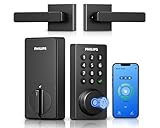
I remember the first time I saw a keypad lock on a front door. It looked so futuristic, so sci-fi. No more fumbling for keys in the dark, no more worrying about lending a spare to a neighbor. Just a quick code and in you go. But as I started tinkering with them, and later actually using them on my own rental properties, a nagging question kept popping into my head: are keypad locks safe on doors? The marketing promises simplicity and security, but the reality can be a lot more… complicated. Let’s peel back the shiny veneer and see what’s really going on.
For years, I’ve been installing, testing, and frankly, sometimes cursing these electronic gizmos. I’ve seen them work like a charm, and I’ve seen them fail spectacularly, leaving me locked out or worse, feeling like my property was less secure than a screen door.
This isn’t about fancy features or the latest Wi-Fi connectivity. This is about whether the damn thing actually keeps the wrong people out, and lets the right people in, without a huge hassle.
How These Gadgets Actually Work (and Don’t)
So, what’s under the hood of these digital doorkeepers? At its core, a keypad lock, or electronic door lock, replaces the traditional key cylinder with a keypad and a motorized deadbolt or latch. You punch in a numerical code, and if it’s correct, a small motor engages, retracting or extending the bolt.
Simple, right? Well, mostly. The brains of the operation are a circuit board, a power source (usually batteries), and some kind of mechanism to translate the electronic signal into physical movement. Most modern ones can store multiple user codes, so you can give temporary access to a dog walker or a guest without handing over a physical key.
Some even have Bluetooth or Wi-Fi, letting you manage access from your phone, which is handy for remote rentals.
The real magic, or sometimes the real headache, lies in the software and the physical build. A good electronic lock has a solid system for verifying your code. It’s not just checking against a stored number; it’s about how quickly and reliably it does it, and how many failed attempts it allows before locking down.
Cheaper models might have simpler processors that are easier to brute-force, or so insecure that a determined person could theoretically cycle through combinations relatively quickly. I once spent an entire Saturday trying to troubleshoot a budget model that kept misreading my code. It wasn’t a security issue, thankfully, but it sure made me appreciate the simplicity of a good old-fashioned tumbler lock. It took me three different YouTube tutorials and a call to customer support (which was… an experience) before I got it working reliably.
That’s not the kind of stress you want on your front door.
The power source is another factor. Most run on AA or 9V batteries, and they’re surprisingly power-efficient.
You’ll usually get a low-battery warning well in advance, often with a blinking light or a beep. But relying on batteries means you’re at the mercy of their lifespan. If your batteries die unexpectedly, and you haven’t got a physical key backup (which many don’t!), you’re stuck.
Some higher-end models have a hidden keyhole for emergencies, which I consider a must. Others have a 9V battery terminal on the outside where you can temporarily power it up with a battery from your car or a smoke detector if the internal ones die.
It feels a bit like performing emergency surgery on your front door, but it works.
The physical construction matters too. Are we talking about a solid metal body that feels hefty and secure, or a plastic housing that looks like it’ll crack if you lean on it too hard? The interface itself, the feel of the buttons when you press them, the responsiveness – it all adds to the perception of quality and, indirectly, security. A mushy, unresponsive keypad feels less trustworthy. I’ve seen some where the numbers are worn off from heavy use, making it harder to enter codes accurately, especially in low light. This isn’t just an aesthetic issue; it can become a functional one.
What to Look for Before You Buy
Alright, so you’re convinced you want to ditch the keys. What should you actually be looking for in a keypad lock? Forget the flashy apps and the voice control for a minute. (See Also: Are Sesame Seeds Kosher For Passoveris Pollock Kosher )
The core stuff is what matters. First up: build quality.
You want something that feels solid. Pick it up. Does it feel heavy and substantial, or like a hollow piece of plastic?
A metal body, preferably zinc alloy or stainless steel, is a good sign. The keypad itself should have durable buttons that are easy to feel and press, even with gloves on or in the dark. Look for backlit buttons if you live somewhere with long, dark winters or have a porch light that’s always on the fritz.
Next, consider the power source and backup. As I mentioned, I’m a huge fan of those that have a hidden physical key override.
It’s your ultimate safety net. If the batteries die, or the electronics glitch out, you still have a way in. If it doesn’t have one, make sure it has an external 9V battery terminal for jump-starting.
Also, check how many user codes it can store and how easy it is to add or delete them. If you’re managing access for multiple people (family, renters, cleaners), this is a big deal.
Some systems are a nightmare to program; others are pretty intuitive. I’ve spent way too long staring at instruction manuals that seem to be written in ancient hieroglyphics.
Think about the locking mechanism itself. Is it a standard deadbolt, or something more specialized? Most will integrate with your existing deadbolt setup. Security standards are also important, though often opaque to the average buyer. Look for mentions of ANSI/BHMA grades. Grade 1 is the highest residential security, followed by Grade 2 and Grade 3. A Grade 2 lock is generally considered good for most homes. It’s a bit like knowing your car has airbags; you hope you never need them, but it’s good to know they’re there. I once bought a lock that felt great, looked good, but turned out to be only Grade 3. It was fine for my garage, but not my front door. Lesson learned.
Here’s a quick rundown of what I prioritize:
| Feature | My Verdict | Why |
|---|---|---|
| Solid Metal Construction | Must-Have | Durability and resistance to tampering. |
| Backlit Keypad | Highly Recommended | Ease of use in low light conditions. |
| Physical Key Override | A must | Ultimate backup if electronics fail. |
| Multiple User Codes | Key for families/rentals | Flexibility in managing access. |
| ANSI/BHMA Grade 1 or 2 | Important | Indicates a higher level of security testing. |
| Weather Resistance | Important (depending on location) | Makes sure longevity in harsh conditions. |
Don’t get bogged down in every single spec. Focus on these core elements. A well-built lock with a physical backup and decent security grading is far more important than one that can tell you if your cat is meowing outside.
Common Mistakes People Make
You know, the most common mistake I see people make isn’t necessarily buying a bad lock, but using it poorly. The biggest one? Leaving the default factory code enabled. Seriously. Most locks come with a universal ‘0000’ or ‘1234’ code. If you install it and walk away without changing that immediately, you’ve basically left your door wide open. I’ve heard stories, and frankly, I’ve had a few close calls myself where I forgot to change it on a rental unit for a day or two. It’s terrifying to think how easy that would be to exploit. Always, always change the default code to something unique and random.
Another biggie is not understanding the battery situation. People wait until the light is blinking red and the lock is making sad little dying noises to change the batteries. Then, of course, the batteries die completely right when they need to get in. I’ve learned to change them proactively, maybe every six to nine months, regardless of warnings. It’s a cheap preventative measure that saves a lot of potential headaches. I keep a fresh set of the correct batteries in my junk drawer specifically for the door locks. It’s a small thing, but it’s paid dividends in avoided frustration.
People also tend to neglect the physical installation. Even the best electronic lock won’t be secure if it’s loose or improperly installed. The strike plate on the door frame needs to be flush and reinforced. The deadbolt needs to extend fully into the strike plate without binding.
If it’s a struggle to lock or open, that’s a problem. A poorly installed lock is easier to force or jimmy. (See Also: Are Sliding Door Locks Common )
I’ve seen DIY installations that looked okay on the surface but were wobbly. A few good shoves and you’d be through. It’s worth spending a little extra time getting it right, or paying a locksmith to do it if you’re not confident. I once tried to install one myself on a new door and the frame wasn’t perfectly aligned.
The bolt wouldn’t go in smoothly. Instead of adjusting the frame, I just forced it. That lock failed within two months. The stress on the motor was too much.
Finally, and this is a contrarian one: people often over-rely on connectivity features. They think because their lock can be controlled from their phone over Wi-Fi, it’s automatically super secure.
While remote management is convenient, those internet-connected features can also be a potential vulnerability if not properly secured. A strong, simple keypad with a good physical backup is often more secure for your primary entry point than a Wi-Fi enabled one that might have unknown firmware bugs or be susceptible to network-based attacks.
I’ve seen more issues with flaky Wi-Fi connections and app glitches than I’ve ever had with a basic, well-built manual keypad lock. For my own home, I stick to a solid keypad with a hidden keyhole. For rentals where I need remote access, I opt for well-vetted brands and keep the firmware updated religiously.
Real-World Use: My Experience
I’ve had keypad locks on a few rental properties for the past five years, and my experience has been… mixed, but mostly positive when I chose wisely. My first foray was with a very budget-friendly model, something I picked up for around $70. It worked fine for the first six months, but then the keypad started to become less responsive. Certain buttons would require multiple presses.
Then, one freezing February morning, it just died. The batteries were fresh, but the motor just wouldn’t engage. I had to use the emergency key, which was a pain.
That lock was replaced within a week with a mid-range model from a reputable brand that cost me closer to $180. That one has been chugging along reliably for over four years now, with only battery changes.
The real test came during a frantic move-out. My tenant was leaving early, and I was rushing to get a new tenant in. I’d given the new tenant the code, but they were running late.
I was stuck on the other side of town. With the app on my phone, I was able to remotely open the door for them. They got in, dropped off the keys, and I was able to re-lock it from my phone.
That’s the kind of convenience that really sells you on these things. It saved me a two-hour round trip and a lot of stress.
That particular lock is a Wi-Fi enabled one, and while I’m generally wary of too many connected gadgets, this one has performed flawlessly for about two years. It’s a Grade 2 lock with a good build quality and a built-in physical key backup.
However, not all experiences are so smooth. I had a friend who installed a supposedly high-end smart lock. It looked amazing, had all the bells and whistles. But the app was buggy, it frequently lost connection to Wi-Fi, and the battery life was abysmal, requiring changes every month. They ended up going back to a traditional deadbolt because the smart lock was more of a hassle than a help. It’s a good reminder that ‘smart’ doesn’t always mean ‘better’ or ‘more secure’. Sometimes, simpler is indeed best.
The key takeaway from my years of using these is that you get what you pay for, but even expensive ones can be problematic if the software or user interface is poorly designed. The physical robustness and the reliability of the core locking mechanism are most important. If a lock feels flimsy or the buttons stick, no amount of app connectivity will make it truly trustworthy. I’ve found that brands known for hardware, rather than just software, tend to be more reliable. It’s like choosing a tool manufacturer; you want the one that focuses on making solid, dependable tools, not just the one with the prettiest packaging. (See Also: Are The Rams Locked Into The 6th Seed )
Can You Really Trust Them?
So, to cut to the chase: are keypad locks safe on doors? Yes, generally, they can be. But it’s not an automatic ‘yes’. It’s a ‘yes, if…’. You have to choose wisely and use them correctly. A well-made, reputable keypad lock, installed properly, with a physical key backup and regularly maintained batteries, offers a very good level of security for most residential applications. They are certainly much more convenient than traditional locks, and for properties where you need to grant access to multiple people frequently, like vacation rentals or homes with frequent visitors, they can be invaluable. The ability to grant temporary codes or revoke access instantly is a significant security advantage over lost or copied keys.
The biggest security risks aren’t usually about sophisticated hacking of the electronic code itself, especially on non-connected models. The vulnerabilities are more often in the physical construction (can it be pried open easily?), the installation (is it loose?), or the user error (leaving default codes, not changing batteries). For Wi-Fi connected models, there’s an added layer of potential risk from network vulnerabilities, though most major manufacturers have invested heavily in securing these. Still, if your primary concern is the absolute highest level of security against determined attackers, a high-quality mechanical deadbolt might still be your go-to. But for everyday convenience and good, solid security, modern keypad locks are more than up to the task.
I’ve found that the fear of them being inherently unsafe is often overblown, especially compared to the everyday risks associated with traditional locks. How many times has someone’s key been lost or stolen? How many people have had their landlord’s master key copied?
Those are very real, common threats. A good keypad lock mitigates many of those.
The biggest hurdle for me was always the trust factor – that leap of faith from a tangible key to a digital code. But after years of using them, and seeing how reliable the good ones are, I’ve come to trust them for my own properties, provided I follow my own rules: buy good quality, install it right, and don’t be an idiot with the maintenance.
It’s also worth remembering that the ‘security’ of your door isn’t just about the lock itself. It’s about the strength of the door, the frame, the hinges, and the overall construction of your entry point. A great lock on a flimsy door is like a top-tier security system on a cardboard box. Make sure your entire door assembly is solid. When you look at how many people still use flimsy screen doors with basic spring latches, a decent keypad deadbolt is a significant upgrade in security and convenience.
Frequently Asked Questions About Keypad Locks
Are Keypad Locks Easier to Break Into Than Traditional Locks?
Not necessarily. While some very cheap or poorly made keypad locks might be susceptible to brute-force attacks or physical tampering, well-built models with solid electronics and solid construction are often as secure, if not more so, than basic traditional locks. The key is choosing a reputable brand, looking for ANSI/BHMA security grades, and making sure proper installation. Physical key backups also mitigate the risk of electronic failure.
Do Keypad Locks Have a Weakness to Hacking?
Keypad locks that are purely mechanical or solely rely on a local code entry have no network connection and are not susceptible to remote hacking. Wi-Fi or Bluetooth-enabled smart locks can be vulnerable to hacking, but manufacturers invest heavily in encryption and security protocols. The risk is generally low for reputable brands, but it’s wise to keep firmware updated and use strong Wi-Fi passwords. User error, like sharing codes or using default ones, is a much more common vulnerability.
What Happens If the Batteries Die in a Keypad Lock?
If the batteries die completely, you’ll usually be locked out unless you have a backup plan. Most good keypad locks have a low-battery warning system (lights, beeps) to give you ample time to replace them. Many also feature a small 9V battery terminal on the exterior of the lock, allowing you to temporarily power it up with a separate battery if the internal ones fail unexpectedly. Some high-end models retain a hidden physical keyhole as a last resort.
Can I Install a Keypad Lock Myself?
Yes, most standard keypad locks are designed for DIY installation and can replace most existing deadbolts with just a screwdriver. The process typically involves removing your old lock, inserting the new components, and connecting the interior and exterior parts. However, making sure the door and frame are properly aligned for smooth bolt operation is important for long-term reliability. If you’re not comfortable with basic DIY tasks or if your door frame needs adjustment, hiring a locksmith is a wise option.
Final Thoughts
So, after all this, are keypad locks safe on doors? My honest answer is yes, they can be, and often they are even better than traditional locks for everyday use, provided you’re smart about it. Don’t cheap out, install it right, and stay on top of those batteries and code changes. The convenience factor is huge, and for renters or busy households, the ability to manage access digitally is a real big deal.
I’ve seen them fail, sure, but I’ve also seen traditional locks fail, keys get lost, and doors kicked in. The technology has matured significantly, and the reputable brands offer solid security. Just remember that a lock is only one part of your home’s security puzzle. A strong door and frame are equally important.
If you’re on the fence, I’d recommend starting with a reputable, non-connected keypad deadbolt with a physical key override for your main door. See how you like the convenience, and then you can explore smarter options if you feel the need. It’s about finding the right balance for your situation.