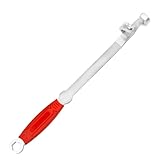
You’re staring at a bolt that looks like it’s been welded in place. It’s massive, probably metric, and stuck fast. Your brain immediately goes to the most expensive tool you own – the torque wrench. You paid good money for that precision instrument, so surely it can muscle its way through this problem, right? Well, let’s cut to the chase: can you unscrew a large bolt with a torque wrench? The answer is a resounding ‘it depends,’ and anyone who tells you otherwise is either lucky or selling you something.
I’ve been there. Standing in my garage, covered in grease, with a stubborn suspension component refusing to budge. My first instinct was to grab the biggest breaker bar I had, but then the thought hit me: what about the torque wrench? It’s designed for precision, but it’s also a pretty hefty piece of metal. This whole notion feels like a bit of a gamble.
When Your Torque Wrench Becomes a Breaker Bar (and Why It’s Dumb)
Look, I get it. You’ve got a shiny, calibrated torque wrench sitting there. It’s got a good grip, a solid handle, and you’re thinking, ‘This thing can handle anything.’ And in a pinch, maybe it can. I’ve seen guys use their torque wrenches like super-duty socket wrenches to loosen fasteners that are really seized up. I’ve even done it myself, though I’d never admit it to the manufacturer.
The truth is, these tools are designed for very specific jobs. A torque wrench’s primary function is to apply a precise amount of rotational force to a fastener. When you’re tightening a bolt to a specific spec – say, 80 foot-pounds for your lug nuts – you set the wrench, and it clicks or beeps when you hit that mark. It’s all about accuracy. But when you’re trying to loosen a bolt, especially one that’s corroded, over-tightened, or just plain stubborn, you’re not looking for precision. You’re looking for brute force. And that’s where you start to screw things up, literally and figuratively.
Think about the internal mechanisms. Torque wrenches, especially click-type ones, have delicate springs and pawls inside. When you apply force in reverse – to loosen a bolt – you’re basically hammering those components. It’s like using your fancy digital kitchen scale to smash walnuts. It might work once, but you’re going to break the scale. The same thing happens to your torque wrench. You might get that bolt to turn, but you’re likely bending or stressing those internal parts. The next time you try to use it for its intended purpose – to accurately torque something down – you’re going to be way off. This can lead to under-tightened bolts that rattle loose or over-tightened ones that snap or strip.
I remember a time I was working on an old farm tractor. The main axle nut was fused on tighter than a politician’s promise. I’d already tried penetrating oil, heat, and a standard breaker bar that was just flexing alarmingly. My only remaining option was my good-quality click-type torque wrench.
Against my better judgment, I set it to its highest setting (which, by the way, is still nowhere near what some seized bolts require) and gave it a yank. It didn’t click. It groaned. It lurched.
And then, with a sickening crunch, the bolt turned. Success?
Not exactly. The torque wrench never felt the same. It would occasionally click at random settings, and I ended up stripping the head off a perfectly good bolt a few weeks later because the wrench was reading wildly inaccurate.
That was a $200 lesson I haven’t forgotten. (See Also: Do You Need Torque Caliper Bolts )
Why Your Torque Wrench Isn’t a Magic Bullet for Stuck Bolts
So, if using your torque wrench to break a stubborn bolt is a bad idea, what’s the alternative? Honestly, it’s usually a much cheaper, simpler tool. The most obvious answer is a good old-fashioned breaker bar. These are built for use and brute force. They have a long handle, a strong head that can swivel, and no delicate internal mechanisms to worry about. You can put your body weight into it, use a pipe for extra use (carefully!), and really put some muscle behind it. They’re not designed for precision, and that’s precisely why they’re the right tool for this kind of heavy-duty loosening.
Another common tool you might overlook is an impact wrench. Now, this is where things get interesting. An impact wrench uses rotational blows, like a controlled hammering, to loosen fasteners. It delivers short, sharp bursts of torque. This can be incredibly effective at breaking free seized bolts without necessarily stressing the bolt head or the tool itself as much as a continuous, high-force pull from a breaker bar or a misused torque wrench. Electric and pneumatic impact wrenches come in various sizes and power levels. For really large bolts, you’ll want a more powerful one, perhaps pneumatic if you have an air compressor. The key here is the shock and vibration rather than sheer, sustained twisting force.
Let’s talk about common advice you’ll see online. Many DIY forums will tell you, ‘Oh, just use your torque wrench on its highest setting and give it a good pull.’ This is terrible advice, and it’s usually peddled by people who haven’t actually seen the long-term damage it does to their tools or the potential for fastener failure later on. They’re probably just happy they got the bolt out in that one instance. It’s like saying you can use a hammer to crack a delicate egg – sure, you can, but you’re going to make a mess and probably break the shell into a million pieces.
The reason this advice persists is probably due to the fact that many people own a torque wrench and don’t own a dedicated breaker bar or impact wrench. They see their torque wrench as the ‘heavy-duty’ wrench in their toolbox and default to it. But that’s like using your expensive chef’s knife to pry open a paint can – it’s the wrong tool for the job, and you’ll regret it. The goal when loosening a stuck bolt is to apply force strategically, not just to crank on it with whatever you have handy. You want to shock it, vibrate it, or apply steady, controlled use that doesn’t damage the tool or the fastener.
The Anatomy of a Stubborn Bolt and How to Fight It
So, why do bolts get so stubborn in the first place? It’s usually a combination of things. Corrosion is a big one. Rust expands, creating a microscopic bond between the bolt threads and the material it’s threaded into. Think of it like concrete setting around rebar. Then you have over-tightening. Someone might have cranked down on that bolt way harder than necessary, stretching the bolt and deforming the threads. This creates a mechanical lock that’s tough to break. Add in dirt, grime, and maybe even some old thread locker that’s turned into superglue, and you’ve got a recipe for a bolt that won’t budge.
When you’re faced with such a beast, the first thing you should do, even before grabbing any wrench, is to apply penetrating oil. Brands like PB Blaster or Kroil are specifically formulated to creep into those tiny gaps between the threads and break down rust and corrosion. You need to give it time. I’m talking hours, sometimes even overnight. Reapply it a few times. You can even tap the bolt head lightly with a hammer after applying the oil. This vibration helps the oil work its way in. Don’t expect miracles in five minutes. Patience is key here.
If the penetrating oil and time aren’t enough, the next step is often heat. A propane torch can work wonders. Heating the material around the bolt (if possible) causes it to expand slightly, which can break the rust bond. Be careful with heat, though. You don’t want to damage surrounding components, melt plastic, or ignite any flammable materials. For really stubborn cases, an induction heater is a professional tool that heats the bolt directly with electromagnetic fields, offering more control and less collateral damage, but that’s a bit overkill for most home mechanics.
Once you’ve tried these preparatory steps, then you can reach for your tools. A long breaker bar is your best friend for applying steady, controlled use. If you’re worried about rounding off the bolt head (which happens if your socket doesn’t fit snugly or the head is already damaged), consider a bolt extractor socket. These have internal flutes that grip onto a rounded bolt head. They’re not foolproof, but they can be a lifesaver. Remember, the goal is to apply force to the bolt head itself, not to the wrench’s calibration mechanism.
Common Mistakes When Loosening Large Bolts
One of the biggest mistakes is using the wrong size socket. This is a surefire way to round off a bolt head. Always make sure your socket is a snug fit. Another error is applying force unevenly. Jerky movements can shock the bolt head and make it more likely to strip. Try to apply steady, increasing pressure. Finally, people often give up too easily. They try once or twice with a standard wrench and then resort to drastic measures without exhausting the less damaging options first. (See Also: Do I Need Special Replacement Bolts For Car Engines )
| Tool | Pros | Cons | Verdict for Loosening Large Bolts |
|---|---|---|---|
| Torque Wrench | Can be used for tightening to spec. | Internal damage, inaccuracy, not designed for breaking torque. | Avoid. High risk of damage to tool and fastener. |
| Breaker Bar | Built for use, durable, simple. | Requires significant manual force. | Excellent. The go-to for manual force. |
| Impact Wrench (Electric/Pneumatic) | Delivers shock and vibration, fast, powerful. | Requires power source (battery/air), can be loud, potential for over-tightening if not careful. | Very Good. Excellent for breaking free seized fasteners with less continuous strain. |
| Adjustable Wrench | Versatile for various sizes. | Poor grip, high risk of rounding bolt heads, low use. | Terrible. Only for very light-duty tasks, avoid for large bolts. |
| Pipe Wrench | Aggressive grip. | Damages fastener heads, designed for pipes, not bolts. | Use as a last resort for severely damaged heads, but expect to replace the bolt. |
What to Look for in a Wrench for Large Fasteners
When you’re dealing with truly large bolts – we’re talking about anything over, say, 17mm or 19mm, and especially anything found on suspension components, engines, or heavy equipment – you need tools that are built for the task. Forget those flimsy sets you find at discount stores. You need heavy-duty, often impact-rated sockets and wrenches. For loosening, your primary tools should be a solid breaker bar and, if you have access to one, an impact wrench.
A good breaker bar will have a long handle, usually 18 inches or more, to give you plenty of use. The head should pivot smoothly but lock firmly in place. Look for chrome-vanadium steel construction; it’s strong and resists corrosion. For sockets, you want deep well, impact-rated sockets. These are thicker-walled and designed to withstand the shock and rotational forces of an impact wrench without cracking. Standard chrome sockets can shatter under impact, which is incredibly dangerous.
If you’re going the impact wrench route, consider the torque output. For automotive work on larger fasteners, you’ll likely want something that can deliver at least 300-400 foot-pounds of torque. For truly industrial-sized bolts, you might need even more. Pneumatic impact wrenches tend to offer more power and durability for heavy use, but a good cordless electric impact wrench can be more than sufficient for many DIYers. Always use the correct adapter for your impact sockets – a standard socket might not hold up.
It’s also worth considering a manual impact driver. This is a tool you strike with a hammer, and the strike converts into a rotational impact. It’s not as powerful as an electric or pneumatic impact wrench, but it’s a great option for bolts that are stubborn but not completely seized. They’re also relatively inexpensive and don’t require any power source. They are particularly useful for screws or bolts with Phillips or flathead slots where an impact wrench might just spin.
Real-World Scenarios: When Torque Wrenches Get Misused
The temptation to use a torque wrench for loosening is strongest when you’re in a bind and don’t have the ‘right’ tool immediately available. This often happens on a weekend when all the good auto parts stores are closed, or you’re halfway through a job and realize you’re missing a specific tool. For example, I’ve seen people try to use a torque wrench to remove a crankshaft pulley bolt. These are notoriously tight, often requiring hundreds of foot-pounds of torque to break free. A standard torque wrench, even at its highest setting, is usually in the 100-150 ft-lb range. Trying to force it past that point is asking for trouble.
Another scenario: trying to remove a large, rusted exhaust manifold bolt. These are often exposed to the elements, heat cycles, and road grime, making them incredibly difficult to turn. People grab their torque wrench, try to budge it, feel the resistance, and then try to force it. The torque wrench might click, or it might just groan and not move. If it clicks prematurely because of internal slippage or damage, you might think the bolt is loose when it’s not, or you might be applying inconsistent force. If it doesn’t click and you keep pulling, you risk damaging the tool’s calibration mechanism.
I recall a friend trying to remove a stubborn wheel hub nut on his truck. He’d already tried a breaker bar, but it wasn’t budging. He then brought out his fancy digital torque wrench, thinking its electronic precision would somehow help.
He set it to its max (150 ft-lbs) and pulled. The wrench beeped, indicating it had reached its limit, but the nut hadn’t moved. He kept pulling, and the wrench started making a weird whining noise.
He eventually had to stop. Later, when he tried to torque his lug nuts, the wrench would sometimes click at 30 ft-lbs and sometimes at 70 ft-lbs. It was ruined. (See Also: Can You Use A Torque Wrench To Break Bolts Loose )
He ended up having to buy a new torque wrench and a heavy-duty impact wrench for the wheel hub nut.
The fundamental problem is a misunderstanding of what a torque wrench does. It measures the amount of twist being applied, and it stops you when you reach a pre-set amount. It’s not designed to overcome extreme resistance or to be used as a pry bar or a hammer. The forces involved in breaking free a severely seized bolt are often far greater and more dynamic than what the internal components of a torque wrench can handle without damage.
Faq About Torque Wrenches and Bolts
Can You Use a Torque Wrench to Loosen a Bolt?
Technically, you can apply force to a torque wrench in reverse to loosen a bolt. However, it is strongly advised against. Torque wrenches are precision instruments designed for tightening fasteners to a specific tension. Using them to break loose seized or over-tightened bolts can damage their internal calibration mechanisms, leading to inaccurate readings in the future and potentially compromising fastener integrity.
Is It Bad to Loosen Bolts with a Torque Wrench?
Yes, it is generally bad practice. The internal springs, gears, and clutches within a torque wrench are not designed to withstand the high, shock-like forces often required to break free a stubborn fastener. This can lead to premature wear, bending of components, and a loss of accuracy, rendering the wrench unreliable for its intended purpose.
What Tool Should I Use to Unscrew a Large, Stuck Bolt?
For large, stuck bolts, a breaker bar is the most appropriate manual tool. If you have access to power tools, an electric or pneumatic impact wrench is highly effective. Both are designed to apply significant force and use without the delicate calibration found in a torque wrench. Always start with penetrating oil and allow it time to work before resorting to brute force.
How Can I Avoid Damaging My Torque Wrench When Loosening Bolts?
The best way to avoid damaging your torque wrench is to not use it for loosening bolts, especially large or seized ones. Always use a dedicated breaker bar or an impact wrench for this task. If you must use a torque wrench for a slightly snug bolt (which is still not ideal), make sure it is set to its lowest possible setting or use a different tool altogether. Never use it for prying or as a hammer.
Conclusion
So, to circle back to the million-dollar question: can you unscrew a large bolt with a torque wrench? The short, blunt answer is: you can, but you absolutely should not if you value the accuracy and longevity of your tool, or the integrity of your project. Think of it like this: you wouldn’t use a surgeon’s scalpel to chop firewood. It’s the wrong tool for the job, and you’ll end up breaking something expensive and delicate.
The temptation is there, especially when faced with a bolt that seems determined to stay put. But trust me, the cost of a new torque wrench, or the potential headache of a bolt failing later because it wasn’t properly torqued, far outweighs the few minutes you might save by trying to force it with your precision instrument. Grab a breaker bar, get some penetrating oil, maybe even a can of freeze-off spray, and do it the right way. Your toolbox (and your future self) will thank you.
Next time you’re faced with a stubborn fastener, step back, assess the situation, and reach for the right tool. It’s not just about getting the bolt out; it’s about doing it right, safely, and without destroying your gear. And if you’re still wondering, remember this: a torque wrench tells you when something is tight enough; it’s not designed to tell you when it’s loose enough, especially when ‘loose enough’ requires a Herculean effort.