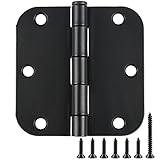
I stood in the hardware aisle, staring at a wall of metal. My front door was sagging, a persistent squeak announcing its every move. I needed new hinges, simple enough, right? I grabbed a pack that looked right and headed home, ready to fix the damn thing. An hour later, surrounded by a pile of useless metal and a still-squeaky door, I was cursing under my breath. Not all door hinges are the same size, not even close.
This whole “are door hinges the same size” question is a minefield for DIYers. It’s one of those things you think you know until you actually need to replace one. Then you’re left wondering if you need a degree in engineering or just a better tape measure.
Hinge Size Isn’t Just About Looks: It’s About Load Bearing
Look, when you’re staring at a door, it’s easy to think, “It’s a door. It needs hinges. They’re all the same.” That’s the trap. The truth is, the size of a door hinge isn’t just some arbitrary measurement.
It’s directly tied to how much weight that hinge needs to hold, and more importantly, how it distributes that weight. A standard interior bedroom door might weigh 20-30 pounds. A solid wood exterior door, especially one exposed to the elements, can easily tip the scales at 50-100 pounds or more.
Then you’ve got heavy architectural doors, or those fancy, oversized interior doors. Each one demands a hinge that’s up to the task, and that means more than just the width and height of the leaf.
We’re talking about the thickness of the metal, the gauge of the pin, and how the knuckles are constructed. A flimsy hinge on a heavy door is a recipe for disaster. I learned this the hard way when I replaced the hinges on my old, solid oak garden shed door. I grabbed what looked like standard utility hinges, and within a year, the door was dragging on the ground.
The cheap hinges had bent under the weight, and the whole setup was compromised. It wasn’t just an aesthetic problem; it made the door hard to lock properly.
Beyond weight, consider the environment. Exterior doors face moisture, temperature swings, and more stress. They often need heavier-duty hinges made from rust-resistant materials like stainless steel or heavy-gauge brass, which inherently come in sturdier, often larger, profiles to handle the added environmental abuse and the weight of solid wood or composite doors. Interior doors have it easier, but even there, the frequency of use can dictate durability. Think of a busy bathroom door that’s opened and closed dozens of times a day versus a rarely used guest room. All these factors mean that simply asking are door hinges the same size doesn’t get you to the right answer for your specific needs. You have to consider the door itself.
The common advice is to measure, measure, measure. And yeah, that’s true. But it’s more than just a quick tape measure across the old hinge.
You need to measure the length of the hinge leaf (the flat part that screws to the door and frame), the width of the leaf when the door is closed (which is usually about half the total width of the hinge), and the thickness of the hinge material. For standard interior doors, you’ll often find hinges that are 3.5 inches tall. But go to a specialized door hardware store, or look at heavy-duty options, and you’ll see 4-inch, 4.5-inch, and even larger sizes.
Don’t forget the pin diameter too – a thicker pin means a stronger hinge. It’s the whole package, not just one dimension.
The Anatomy of a Hinge: Why Size Matters in Detail
Let’s break down what makes a hinge, because understanding these parts clarifies why they can’t all be the same size. You’ve got the two leaves, the flat metal plates. One attaches to the door jamb, the other to the edge of the door. Then there are the knuckles, the cylindrical parts that interlock and house the pin. The pin itself is the central rod that allows the leaves to pivot. When we talk about hinge size, we’re usually referring to the overall dimensions of the leaves, and often, the length is the most visible spec. A common interior door hinge might be 3.5 inches long and 1.5 inches wide (when closed). But there are variations.
Consider the corner radius. Hinges come in square corners or rounded corners. (See Also: A Box Without Hinges Key )
For a standard mortise (where the hinge is set into the door and frame), the radius needs to match the cutout. If you have a door with beautifully rounded corners, you can’t just jam a square-cornered hinge in there and expect it to look right or sit flush. This is where I’ve seen people make mistakes, trying to force the wrong shape, which damages the wood and makes the hinge sit proud, looking terrible and potentially weakening the mounting.
I once tried to “trim” a rounded hinge leaf to fit a square mortise on an old cabinet. It was a nightmare. The metal is tough, and I ended up mangling both the hinge and the cabinet frame.
It looked awful and the door didn’t hang right.
The thickness of the hinge material is another important “size” factor. Thicker steel means more strength and durability. You can have two hinges that are 3.5 inches long and 1.5 inches wide, but one might be made of 1.5mm thick steel, and the other of 3mm. That 3mm hinge will be significantly stronger and more resistant to bending or warping. This is why those cheap, lightweight hinges you find in bulk packs are often the first to fail on anything but the lightest interior doors. They’re undersized in terms of material thickness, even if the length and width seem standard.
Then there’s the pin. Standard hinges have a removable pin, often with a security tip. The diameter of this pin, while not always advertised as a primary spec, contributes to the hinge’s overall load capacity. Larger pins mean more surface area for the knuckles to rest on, distributing the load better. You’ll see this difference most starkly when comparing a standard residential hinge to a heavy-duty commercial or industrial hinge. The latter will often have noticeably thicker pins and overall beefier construction. So, when asking are door hinges the same size, remember it’s a multi-faceted question involving length, width, thickness, corner radius, and pin diameter.
Here’s a quick comparison of common hinge types and their typical characteristics:
| Hinge Type | Typical Length | Typical Width (Closed) | Material Thickness | Common Use Case | Opinion/Verdict |
|---|---|---|---|---|---|
| Standard Interior Residential | 3.5″ | 1.5″ | 1.5mm – 2.0mm | Interior doors (bedrooms, closets) | Fine for light doors, but upgrade if you notice sag. |
| Heavy-Duty Interior Residential | 4″ – 4.5″ | 1.75″ – 2.0″ | 2.5mm – 3.0mm | Heavier interior doors, French doors | Worth the extra cost for peace of mind on substantial doors. |
| Exterior Residential | 4″ – 4.5″ | 1.75″ – 2.0″ | 2.5mm – 3.5mm (often thicker, rust-resistant) | Exterior entry doors | Don’t skimp here; weather resistance and strength are key. |
| Wrought Iron / Decorative | Varies widely | Varies widely | Often thinner, aesthetic focused | Decorative gates, cabinets, rustic doors | Primarily for looks; make sure they can actually support the load. |
| Ball Bearing (Commercial/Heavy Duty) | 4.5″ – 5″+ | 2.0″ – 2.5″+ | 3.0mm+ | Heavy commercial doors, high-traffic areas | Overkill for most homes, but built to last. |
Common Mistakes and How to Avoid Them
The biggest mistake people make is assuming all hinges are interchangeable. They see a hinge, it fits a door, therefore it must be the right hinge. Wrong. I’ve seen countless doors that sagged, rubbed the frame, or even had hinges that snapped off because the wrong type was used. It usually happens when someone buys a pack of cheap hinges from a big box store to replace an old, worn-out set, without considering the door’s weight or type. If you’re replacing a single hinge, you need to match the old one as closely as possible in size, corner radius, and thickness. If the old hinge was a beast and the new one is flimsy, you’re asking for trouble.
Another common pitfall is not checking the “hand” of the hinge. While most hinges are reversible (meaning they work whether the door swings left or right), some specialized hinges are not. This is less common for standard door hinges but can be a factor with other types of door hardware.
More practically, people often overlook the screw length. The screws that come with hinges are usually adequate for new installations into solid wood. But if you’re replacing hinges on an old door, the screw holes might be stripped or enlarged. Using the short screws that came with the new hinges in these cases is a recipe for a loose door.
Always use longer screws, or at least screw anchors, to make sure the hinge is securely fastened to the frame and door. I learned this the hard way on a heavy pantry door.
The original screws were long and substantial. The new hinges came with puny little screws. The door sagged within a week.
I had to remove the new hinges, drill out the holes, and use much longer, thicker screws I had to buy separately. It’s frustrating, but key for a solid hang. (See Also: Are Integrated Washing Machine Door Hinges Standard )
People also forget about the finish. While not strictly a “size” issue, the finish can affect how the hinge interacts with its environment and its longevity. A cheap plated finish might look okay initially but will quickly corrode on an exterior door, leading to stiffness, rust stains, and eventual failure. For exterior doors, or doors in high-humidity areas like a bathroom, opt for solid brass, stainless steel, or a high-quality powder-coated finish. These might be slightly more expensive upfront, but they save you headaches and replacement costs down the line. Thinking are door hinges the same size means you need to consider all these aspects, not just the most obvious measurements.
Contrarian opinion: Most people overthink the screw length for interior doors. For standard interior doors that aren’t excessively heavy, the screws that come with good quality hinges are usually sufficient. The real issue is often the hinge quality itself, or stripped screw holes due to previous shoddy work or the hinge failing. If your holes are stripped, use wood filler or dowels and re-drill, rather than just jamming in longer screws willy-nilly. That’s a band-aid fix.
What Are the Standard Door Hinge Sizes?
The most common size for interior residential doors is 3.5 inches (height) by 3.5 inches (width when open, or 1.75 inches per leaf). Exterior doors and heavier interior doors often use 4-inch or 4.5-inch hinges for increased strength and stability. The width of each leaf when closed is typically around 1.5 to 2 inches. Always measure your existing hinge’s length and width, and check the corner radius (square or rounded) to make sure a proper fit.
Measuring for Replacement: Precision Is Key
When you’re faced with a sticky door or a squeaky hinge, and you’ve realized not all hinges are created equal, the next step is accurate measurement. Don’t just grab a tape measure and guess. You need to be methodical. First, remove the old hinge. If it’s just one that’s failed, take it off the door or frame. If the whole door is coming off, that’s fine too, but it’s often easier to measure a hinge still attached, or at least the mortise it came from.
Measure the length of the hinge leaf. This is the longest dimension. For standard interior doors, this is often 3.5 inches. For exterior or heavier doors, it’s commonly 4 inches or 4.5 inches. Next, measure the width of one leaf when the door is closed. This measurement is usually taken from the edge of the pin barrel to the outer edge of the leaf. A common width is around 1.75 inches for a 3.5-inch hinge, meaning each leaf is roughly that wide. You’re basically measuring half the hinge’s total width when open.
Pay close attention to the corner radius. Look at the corners of the hinge leaf where it meets the door or frame. Are they perfectly square, or do they have a curve? You’ll typically find hinges with a 1/4-inch radius or a 5/8-inch radius, or square corners. You need to match this to the cutout (mortise) in the wood. If you try to put a square hinge into a rounded cutout, it won’t sit flush, and you’ll have gaps. Similarly, a rounded hinge won’t fit neatly into a square mortise. This is a common reason why new hinges don’t sit flush and look amateurish.
Finally, check the thickness of the hinge material. While not always obvious without calipers, you can usually get a good feel for it. Hold the old hinge next to a new one if possible. Does the old one feel significantly thinner or flimsier? If you’re buying online and can’t compare directly, look for descriptions that mention gauge or thickness, especially for heavy-duty applications. For exterior doors or any door that feels substantial, aim for thicker gauge hinges.
If you’re replacing a hinge, try to find one that matches in all these respects. If you’re replacing all hinges on a door, you have more flexibility, but you still need to choose based on the door’s weight and swing. The number of screws per leaf is also a good indicator of load capacity – more screws usually mean a stronger mounting. Standard hinges have 3 screws per leaf, while heavy-duty ones often have 4 or even 5.
How Do I Know What Size Hinge I Need?
You need to measure your existing hinges accurately. Measure the length of the hinge leaf (the flat metal part). The most common sizes are 3.5 inches for interior doors and 4 or 4.5 inches for exterior or heavier doors. Also, measure the width of one leaf when the door is closed. Importantly, check the corner radius of the hinge leaves – they will be either square or rounded (often 1/4″ or 5/8″). Match these dimensions and the corner type precisely when buying replacements. Don’t forget to consider the thickness of the metal for heavier doors.
Hinge Material and Finish: More Than Just Aesthetics
When you’re wrestling with the question, are door hinges the same size, it’s easy to get caught up in just the dimensions. But the material and finish play a massive role in how a hinge performs, especially over time. The most common materials you’ll encounter are steel and brass. Steel hinges are generally strong and affordable. They’re often plated with zinc or nickel for corrosion resistance. However, lower-quality steel hinges with thin plating can rust, especially in humid environments or on exterior doors. This rust can stain your door and frame, and it will seize up the hinge, making it stiff and noisy.
Solid brass hinges are beautiful and naturally resistant to corrosion. They’re a popular choice for interior doors where aesthetics matter. However, solid brass can be more expensive than steel. Over time, brass can develop a patina, which some people love, while others prefer to keep it polished. High-quality brass hinges are durable and can last for decades. They tend to be a bit softer than steel, so for extremely heavy doors, you might still lean towards heavy-gauge steel or specialized hinges.
Stainless steel is fantastic for exterior doors and high-moisture areas. It’s highly resistant to rust and corrosion and very durable. If you’re doing an exterior door replacement, or any door exposed to the elements, stainless steel is usually your best bet, though it can be pricier. Aluminum hinges are lighter and won’t rust, but they generally aren’t as strong as steel or brass and are more common on lightweight cabinet doors or utility applications. (See Also: Are Hinges Wheeels )
The finish is the protective or decorative coating applied to the material. Common finishes on steel include:
- Zinc Plated: A basic, affordable finish. Good for interior use, but can corrode over time.
- Nickel Plated: Offers better corrosion resistance than zinc, with a brighter look.
- Black Oxide: Provides a dark, matte finish. Can be durable but may show wear.
- Powder Coating: A durable, baked-on finish that comes in various colors, including black, white, and bronze. Excellent for both interior and exterior use.
On brass hinges, finishes can include lacquer (to prevent tarnishing), unlacquered (to develop a natural patina), or polished brass. For any exterior application, or even a frequently used interior door like a bathroom, I’d steer clear of basic zinc-plated steel. I once installed a set of zinc-plated hinges on a garden gate that was only partially sheltered. Within two years, they were visibly rusting, stiff, and streaking the wood. I ended up replacing them with powder-coated stainless steel hinges, which were a bit more expensive but have held up perfectly for the last five years. It’s a classic case of buying cheap, buying twice.
The Faq: Clearing Up Hinge Confusion
Are All Door Hinges the Same Width?
No, door hinges are not all the same width. While common interior door hinges often have a leaf width of about 1.5 inches when closed (meaning the hinge itself is roughly 3 inches wide when fully open), this can vary significantly. Wider hinges are used for heavier doors or for increased stability. You’ll find hinges that are wider to accommodate larger doors or provide more solid support. Always measure your existing hinge or the space available to make sure the new one will fit.
Can I Use a Different Size Hinge?
Generally, it’s best to use the same size hinge that was originally installed, especially for standard doors. Using a different size can affect how the door hangs and operates. If you use a smaller hinge on a heavy door, it will likely sag. If you use a larger hinge, it might not fit into the existing mortise (the cutout in the door and frame) without significant modifications, potentially damaging the wood. For specialized applications or when upgrading to a heavier door, custom solutions or heavy-duty hinges of appropriate dimensions are necessary.
Do Hinges Need to Match the Door Weight?
Absolutely. The weight of the door is one of the most important factors in determining the correct hinge size and strength. Lighter interior doors might only need standard 3.5-inch hinges, while heavier solid wood or exterior doors require larger, thicker, and stronger hinges, often 4 or 4.5 inches, with thicker pins and heavier gauge metal. Using hinges that are too light for the door’s weight will lead to sagging, binding, and premature failure of the hinge. Always check the door’s weight and select hinges rated for that load.
What Happens If I Use the Wrong Size Hinge?
Using the wrong size hinge can cause several problems. A hinge that is too small or too weak for the door’s weight will cause the door to sag, making it difficult to open and close, and potentially causing it to rub against the floor or frame. It can also put undue stress on the hinge and mounting screws, leading to stripping of screw holes or even the hinge breaking. Conversely, a hinge that is too large might not fit into the mortise correctly, requiring extensive wood modification, or it might protrude, looking unsightly. In essence, it compromises the door’s functionality, appearance, and longevity.
Hinge Types Beyond the Standard Square Leaf
While we’ve focused heavily on the standard rectangular or square-leaf hinges, it’s worth noting that doors aren’t always fitted with these. Sometimes, the need for a specific hinge type arises from the door’s design or function. For instance, what about those old, antique doors with intricate carvings or unique mounting requirements? You might encounter strap hinges, which are decorative and feature a long strap that attaches to the face of the door and the frame. These are often used for a rustic or historical look, and their “size” isn’t just about the leaf but the overall length and decorative elements. They can be quite substantial and are often bought in sets that match visually.
Then there are pivot hinges. These are commonly found on very large or heavy doors, like storefront entrances or some modern architectural designs. Instead of traditional side-mounted hinges, pivot hinges are installed at the top and bottom of the door, allowing it to swing from a central point. They are designed to carry a significant amount of weight and operate very smoothly. The “size” here is more about the load capacity and the pivot point dimensions, rather than the leaf dimensions we’ve been discussing.
Concealed hinges, often called European or Soss hinges, are another category. These are designed to be almost invisible when the door is closed, offering a clean, minimalist look. They are mortised into both the door and the frame and consist of multiple barrels that rotate. Their sizing is about the overall length and diameter of the barrel mechanism. They often have specific installation requirements and are not typically interchangeable with standard butt hinges without significant work. If you’re looking for a sleek, modern aesthetic, these are the way to go, but they are usually more expensive and can be trickier to install correctly.
Also, consider specialized hinges for specific door types. Screen doors often use spring-loaded hinges that automatically close the door. Garage doors use complex systems of sectional hinges that allow panels to articulate. While the basic principles of load-bearing apply, the form and function can be drastically different. So, the initial question, are door hinges the same size, becomes even more complex when you branch out from the most common residential butt hinge. Each type has its own sizing conventions and installation needs.
My own encounter with non-standard hinges was when I inherited a vintage secretary desk. The small drop-down writing surface was supported by tiny, ornate quadrant hinges. They weren’t anything like a door hinge, but the principle was the same: they had to support a weight and allow smooth movement. When one broke, finding a replacement was a real hunt, requiring precise measurements of the arc they swung through and the mounting screw pattern. It taught me that even for smaller applications, “size” is a nuanced concept.
Final Thoughts
So, to cut to the chase: are door hinges the same size? Absolutely not. It’s a question that sounds simple but quickly reveals a world of variation based on door weight, material, environment, and desired aesthetic. I’ve wasted money and time on hinges that looked right but were fundamentally wrong for the job. Measuring precisely, considering the material, and understanding the door’s load are key.
Don’t just grab the cheapest pack you see. Take the time to measure your existing hinges, check the corner radius, and think about the weight of your door. If it’s an exterior door, prioritize corrosion resistance. If it’s a heavy interior door, invest in heavier-duty hardware. Getting the right hinge means a door that swings smoothly for years, not one that sags and squeaks after a few months.
Next time you’re at the hardware store, or even just looking at your own doors, you’ll see the differences. It’s not just about the metal; it’s about the engineering that keeps your doors functional. Keep these points in mind, and you’ll save yourself a lot of frustration and potential rework. Your doors will thank you.