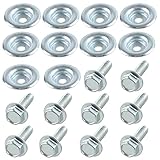
I remember staring at a pile of assorted bolts after a particularly disastrous DIY shelving project. Some had snapped clean off, others had bent like cheap spoons. The frustration was immense. I’d bought what I thought were strong bolts, only to watch my carefully constructed shelves sag and eventually collapse. It all came down to understanding what I actually needed, and that meant getting a handle on something like a 286 bolt proof strength.
It’s easy to get lost in the jargon, the SAE vs. Metric, the fancy coatings. But at the end of the day, if a bolt can’t hold what it’s supposed to, it’s just a fancy piece of metal. This isn’t about theoretical engineering; it’s about practical application and not wasting your hard-earned cash on hardware that’s going to fail you when you least expect it.
What Exactly Does ‘proof Strength’ Mean for a Bolt?
Look, nobody wants their fasteners to go the way of my shelves. When we talk about ‘proof strength’ for a bolt, especially something like a 286 bolt proof strength, we’re talking about the minimum stress a bolt can withstand without permanently deforming. Think of it like this: you can bend a paperclip a little and it’ll spring back to shape. Bend it too much, and it stays bent. Proof strength is that point of no return for a bolt, but on a much, much larger scale.
It’s not the absolute breaking point, mind you. That’s tensile strength. Proof strength is more conservative. It’s the load where you can be sure the bolt won’t take a permanent “set,” meaning it won’t stretch or yield in a way that compromises its ability to do its job reliably. For engineers and serious DIYers, this is a important number. It tells you how much load you can apply before you start risking structural integrity. It’s about preventing that subtle, insidious deformation that can lead to failure down the line, even if the bolt doesn’t snap immediately.
So, when you see a designation like ‘286’, it’s not just some random number. It refers to a specific grade or specification of material and heat treatment, all designed to achieve a certain level of yield strength – the proof strength. Different materials and manufacturing processes will yield different proof strengths. For instance, a plain old mild steel bolt will have a much lower proof strength than a hardened alloy steel bolt subjected to specific heat treatments.
It’s why some bolts feel substantial and others feel like they’d buckle under a strong handshake. Getting this wrong is how you end up with projects that look good on day one but start showing their age, or worse, their structural weakness, far too soon.
I learned this the hard way after a few too many wobbly furniture builds.
Decoding Bolt Grades and Their Proof Strength Implications
Here’s where things can get a bit murky, but understanding bolt grades is key to understanding proof strength. The common ones you’ll run into are SAE (Society of Automotive Engineers) grades for inch-based fasteners and Metric grades for metric ones. For SAE, you’ve got grades like 2, 5, and 8. Grade 8 bolts are significantly stronger than Grade 5, which are stronger than Grade 2. A Grade 8 bolt has a much higher proof strength than a Grade 2 bolt made from the same diameter steel, all thanks to material composition and heat treatment.
Now, this is where that ‘286’ I mentioned might pop up, or you might see numbers like 8.8, 9.8, 10.9, or 12.9 for metric bolts. These numbers are directly related to the bolt’s mechanical properties, including its proof strength. For example, a metric bolt marked 10.9 has a minimum tensile strength of 1000 MPa and a proof strength (or yield strength) of at least 90% of that, which is 900 MPa. That’s a huge jump from a standard hardware store bolt. The first number in the metric designation (like the ’10’ in 10.9) roughly relates to the tensile strength (1000 MPa), and the second number (the ‘.9’) relates to the yield strength as a percentage of the tensile strength (90% in this case).
So, a 286 bolt proof strength isn’t a standard designation you’ll find stamped on most bolts in your local hardware store. It sounds more like a specific internal specification or perhaps a less common standard. More typically, you’ll see ASTM designations like A325 or A490 for structural bolts, which have very specific proof and tensile strength requirements. If you encounter a ‘286’ designation, it’s vital to find out what standard it refers to. Is it a proprietary grade? A custom alloy? Without that context, the number itself is just a placeholder. (See Also: Are All Honda Atv Bolt Patterns The Same )
I once tried to replace some important fasteners on a piece of vintage machinery with what the supplier claimed were equivalent. They looked the part, but the proof strength was significantly lower. The machine started vibrating oddly after a few weeks. Turns out, the supplier’s “equivalent” wasn’t equivalent at all. This taught me to always verify the grade and its associated strength specs, not just trust the look or the vague description.
Common Bolt Grades and Approximate Proof Strength Ranges (for a Given Diameter)
| Grade/Class | Approximate Proof Strength (psi) | Typical Use | My Verdict |
|---|---|---|---|
| SAE Grade 2 | 33,000 – 45,000 | General purpose, light-duty applications | Fine for attaching a license plate, useless for anything structural. |
| SAE Grade 5 | 60,000 – 80,000 | Automotive, machinery, medium-duty construction | Decent for many common tasks, but don’t push it. |
| SAE Grade 8 | 92,000 – 120,000 | Heavy-duty equipment, bridges, structural applications | The workhorse for serious loads. When in doubt, go Grade 8. |
| Metric 4.6 | ~34,000 – 41,000 | Light-duty general use | Similar to SAE Grade 2, avoid for anything important. |
| Metric 8.8 | ~61,000 – 70,000 | General industrial, automotive, medium-duty | A good all-rounder for many mechanical applications. |
| Metric 10.9 | ~80,000 – 90,000 | High-strength structural, heavy machinery | Getting serious. Good for demanding jobs. |
| Metric 12.9 | ~105,000 – 120,000 | Aerospace, high-performance automotive, important components | The top tier. Use when failure is absolutely not an option. |
How Proof Strength Affects Real-World Applications
So, why should you care about proof strength beyond just grabbing the strongest-looking bolt? Because it directly impacts the reliability and longevity of whatever you’re building or repairing. Imagine bolting a heavy piece of equipment onto a vibrating platform. You need bolts that can handle both the static weight and the dynamic, shock loads without deforming. A bolt with insufficient proof strength might withstand the initial static load, but under vibration, it could slowly yield, leading to loosening fasteners, increased stress on the surrounding material, and eventual failure. This is a silent killer of projects.
I had a friend who was building a custom off-road trailer. He was meticulous about the frame and welding, but he skimped on the trailer hitch bolts, opting for standard hardware store bolts because they were readily available and cheaper. On the first major trip, hitting a few bumps that weren’t even that severe, the hitch started to wobble. One of the bolts had visibly stretched and deformed. Thankfully, it didn’t break completely, but it was a stark reminder that the weakest link in any assembly is often the fasteners, and proof strength is a huge part of that link’s integrity.
When you’re looking at something like a 286 bolt proof strength, if it’s a high number, it means that bolt is designed for applications where significant, sustained loads are expected, and where even slight deformation is unacceptable. This could be in important structural connections, high-stress machinery components, or anything where safety is most important. Conversely, if you’re just hanging a lightweight picture frame, you don’t need overkill. But understanding the difference means you won’t be over-specifying and overpaying, nor will you be dangerously under-specifying.
One of the most important things to consider is the environment. Is the bolt exposed to extreme temperatures, corrosive elements, or cyclic loading? These factors can all reduce the effective strength of a bolt over time. High-strength bolts, like those with a high proof strength, are often made from specialized alloys and undergo specific treatments to resist these environmental stresses. For instance, stainless steel bolts have good corrosion resistance but might have lower proof strength than some carbon steel alloys unless they are of a specific hardened grade.
Common Mistakes and What to Look For
The biggest mistake people make? Assuming all bolts of the same size are created equal. They aren’t. Grabbing a handful of M10 bolts from the discount bin because they fit the hole is a recipe for disaster if that application requires significant load-bearing capacity. You absolutely need to check the markings on the bolt head. These markings are your key to understanding the grade and, by extension, the proof strength and tensile strength. For SAE bolts, look for the radial lines. For metric bolts, look for the numbers like 8.8, 10.9, etc.
Another common pitfall is confusing tensile strength with proof strength. While related, they’re not the same. Tensile strength is the ultimate breaking point. Proof strength is the point of permanent deformation. For most applications where you want the bolt to maintain its shape and function under load, proof strength is actually the more relevant number to consider. You want to be well below the proof strength for safe operation. I’ve seen plenty of engineers spec bolts based on tensile strength alone, and then wonder why components start to loosen or deform prematurely under dynamic loads.
When you’re looking for a bolt with a specific proof strength, like the hypothetical 286 bolt proof strength, you’re probably dealing with a higher-performance application. This means you need to be looking at specialized suppliers, not just your local big-box hardware store. Check for ASTM specifications (like A325, A490 for structural, or A193/A194 for high-temperature/pressure applications) or DIN/ISO standards for metric. These standards define precise material compositions, heat treatments, and mechanical properties, including proof strength.
Always, always, always consider the source. Are you buying from a reputable fastener supplier or a general merchandise store? Reputable suppliers will have detailed specifications available for their products, including grade, tensile strength, and yield (proof) strength. If a supplier can’t provide that information, walk away. I learned this when I bought some bolts online that were described as “high strength.” They looked tough, but when I subjected them to a modest test load, they bent like a pretzel. Turns out they were just regular steel bolts with a shiny coating. Never again. (See Also: Are Ak Bolts Interchangeable )
People Also Ask: Your Bolt Strength Questions Answered
What Is the Difference Between Proof Strength and Tensile Strength?
Tensile strength is the maximum stress a material can withstand before it breaks. Proof strength, also known as yield strength, is the stress at which a material begins to permanently deform (bend or stretch without returning to its original shape). For many applications, proof strength is the more important metric because you want to avoid permanent deformation, even if the bolt isn’t broken.
How Do I Know the Proof Strength of a Bolt?
Proof strength is directly related to the bolt’s grade. For SAE bolts, higher grades (like Grade 8) have higher proof strengths than lower grades (like Grade 2). For metric bolts, the numbers on the head (e.g., 8.8, 10.9) indicate the grade and approximate tensile and yield (proof) strength. You can also find this information in the manufacturer’s or standards body’s specifications for a particular grade or ASTM designation.
Is a Higher Grade Bolt Always Better?
Not necessarily. A higher grade bolt has higher proof and tensile strength, which is great for heavy-duty applications. However, using an unnecessarily high-grade bolt can be overkill, more expensive, and sometimes even detrimental. For instance, very hard, high-strength bolts can be more brittle and less tolerant of shock loads than slightly lower-grade, tougher bolts. Always match the bolt grade to the specific load requirements of the application.
What Is Proof Load?
Proof load is the maximum load that a fastener can withstand without permanent deformation. It’s calculated by multiplying the bolt’s tensile stress area by its proof strength. It represents a safe working limit to make sure the bolt doesn’t yield. Exceeding the proof load means the bolt will permanently deform.
Practical Tips for Choosing and Using Bolts
When you’re selecting bolts for a project, start by assessing the load. What forces will the bolt be subjected to? Is it static weight, dynamic shock, vibration, shear stress, or tension? Don’t just guess. If possible, look up the expected loads for similar applications. If you’re building something structural, like a deck ledger board or a important piece of machinery, err on the side of caution. Opt for a higher grade than you think you need. For example, if a Grade 5 bolt might be sufficient, consider a Grade 8 if the cost difference isn’t prohibitive.
Always use the correct tightening torque. Over-tightening a bolt can exceed its proof strength and cause it to yield, even if the load it’s holding is well within its rated capacity. Under-tightening can lead to loosening under vibration. Use a torque wrench and consult a reliable chart for the recommended torque values for your specific bolt grade, size, and any lubrication present on the threads. A little lubricant can significantly reduce the torque required, so be aware of that when using charts.
When you’re dealing with high-stress situations or important components, it’s often wise to use locking mechanisms like lock washers or thread-locking compounds, especially if vibration is a concern. Even a bolt with a high proof strength can loosen over time if not properly secured. I once had a motorcycle exhaust pipe constantly coming loose until I started using high-strength thread locker. It made all the difference. It’s about creating a system, not just relying on a single component.
And finally, inspect your fasteners regularly, especially in applications that experience heavy use or harsh conditions. Look for signs of corrosion, deformation, or wear. If you see anything suspicious, replace the bolt. It’s a cheap insurance policy against catastrophic failure. The initial investment in quality fasteners and regular checks will save you a lot of headaches and potential repair costs down the line. Remember that a 286 bolt proof strength is a specification that indicates a high level of performance, and to get that performance, you need to treat the bolt right from selection to installation.
When to Call in the Experts or Use Standards
There are times when your gut feeling and a quick Google search just won’t cut it. If you’re designing anything for public safety, like a playground structure, a pedestrian bridge, or even modifying a vehicle’s safety systems (like suspension or brakes), you absolutely need to involve a qualified engineer. They can perform precise calculations based on load, material properties, fatigue, and environmental factors to determine the exact specifications required, including the necessary proof strength. Trying to wing it in these situations is not only risky but can have severe legal and ethical consequences. (See Also: Are All Bolt Patterns The Same )
For most common DIY projects, like building furniture, installing shelves, or basic automotive repairs, understanding the common SAE and Metric grades will get you 90% of the way there. However, if you encounter a situation where you need to replace a fastener on a piece of specialized equipment, machinery, or a vintage item, and you can’t find clear markings, it’s time to do more digging. Look for the original manufacturer’s documentation or service manuals.
These often specify the exact grade and type of fasteners used. If you can’t find that, contacting the manufacturer directly is your best bet. I once had to replace a bolt on an old industrial sewing machine; the manufacturer was the only one who could confirm the exact specifications needed to maintain its performance.
When dealing with high-pressure, high-temperature, or corrosive environments – think chemical plants, power generation, or food processing equipment – you’ll need to look beyond standard hardware store grades. You’ll be diving into ASTM specifications like A193 (alloy steel bolts) and A194 (nuts) or similar ISO/DIN standards.
These standards define specific material compositions (like various stainless steels or alloy steels), heat treatments, and mechanical properties, including proof strength, tensile strength, and creep resistance at lifted temperatures. For instance, an A193 B7 bolt has specific requirements that far exceed a common Grade 8.
It’s about making sure reliability under extreme conditions where failure is not an option and can be incredibly costly or dangerous. So, while many applications can be handled with common knowledge, some demand a deeper dive into established engineering standards, especially when dealing with high performance like that associated with a 286 bolt proof strength.
Final Thoughts
Ultimately, understanding bolt strength isn’t just for engineers with slide rules. It’s about making informed choices so your projects don’t fall apart, literally. Whether you’re building a bookshelf or repairing a important piece of machinery, knowing the difference between a bolt that will hold and one that will buckle is a fundamental skill.
Don’t get caught by fancy marketing or vague descriptions. Always look for those grade markings and, if you’re dealing with anything serious, consult the specifications. If a 286 bolt proof strength is what the job demands, make sure you’re getting a bolt that actually meets that standard, not just one that claims to. It’s the difference between a job well done and a costly, frustrating failure.
Next time you’re at the hardware store, take a second look at those bolts. They’re more than just metal; they’re the unsung heroes holding your world together. Choose wisely.