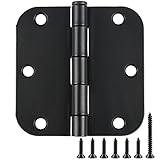
I remember staring at a pile of new door hardware, all shiny and promising. The salesman kept going on about ‘commercial grade’ this and ‘heavy-duty’ that. But when it came to fire safety, he just sort of shrugged and pointed to a different box entirely. It made me wonder, what’s the deal with these numbered grades? Specifically, are grade 11 hinges fire rated? It’s not as straightforward as you might think, and frankly, many people get this wrong, putting their safety at risk.
You see, the grading system for hinges isn’t about how tough they are against a crowbar; it’s a whole different ballgame related to how they perform under fire conditions. If you’re building or renovating, understanding this is a must. I’ve seen too many shortcuts taken because someone didn’t know the difference, and it’s a mistake you absolutely do not want to make.
Understanding Hinge Ratings: What Does ‘grade 11’ Even Mean?
Alright, let’s cut through the BS. When we talk about hinge grades, especially in the context of fire ratings, we’re not talking about some universal, free-for-all system where ’11’ automatically means indestructible or fireproof. It’s actually a bit more nuanced, and frankly, the numbering system itself can be misleading if you don’t know what you’re looking for.
Most people just see a number and assume higher is better, which is often true for durability, but not necessarily for fire performance. I’ve learned this the hard way. I once bought what I thought were the ‘best’ hinges because they had a high number – felt super solid, chunky steel.
Turns out, they were great for heavy doors and not squeaking, but had zero fire rating. The fire department was… unamused.
The primary grading system you’ll encounter for hinges, especially in the US, comes from the Builders Hardware Manufacturers Association (BHMA). They have different standards, but the one most relevant to door hardware performance, including how it holds up in a fire, falls under ANSI/BHMA A156.1. This standard covers a wide range of hardware, and hinges are a big part of it.
They test for things like cycle life (how many times a door can open and close before failing), load-bearing capacity, and, yes, fire resistance. But here’s the kicker: not all BHMA grades are created equal, and ‘Grade 11’ isn’t a specific fire rating designation in itself. It’s more commonly a classification within standards like A156.1 that relates to durability and general performance characteristics, not directly fire rating. (See Also: A Box Without Hinges Key )
So, when you see a hinge described as ‘Grade 11,’ it usually refers to a specific performance category within a manufacturer’s internal standards or a particular industry classification for general hardware. It doesn’t automatically tell you if it’s going to survive a blaze.
Think of it like car tire ratings – you have speed ratings, load ratings, but none of them specifically say ‘snow performance’ unless it’s explicitly labeled for that. For fire ratings, you need to look for specific certifications, usually from organizations like UL (Underwriters Laboratories) or Intertek, and specific markings on the hinge itself or its packaging.
Without those specific fire-rated labels, assuming a hinge is fire-rated based on a ‘grade’ alone is a dangerous gamble. My initial assumption about my ‘chunky’ hinges was just that – an assumption, and a wrong one at that.
The Real Deal on Fire-Rated Hinges: What to Look For
Forget the grade number for a second and focus on what actually matters for fire safety. If you need a hinge for a fire-rated door assembly – and believe me, you do if that door is meant to compartmentalize a building and slow the spread of flames and smoke – you need hinges that are specifically listed and labeled as fire-rated. This isn’t a suggestion; it’s a building code requirement in most places. The grade number, as we discussed, is mostly about general durability, cycle life, and how much weight it can handle. It tells you nothing about its ability to withstand the intense heat and pressure of a fire, or how long it will remain functional to keep that fire door closed.
So, what should you be looking for? First, check for markings. Fire-rated hinges will almost always have a label or stamp from a recognized testing laboratory. The most common ones are UL (Underwriters Laboratories) and FM (Factory Mutual).
You’ll often see a UL logo followed by a designation like ‘UL 10C’ or ‘UL 20-minute’. Sometimes, it might be an Intertek mark. (See Also: Are Integrated Washing Machine Door Hinges Standard )
This mark signifies that the hinge has been tested and meets specific fire resistance standards. The ’10C’ designation, for instance, refers to the Uniform Fire Code standard for swinging doors in fire-rated assemblies, typically requiring doors to withstand a positive and negative pressure differential.
The duration (e.g., 20-minute, 45-minute, 90-minute, 3-hour) indicates how long the entire door assembly, including the hinges, is expected to resist fire penetration.
The door itself will have a fire rating, and the hardware – hinges, locks, closers – must be compatible with that rating. You can’t just slap any old hinge on a fire door. If the door is rated for 90 minutes, your hinges must also be rated for at least 90 minutes. It’s a system, and every component has to play its part.
I learned this when I was helping a friend upgrade their old house and they wanted to convert a doorway to a fire-rated one. We found a beautiful solid wood door that was rated for 60 minutes, but the hinges they picked out were standard, non-rated ones. The building inspector nearly had a conniption.
He explained that the entire system had to be certified. You can’t get away with skimping on one part; the whole assembly is evaluated.
A common mistake people make is thinking that because a hinge is ‘heavy-duty’ or has a high BHMA grade (like 11, if that were a specific fire rating), it’s automatically fire-rated. It’s not. The weight and strength of a hinge are about its mechanical performance over time, not its thermal performance during a fire. You need to see that specific fire-rating label. If you can’t find it, or if it’s unclear, ask the manufacturer or supplier for documentation. Don’t take their word for it. Get it in writing, and look for the official marks. Your safety, and the safety of those around you, depends on it. (See Also: Are Hinges Wheeels )
Why Grade 11 Hinges Aren’t Automatically Fire Rated (and What to Do)
Let’s be crystal clear: The term ‘grade 11 hinges’ as a standalone description, especially without any accompanying fire-rating certification, means they are NOT fire rated. This is where a lot of confusion happens. The grading system, particularly the BHMA A156 standards, categorizes hinges based on their durability, cycle testing (how many times they can open and close before failing), and load capacity.
For example, BHMA Grade 1 hinges are the most durable, typically used in high-traffic commercial settings, while Grade 3 is for residential use. A ‘Grade 11’ isn’t a standard BHMA designation; if you see it, it’s likely a manufacturer’s internal classification or a misinterpretation.
Even if it were a BHMA grade, it would relate to general wear and tear, not fire resistance.
Fire resistance is a completely different set of tests. Hinges that are fire-rated must be tested by independent laboratories (like UL) to withstand specific fire conditions for a certain duration. They are designed not just to endure the heat but also to maintain their structural integrity to keep the fire door functioning as intended – to compartmentalize the fire and smoke. This involves tests that simulate extreme temperatures, pressure changes, and mechanical stress that occur during a fire. A heavy-duty hinge might survive the mechanical stress of a door slamming, but it could warp, melt, or fail under the thermal stress of a fire, rendering the fire door useless.
Verdict
So, what’s the fix if you’ve got hardware that isn’t fire-rated but needs to be? You have to replace it. There’s no way around it. Trying to ‘make’ a non-fire-rated hinge fire-rated is like trying to make a plastic spoon fireproof – it’s not designed for it, and it’s not safe. You need to purchase hinges that are specifically manufactured and certified for fire-rated applications. When you’re shopping, look for the labels from UL, FM, or other accredited testing bodies. The product packaging or the hinge itself should bear this certification. You’ll often see designations like ‘For use on 20-minute rated doors’ or ‘UL 10C compliant’.
I learned this the hard way when I was renovating my workshop. I had a heavy steel door I wanted to use as a fire barrier between the shop and the house. I bought some really solid, industrial-looking hinges. They felt incredibly solid. But when I went to install them and looked closely at the specs, I found they were only rated for heavy-duty use, not fire. I had to order new hinges specifically designed for fire doors, even though they looked similar and cost about the same. It was a lesson in reading the fine print and understanding that ‘tough’ doesn’t automatically mean ‘fire-resistant’. Always prioritize the fire-rating certification over general grade numbers when fire safety is a concern.