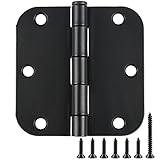
I remember staring at a pile of replacement parts for my old Ford F-150, feeling like I was drowning in a sea of metal. Among the fenders and brake pads, there was a box of shiny, new door hinges. It got me thinking, in the grand scheme of a vehicle, what are these things, really? It’s a question that might seem odd at first glance, but understanding the fundamental role of components, even seemingly simple ones, is key to truly grasping how a machine works. So, let’s get down to it: are hinges classified as wheels?
What Exactly Is a Hinge, Anyway?
When you hear ‘hinge,’ you probably picture the things on doors, right? Open a car door, and there it is, a joint that lets it swing open and shut.
Simple enough. But let’s break down what it actually does. A hinge is basically a pivot. It connects two solid objects, allowing relative rotation between them, but usually only along a single axis.
Think of it as a mechanical joint. In a car, these joints are important for everything from doors and the hood to the trunk lid and even some tailgate designs. They’re built to withstand constant use, weather, and the stresses of being part of a vehicle that moves.
The materials can range from basic steel to more specialized alloys, often coated to prevent rust and wear. The design can vary too – some are simple pin-and-barrel affairs, while others are more complex, multi-piece assemblies designed for specific load-bearing or movement requirements. My first car, a beat-up Honda Civic, had doors that sagged so badly you had to lift them to close them properly. Replaced the hinges, and bam – like a new car.
Well, almost.
Wheels: The Unsung Heroes of Motion
Now, let’s talk wheels. What are they? Obvious, right? They’re round, they spin, they let the car move.
But their function is far more profound than just spinning. Wheels are the primary interface between the vehicle and the road surface. They convert rotational motion into linear motion, allowing the vehicle to travel. The physics behind it are pretty neat: the wheel rotates, and its outer edge pushes against the ground, propelling the vehicle forward (or backward).
Without wheels, a car is just a very heavy, stationary box. They’re designed to handle immense forces – the weight of the car, the acceleration, braking, and the constant impact from road imperfections.
Tire compounds, wheel construction (alloy, steel), and rim size all play massive roles in how a vehicle performs, handles, and feels. I once spent a small fortune on some fancy lightweight alloy wheels for a project bike.
The difference in acceleration and how the bike felt cornering was night and day. It wasn’t just aesthetics; it was pure performance because those wheels were lighter and better balanced. (See Also: A Box Without Hinges Key )
The Core Difference: Function and Classification
So, where do hinges and wheels diverge? It all comes down to their fundamental purpose. Wheels are designed for locomotion. They are the mechanism that enables a vehicle to move from point A to point B.
They are a prime mover, the point of contact that generates forward or backward momentum. Hinges, on the other hand, are designed for access and articulation. They help movement, yes, but it’s a controlled, limited movement – opening and closing.
They don’t contribute to the vehicle’s ability to travel down the road. Think about it: if you removed all the wheels from a car, it wouldn’t move.
If you removed all the hinges, you’d have a very hard time getting into or out of the car, or accessing the engine bay or trunk, but the car itself could still roll (assuming it was on jacks, of course).
This distinction is why, from a mechanical and engineering standpoint, hinges are never classified as wheels. They belong to entirely different functional categories within a vehicle’s design. Wheels are part of the drivetrain and suspension system, directly impacting mobility. Hinges are part of the body and chassis, relating to access and structural integrity.
| Component | Primary Function | Classification | Opinion/Verdict |
|---|---|---|---|
| Wheels | Locomotion, enabling movement | Drivetrain/Suspension Component | Absolutely vital. The heart of motion. |
| Hinges | Access, controlled articulation | Body/Chassis Component | Necessary for usability, but not for driving. |
Common Misconceptions and Why They’re Wrong
The main reason someone might even ask if hinges are classified as wheels is probably a loose interpretation of ‘moving parts’. Both components move.
Hinges move to allow doors to open, and wheels move to allow the car to travel. This is where the comparison breaks down.
It’s like asking if your elbow is a wheel because it bends. Your elbow is a joint that allows your arm to move; a wheel is the component that allows the entire vehicle to move.
Everyone says hinges are just parts of the car’s body, and while that’s true, it’s the reason that matters. They are not ‘wheels’ because their movement doesn’t contribute to the vehicle’s primary function of transportation. I’ve seen people try to jury-rig things with hinges in ways that were supposed to allow some sort of rotational movement for a makeshift trailer, but even then, the hinge itself wasn’t the ‘wheel’; it was just helping the attachment of something that would act like a wheel. It’s a category error.
Another point of confusion might be the idea of a ‘rolling’ part. Wheels definitely roll. Hinges don’t roll; they pivot. (See Also: Are Integrated Washing Machine Door Hinges Standard )
The motion is fundamentally different. One is continuous rotation along an axis to cover distance, and the other is a more limited, controlled swing. Thinking about weight distribution and load bearing also highlights the difference.
Wheels bear the entire weight of the vehicle and transmit driving and braking forces. Hinges support the weight of a door or hood, but their structural role is vastly different and less demanding in terms of dynamic forces.
Trying to use a hinge where a wheel is needed would be catastrophic, and vice versa. You wouldn’t attach a wheel to your car door to make it swing open, and you wouldn’t try to drive your car on door hinges.
Practical Examples: When Movement Isn’t Locomotion
Let’s look at some real-world applications. Take the hood of your car. It’s attached by hinges, usually at the back.
When you open it, the hood swings upwards. It’s a controlled movement, allowing access to the engine.
Those hinges aren’t classified as wheels because they don’t make the car move down the road. Similarly, the trunk lid operates on hinges.
It opens to let you put stuff in the back, but it doesn’t contribute to the car’s ability to drive. Even more complex moving parts, like the steering wheel itself, are not wheels in the vehicular sense. The steering wheel is a control input device.
The wheels it controls are at the end of the axles. The steering column might have universal joints, but those aren’t wheels either; they allow the angle of rotation to change. The only parts designed for and classified as wheels are the ones that enable the vehicle to roll and travel.
Consider a simple toolbox. It has a lid that opens with hinges. Does anyone call those hinges wheels? Of course not.
They allow you to access your tools. The same principle applies to vehicles. The door hinges, the hood hinges, the trunk hinges – they all serve the same basic purpose: to allow access by enabling controlled movement of a panel or door. (See Also: Are Hinges Wheeels )
They are structural components that help access, not components that enable locomotion. It’s important to get these classifications right, especially when you’re diagnosing issues or planning repairs. Understanding the role of each part prevents costly mistakes and makes sure you’re looking for the right solutions.
For example, if your car door is sticking, you’re looking at hinge maintenance or replacement, not wheel alignment.
The Verdict: No, Hinges Are Not Wheels
To put it bluntly, hinges are not wheels. They are fundamentally different components with distinct purposes. Wheels are for motion; hinges are for access and articulation.
This isn’t a trick question or a matter of semantics; it’s a clear engineering and mechanical distinction. I’ve seen mechanics argue about the slightest detail, but this one is straightforward. The common advice is that hinges are part of the body structure, and wheels are part of the drivetrain and suspension. I agree with that.
My own experience, tinkering with everything from old motorcycles to modern SUVs, has only reinforced this. If a component’s primary role is to enable the vehicle to travel along a surface, it’s a wheel (or part of the wheel system). If its role is to allow something to swing open or closed, it’s a hinge.
People Also Ask:
What Is the Function of a Car Hinge?
The primary function of a car hinge is to connect two separate parts of the vehicle’s body, such as a door to the frame or a hood to the chassis, allowing them to open and close smoothly and securely. They provide a pivot point that helps controlled movement, enabling access to the interior, engine bay, or trunk, while also making sure these panels remain firmly in place when closed.
Are Door Hinges Considered Mechanical Parts?
Yes, door hinges are absolutely considered mechanical parts. They are engineered components designed to perform a specific mechanical function: to provide a pivoting connection that allows for rotational movement. They are subject to wear and tear and often require lubrication or adjustment, just like other mechanical elements in a vehicle.
What Is the Difference Between a Hinge and a Joint?
A hinge is a specific type of joint, typically designed to connect two objects and allow only limited, specific rotation between them. A joint, in a broader mechanical sense, can be any connection between two or more parts that allows for relative motion, which can include pivots, sliders, ball-and-socket connections, and more complex articulating systems. So, while all hinges are joints, not all joints are hinges.
How Do Wheels Help a Vehicle Move?
Wheels help a vehicle move by converting rotational motion into linear motion. When the engine (via the drivetrain) causes the wheels to spin, their circumference presses against the ground, creating friction that propels the vehicle forward. The round shape of the wheel minimizes resistance and allows for smooth rolling over distances, making transportation efficient.
Final Verdict
So, to settle this once and for all: no, hinges are not classified as wheels. It’s a fundamental difference in purpose. Wheels are about locomotion, the very act of travel. Hinges are about access, letting you get in, under, or into the trunk. I’ve seen my fair share of automotive parts, and I can tell you, they serve entirely different masters.
Next time you’re working on your car or just observing how it functions, remember this distinction. It’s the kind of basic understanding that separates a casual observer from someone who truly gets how these machines work. Don’t let anyone tell you otherwise; the difference is as clear as black and white, or perhaps, as clear as a spinning wheel versus a swinging door.
If you’re experiencing issues with your car’s doors or hood, focus your attention on the hinges. If your car isn’t moving correctly, then you’re looking at the wheels and their associated systems. It’s that simple.