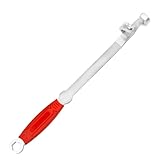
I remember the first time I stared down a lug nut that felt like it was welded on. My trusty 1/2-inch drive torque wrench, the one I thought was the bee’s knees, just laughed at me. I was trying to rebuild a classic truck’s suspension, and the specs called for a truly eye-watering number: 900 ft-lbs. My gut reaction was a hard no. Can you even get that much torque? And if you can, should you?
This isn’t about gentle persuasion; this is about brute force applied with precision. It’s a world away from tightening down your garden-variety lug nuts or even most engine components. We’re talking about applications where failure isn’t just inconvenient; it’s catastrophic.
When 900 Ft-Lbs Isn’t Just a Number, It’s a Necessity
Let’s cut to the chase: can you torque a bolt to 900 ft-lbs? Absolutely. But the real question you should be asking is why you would need to, and what kind of beast you’re dealing with to achieve it. This kind of torque isn’t found on your average sedan or even most farm equipment. We’re talking about heavy-duty industrial machinery, massive construction equipment, specialized off-road vehicles, or perhaps the important fasteners holding together a massive industrial pipeline. Think Caterpillar earthmovers, colossal wind turbine bases, or the main bearing caps on a vintage diesel engine that’s meant to haul the world.
The bolts themselves are usually monstrous. We’re not talking about a standard 10mm or 1/2-inch bolt here. These are often 1-inch diameter or larger, made from high-strength alloys, and designed specifically to handle immense tensile and shear forces. The threads are coarse, deep, and built to take a beating. The mating components are equally solid, often massive castings or forged steel components that look like they could survive a meteor strike. Simply put, a bolt rated for 900 ft-lbs is built to be abused, and the system it’s part of is designed to put it there.
I once had to tackle a job on an old railroad crane. The manual called for a specific torque on the main boom pivot bolt. I recall the number vividly: 850 ft-lbs. I remember looking at the bolt – it was easily 1.5 inches in diameter, a dark, formidable thing. My initial thought was, ‘There’s no way my torque wrench can handle that.’ It turned out I needed a specialized hydraulic torque wrench, the kind that looks more like a piece of industrial plumbing than a hand tool. It was a humbling reminder that some jobs demand tools far beyond the DIY garage.
The applications for such high torque are generally where immense, sustained loads are applied. This could be in the automotive world for things like crankshaft main bolts on heavy-duty diesel engines, or the kingpin bolts on semi-trucks. In construction, it’s about making sure structural integrity under tons of pressure. And in the oil and gas industry, it’s about safely containing high-pressure fluids or securing massive structural components. If you’re not working on something that looks like it belongs in a heavy-duty industrial catalog, you probably don’t need to worry about torquing to 900 ft-lbs.
The Tools of the Trade: Beyond Your Garage Bench
Forget about your standard click-type or beam torque wrenches that you’d use for car wheels. To hit 900 ft-lbs and actually measure it accurately, you need specialized equipment. The most common tools for this kind of torque are hydraulic torque wrenches and, to a lesser extent, high-range mechanical torque multipliers. Pneumatic (air-powered) impact wrenches can certainly deliver massive torque, but they are notoriously imprecise and are generally used for loosening or for rough tightening where exact torque isn’t the primary concern.
Hydraulic torque wrenches are the workhorses for this level of precision. They use a hydraulic pump to pressurize a cylinder, which then drives a torque-generating head. These tools are incredibly accurate, often within +/- 3% or better, and come in various sizes to fit different applications. They can be relatively portable, but they’re still heavy and require a power source (usually an electric or air-powered pump). I’ve used these on large industrial pumps, and the sheer power, controlled by a dial on the pump, is impressive. You can set the exact pressure and watch the gauge climb, knowing you’re applying precisely the force needed.
Torque multipliers are another option, though they often come with a caveat. These are gearboxes that increase the input torque from a standard wrench.
For example, a 1:10 multiplier would turn 100 ft-lbs from your wrench into 1000 ft-lbs at the bolt. The problem is that accuracy is dependent on the accuracy of the input wrench, and the multiplier itself can have some inherent slop or friction that affects the final reading. They are generally less precise than hydraulic systems but can be a more cost-effective solution for occasional high-torque needs, provided you understand their limitations. I once tried a multiplier on a stubborn anchor bolt and ended up over-tightening it because I underestimated the mechanical advantage and the slight play in the gears. (See Also: Do You Need Torque Caliper Bolts )
Lesson learned: know your multiplier’s ratio and its accuracy limits.
Here’s a quick rundown of common high-torque tools and my take:
| Tool Type | Typical Torque Range | Accuracy | My Verdict |
|---|---|---|---|
| Hydraulic Torque Wrench | 200 – 70,000+ ft-lbs | +/- 3% | The gold standard for precision and power. Expensive, but worth it for important applications. |
| Torque Multiplier | Up to 5,000+ ft-lbs | +/- 5-10% (depends on input wrench & multiplier) | Good for less important tasks or when budget is a major constraint. Be cautious with accuracy. |
| High-Range Mechanical Wrench | Up to 1,000 ft-lbs | +/- 4% | Less common for 900 ft-lbs, but some heavy-duty models exist. Can be bulky. |
If you need to hit 900 ft-lbs consistently and accurately, a hydraulic system is almost always the way to go. Anything less is often a compromise you don’t want to make when dealing with forces this significant.
The Real-World Application: When Things Go Wrong
So, you’ve got the tool, you’ve got the bolt. Now what? The reality is that applying 900 ft-lbs of torque isn’t just about spinning a wrench. It’s a carefully controlled process where lubrication, bolt stretch, and the condition of the mating surfaces all play a massive role. Overlooking these details is a fast track to disaster.
I learned this the hard way trying to assemble a custom differential housing. The specs were tight, and I was aiming for a specific torque value that, while not 900 ft-lbs, was high enough to matter.
I used a new bolt, but I skipped the recommended anti-seize compound. Big mistake.
The torque reading felt ‘right’ on my wrench, but once the assembly was under load, I heard a sickening crack. One of the bolts had sheared. Turns out, without the proper lubrication, the friction between the bolt threads and the housing was so high that the torque wrench was reading the friction, not the actual clamping force.
The bolt hadn’t stretched enough to create the necessary clamping force, and the housing failed under pressure. It cost me a new housing and a lot of humility.
When you’re talking about 900 ft-lbs, the bolt itself is designed to stretch. This stretch, or tension, is what creates the clamping force that holds everything together. Torque is just a proxy for that tension. Lubrication is absolutely vital because it reduces friction, allowing the bolt to stretch properly and for the torque wrench to give a more accurate reading of the actual tension. Different applications call for different lubricants – some require high-temperature grease, others specific anti-seize compounds, and some might even specify a dry torque. Always, always follow the manufacturer’s recommendations for lubrication. (See Also: Do I Need Special Replacement Bolts For Car Engines )
Another common mistake is uneven tightening. You can’t just go around tightening bolts one by one to the final torque value. You have to do it in stages, working in a star or crisscross pattern. This makes sure that the components are drawn together evenly, preventing warping, distortion, or uneven stress distribution. For 900 ft-lbs, this isn’t just good practice; it’s a necessity. Imagine trying to seat a massive cylinder head by torquing one bolt all the way down before moving to the next. You’d warp the head before you even got close. You work in stages, perhaps to 300 ft-lbs, then 600 ft-lbs, then finally the full 900 ft-lbs, always in the correct pattern.
The condition of the threads is also most important. Any dirt, debris, galling, or damage on the threads will throw off your torque readings and can weaken the bolt. Inspect threads meticulously and clean them if necessary. If a bolt’s threads are damaged, it should be replaced, not hammered or forced.
Common Misconceptions and What Experts Say
There are a lot of myths floating around about high-torque applications. One of the biggest is that any old heavy-duty wrench can handle it, or that an impact wrench is just as good as a calibrated torque wrench. That’s frankly dangerous nonsense.
Everyone says you need to ‘feel’ the torque. While experience helps, when you’re dealing with numbers like 900 ft-lbs, ‘feeling’ is a gamble. Your fingers and arms aren’t calibrated instruments. An impact wrench, while capable of delivering immense rotational force, does so in rapid pulses. It’s great for breaking loose stubborn fasteners or for rapid assembly where precision isn’t key, but it cannot reliably achieve a specific, measured torque value. Trying to ‘dial in’ 900 ft-lbs with an impact wrench is like trying to paint a masterpiece with a fire hose. You might hit the canvas, but you’re not going to get the detail.
I remember a buddy of mine bragging about how he ‘eyeballed’ the torque on his massive lifted truck’s axle bolts. He figured if it felt tight, it was good. A few weeks later, he called me in a panic because his wheel was wobbling precariously. Turns out, he’d under-torqued one side and massively over-torqued the other, leading to uneven stress and component fatigue. It was a costly and potentially dangerous lesson in why specifications exist.
The common advice is to use torque-to-yield (TTY) bolts, where you tighten them to a specific torque and then an additional angle. This is often true for important components like cylinder head bolts or connecting rod bolts. However, when you’re talking about the extreme end of 900 ft-lbs, the bolts are often designed with very specific stretch characteristics that are measured directly by the torque value. The concept of TTY is still relevant, as achieving the correct bolt stretch is the ultimate goal. Many high-torque applications will specify a torque value and an angle, or rely on torque alone if the bolt material and design are sufficiently predictable.
According to many fastener engineering resources, the relationship between torque and bolt tension isn’t a perfect 1:1, especially with varying friction. However, for standard, well-maintained fasteners and proper lubrication, torque is the most practical and widely accepted method for achieving controlled clamping force. It’s a compromise, but a highly effective one when done correctly. The key is understanding the variability and mitigating it through careful procedures, proper tools, and appropriate lubrication.
People Also Ask:
What Is a Normal Torque Spec for a Bolt?
Normal torque specs can vary wildly depending on the bolt size, grade, and the application. For small, low-strength bolts (like those you might find on electronics or small machinery), you might be looking at just a few inch-pounds or a couple of foot-pounds. For common automotive applications like lug nuts, you might see figures ranging from 80 to 150 ft-lbs. For structural or heavy-duty applications, these numbers climb significantly, but 900 ft-lbs is definitely on the extreme high end.
What Is the Highest Torque Wrench You Can Buy?
The highest torque wrenches available are typically hydraulic systems designed for massive industrial applications. These can go well into the tens of thousands, even hundreds of thousands, of foot-pounds. For more common, albeit still heavy-duty, industrial uses, you’ll find tools capable of exceeding 10,000 or 20,000 ft-lbs. The consumer market rarely, if ever, sees tools designed for these extreme levels. (See Also: Can You Use A Torque Wrench To Break Bolts Loose )
What Happens If You Over-Torque a Bolt?
Over-torquing a bolt can have several serious consequences. It can strip the threads in either the bolt or the mating component, making it impossible to secure properly. It can also stretch the bolt beyond its elastic limit, permanently weakening it and making it prone to failure. In extreme cases, it can even shear the bolt head off or crack the component it’s fastening. This leads to loss of clamping force, potential leaks, and structural failure.
Practical Tips for High-Torque Fastening
If you find yourself in a situation where you need to apply 900 ft-lbs of torque, here are a few things I’ve learned that might save you some headaches. First, always double-check your torque specifications. Make sure you’re reading the correct spec for your exact bolt size, grade, and application from a reliable source, like the manufacturer’s service manual or engineering documentation. Don’t guess.
Second, invest in the right tools. If you’re going to be doing this kind of work regularly, a quality hydraulic torque wrench system is a must. Renting is an option for a one-off job, but quality tools are expensive for a reason. Make sure your tool is calibrated. Torque wrenches, especially high-range ones, need periodic calibration to maintain their accuracy. Check the manufacturer’s recommended calibration interval. I had a wrench that was off by nearly 100 ft-lbs because it hadn’t been calibrated in years. That’s not a small margin of error when you’re dealing with forces this large.
Third, understand the role of lubrication. As I mentioned, it’s not just about making it easier to turn. It’s about achieving the correct bolt stretch and clamping force. Use the lubricant specified by the manufacturer. If none is specified, use a high-quality anti-seize compound suitable for the materials and operating temperature. Apply it evenly to the threads and under the bolt head (if applicable). Don’t go crazy with it, but make sure good coverage.
Fourth, follow a methodical tightening sequence. For any important fastener, especially those requiring high torque, tightening in stages and in a pattern is a must. Start at a lower torque value (e.g., 30-40% of the final value), then go to an intermediate value (e.g., 70-80%), and finally to the full torque. Always work in a crisscross or star pattern to make sure even pressure distribution. This prevents distortion and makes sure the components seat properly.
Finally, inspect everything before and after. Check the bolt threads for damage or debris. Inspect the mating surfaces for flatness and cleanliness. After torquing, give the assembly a visual inspection. Look for any signs of stress, deformation, or leaks. If something looks or feels off, stop and investigate. It’s better to be safe and spend a little extra time than to deal with a catastrophic failure down the road.
Final Thoughts
So, can you torque a bolt to 900 ft-lbs? Yes, but it’s not a casual undertaking. It demands specialized tools, meticulous attention to detail, and a deep understanding of the forces involved. It’s a world that requires precision engineering and execution, far removed from the average DIY repair.
If you’re contemplating a job that requires this kind of torque, take a step back and assess your resources. Do you have access to the right hydraulic torque wrench? Are you absolutely certain about the specifications and the procedure? If the answer to any of these is shaky, it might be time to call in the professionals.
For most of us, 900 ft-lbs is a number you’ll likely only encounter in heavy industry or specialized racing applications. But if your work demands it, knowing the nuances can mean the difference between a perfectly secured component and a very expensive, very dangerous failure.