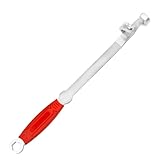
I remember the first time I really torqued down a important fastener. It was on a motorcycle engine rebuild, and the manual said ’35 foot-pounds’. I’d used a wrench before, sure, but just ‘snugging things up.’ This felt different. I cranked that wrench, heard a distinct click, and felt a weird sense of accomplishment. Then I wondered, was that little click just the wrench, or did something else happen? A question that nagged at me, and probably at you too, is: do bolts stretch when torqued?
It’s a simple question, but the answer has massive implications for anything you build, fix, or rely on. Forget the corporate jargon; let’s talk about what’s actually going on in that metal when you apply force.
The Tiny Stretch That Holds Everything Together
So, do bolts stretch when torqued? Hell yes, they do. It’s not some dramatic elongation where the bolt suddenly looks like a piece of taffy, but it’s a real, measurable deformation. Think of it like stretching a rubber band – apply enough force, and it gets longer. A bolt is no different, just made of much stiffer stuff. When you apply torque, you’re twisting the bolt. This twisting action, combined with the clamping force pushing the surfaces together, creates tension along the bolt’s length. This tension is what pulls the threads into the mating material, creating the clamping force that holds your parts together.
This stretching is called ‘bolt elongation’ or ‘preload.’ It’s not a flaw; it’s the entire point of torquing a bolt. The goal isn’t just to make it tight; it’s to stretch the bolt just enough to create a specific amount of clamping force. Too little stretch, and it might vibrate loose. Too much, and you risk permanently deforming the bolt, stripping threads, or even snapping it clean off. It’s a delicate dance between force and material properties.
I learned this the hard way, trying to assemble a custom bike frame. I relied on feel, thinking ‘tight’ was good enough. The rear derailleur hanger kept loosening, and I couldn’t figure out why. Turns out, I wasn’t getting anywhere near the required preload. Once I finally caved and bought a decent torque wrench, the problem vanished. It felt like magic, but it was just physics and a properly stretched bolt.
The amount of stretch is tiny, often measured in thousandths of an inch (or hundredths of a millimeter). For most common automotive or mechanical applications, a bolt might stretch anywhere from 0.002 to 0.015 inches. This seems insignificant, but it’s this controlled stretch that creates the massive holding power. Without it, your engine parts would rattle apart, your wheels would fly off, and your entire project would be a very expensive, very dangerous paperweight.
What’s Actually Happening Inside the Bolt
When you apply torque, you’re basically winding up the bolt like a spring. Imagine a coil spring. If you twist it, it gets shorter. If you pull on its ends, it gets longer. A bolt does both simultaneously when you torque it. The twisting motion (torsion) is what you feel as resistance when you turn the wrench. The pulling motion (tension) is the bolt trying to stretch along its axis.
The key is that the bolt material has a certain elasticity. Within its elastic limit, the bolt will deform under load and return to its original shape when the load is removed. That’s the sweet spot we’re aiming for with torquing. If you go beyond the elastic limit, you enter the plastic deformation zone. The bolt will permanently stretch and will never return to its original length. This is bad news because it weakens the bolt and changes its properties. It might hold for a while, but it’s a ticking time bomb. And if you go even further, you reach the ultimate tensile strength, and the bolt snaps.
The material of the bolt plays a huge role. High-strength alloy steels can withstand more stress and stretch more before yielding than softer materials. The thread pitch and the length of the bolt also influence how much it stretches for a given torque value. A finer thread pitch will generally result in less stretch for the same torque because the helix angle is shallower. Longer bolts will also stretch more than shorter ones of the same diameter for the same applied torque, simply because there’s more material to deform. (See Also: Do You Need Torque Caliper Bolts )
My first real understanding of this came when I was working with some aerospace-grade titanium bolts. They felt incredibly strong, but the specs were important. One instruction was to use an angle gauge after reaching the torque spec. This was to account for the stretch. I remember thinking, ‘An angle gauge? For a bolt?’ It turned out that the bolt itself acted as a spring, and by measuring its twist (angle), they could precisely determine the elongation and therefore the clamping force. It blew my mind how sensitive this all was.
Common Mistakes and Why They’re Dumb
The biggest mistake I see people make is relying on ‘feel.’ I hear it all the time: “Oh, I just tighten it until it feels right.” That’s a recipe for disaster. What feels ‘right’ to you might be way too loose or dangerously overtight. Your strength, grip, and the tool you’re using all vary. A 1/4-inch drive ratchet feels different than a 1/2-inch drive breaker bar, even if you’re applying the same force relative to the tool’s use. This inconsistency is where failures happen.
Another classic blunder is not cleaning the threads. Dirt, rust, paint, or thread locker residue can all act like a lubricant or, conversely, create high spots.
This throws off the friction in the threads, which is a massive component of what your torque wrench is measuring. The torque value accounts for a certain amount of friction between the bolt threads and the nut or tapped hole.
If that friction is different, the actual clamping force you achieve will be wildly off, even if your torque wrench clicks at the right number. I once spent hours chasing a persistent oil leak on a transmission housing because I didn’t thoroughly clean the bolt threads. They had some old sealant on them, and I wasn’t getting enough clamp force.
Once I cleaned them and re-torqued, the leak stopped.
People also forget about the clamping surfaces. If the surfaces you’re trying to press together aren’t flat or clean, you won’t get even pressure. This can lead to leaks, vibrations, and stress concentrations on the bolts. Always make sure mating surfaces are clean, smooth, and free from debris. Another common mistake is reusing old fasteners, especially stretch bolts (often found in modern engines). These are designed to be used once. Reusing them can lead to them not stretching correctly, or worse, failing prematurely.
Here’s a quick rundown of what not to do: (See Also: Do I Need Special Replacement Bolts For Car Engines )
| Mistake | Why It’s a Problem | Verdict |
|---|---|---|
| Tightening by feel | Inconsistent, leads to over/under-tightening. | Absolute No-No |
| Dirty threads/surfaces | Alters friction, affects clamping force. | Major Issue |
| Reusing stretch bolts | Designed for single use; failure risk. | Dangerous |
| Using the wrong lube/threadlocker | Changes friction characteristics unpredictably. | Risky |
| Incorrect torque wrench calibration | Tool reads incorrectly, leading to errors. | Important Flaw |
Real-World Applications: Where It Actually Matters
You might be thinking, “Okay, but does this matter for my bike rack or my garden gate?” For most non-important items, probably not. But for anything that carries significant load, operates under vibration, or is part of a safety system, it absolutely matters. Think about your car. Every major component – the engine, transmission, suspension, wheels – relies on precisely torqued fasteners. The head bolts on an engine are a prime example. They create the seal between the cylinder head and the engine block, holding in combustion pressures and coolant. They are often torqued in stages and with an angle measurement to achieve the exact stretch needed.
Wheels are another big one. Lug nuts are torqued to specific values. If they’re too loose, the wheel can wobble and eventually detach. If they’re too tight, you can warp the brake rotors or strip the studs. For something as simple as attaching a tow hitch, following the torque specs is a must. A tow hitch failure can be catastrophic.
In construction, structural bolts are torqued to very precise specifications. These aren’t just random bolts holding things together; they’re engineered to withstand immense forces. The ability of a structure to resist wind, seismic activity, or heavy loads depends entirely on the integrity of these connections, which is achieved through correct bolt tension and elongation.
Even in your home, there are places where it matters. If you’re assembling furniture that uses bolts, especially larger pieces or those that experience stress (like a desk under load or a bed frame), using a torque wrench can prevent squeaks and make sure stability. For anything involving plumbing or gas lines, using the correct torque on fittings is key for preventing leaks, which can be dangerous or costly.
The core principle is this: if the failure of a fastener could lead to damage, injury, or a loss of function, then understanding and achieving the correct bolt stretch through proper torquing is most important.
How to Get It Right (without Going Crazy)
The most important tool you need is a quality torque wrench. Don’t cheap out here. A cheap wrench might be wildly inaccurate, especially at the lower end of its range. For most home mechanics, a click-type torque wrench covering the range of 20-150 ft-lbs will handle a lot of jobs. If you’re doing more specialized work, you might need a beam-type wrench (more affordable but less precise for setting) or a digital torque wrench (very accurate but pricier). Make sure to get one that’s calibrated, or have it calibrated periodically. Most torque wrenches are designed to be stored with the spring released (set to the lowest setting) to maintain accuracy.
Always read the manual or service guide for the specific torque value and any special procedures. Some bolts require a multi-stage torque sequence, meaning you tighten them incrementally. Others require an additional angle tightening after reaching the torque spec. This is often indicated by a degree symbol and a number (e.g., 90°). You’ll need an angle gauge for this, which is a separate, inexpensive tool that attaches to your ratchet.
When torquing, apply force smoothly and steadily. Don’t jerk the wrench. For click-type wrenches, stop immediately when you feel the click. Don’t try to get ‘one more click’ in. For digital wrenches, stop when it beeps or displays the set torque. If you’re unsure about thread lubrication, check the manual. Some applications require a specific lubricant (like engine oil or anti-seize), while others require dry threads. Using the wrong lubricant can significantly alter the clamping force for a given torque value. (See Also: Can You Use A Torque Wrench To Break Bolts Loose )
Here’s a simplified process for most standard torquing jobs:
- Identify the fastener and the required torque value. This is usually in foot-pounds (ft-lbs) or Newton-meters (Nm).
- Select the correct socket and extension (if needed).
- Set your torque wrench to the specified value.
- If required, apply the specified lubricant to the bolt threads and/or mating surfaces.
- Thread the fastener in by hand or with a low-torque setting until snug.
- Use the torque wrench to tighten the fastener smoothly and steadily until it clicks (or beeps).
- For multi-stage torquing, repeat steps 5 and 6 in the specified sequence and at each torque value.
- For angle torquing, after reaching the specified torque, attach an angle gauge and rotate the fastener the specified additional degrees.
People Also Ask:
What Happens If You Overtighten a Bolt?
Overtightening a bolt can cause several problems. It can strip the threads in the bolt or the mating material, making the connection weak or impossible to properly tighten. It can also permanently deform the bolt, weakening it and making it prone to failure under stress. In extreme cases, overtightening can snap the bolt head off or even crack the parts being clamped together. This often leads to costly repairs and potential safety hazards.
What Happens If You Undertighten a Bolt?
Undertightening means the bolt hasn’t stretched enough to provide adequate clamping force. This can lead to vibrations loosening the fastener over time, potentially causing parts to separate. This is incredibly dangerous for important components like wheels or engine parts. It can also lead to leaks in fluid or gas systems because the seal isn’t tight enough.
How Do I Know If a Bolt Is Stretched?
You usually don’t ‘see’ a stretched bolt in the common sense unless it’s been severely overtightened. The stretching we’re talking about is microscopic and is what creates the clamping force. If a bolt has been stretched beyond its elastic limit, it’s permanently deformed and weakened. You might notice it feels looser after being torqued, or it might be visibly distorted if the deformation is severe. Modern engines often use ‘stretch bolts’ which are specifically designed to be used once to achieve a precise clamping load through controlled elongation; these are often identified by their appearance or in service manuals and should never be reused.
What Is the Correct Torque for a Bolt?
There isn’t one single ‘correct’ torque for a bolt; it depends entirely on the bolt’s size, material grade, thread pitch, and the application. The manufacturer of the equipment or component will specify the exact torque value in their service manual or on the product documentation. Always refer to the official specifications for the job you are doing, as using the wrong torque can lead to failure.
Verdict
So, the answer to ‘do bolts stretch when torqued’ is a definitive yes. It’s not just a mechanical quirk; it’s the fundamental principle that allows fasteners to do their job and hold things together reliably. Understanding this elongation is key to avoiding the frustration and potential dangers of improperly fastened components.
Don’t guess. Invest in a decent torque wrench, follow the specs, and pay attention to the details like thread cleanliness and lubrication. It might seem like extra work, but for anything important, it’s the difference between something that lasts and something that falls apart.
Next time you’re reaching for that wrench, remember you’re not just tightening something; you’re precisely controlling the stretch that holds your world together.