
Look, I’ve been there. You crack open an old iPhone to replace a battery or a cracked screen, armed with what you thought was the right screwdriver kit, only to find a tiny, alien-looking screw staring back at you. And then another, slightly different one. Suddenly, what should have been a quick fix turns into a frustrating scavenger hunt for the exact right bit. Figuring out how to differentiate iPhone screws isn’t just about avoiding stripped heads; it’s about saving yourself hours of pure aggravation and potential damage.
I’ve personally cursed Apple’s proprietary screw designs more times than I care to admit, often after buying a kit that promised universal compatibility but delivered… well, close enough for most things, but not for my precious iPhone.
This is the stuff they don’t tell you in the YouTube videos, the nitty-gritty that separates a successful repair from a trip to the nearest repair shop (or worse, a bricked phone).
Why Apple’s Screws Are a Headache (and How to Tell Them Apart)
Let’s get one thing straight: Apple isn’t just being difficult for the sake of it with their screws. Well, maybe a little. But the primary reason they use such varied and often tiny screw types is for space-saving and security. In a device as thin as an iPhone, every millimeter counts. Different screw heads allow them to pack components closer together and prevent casual tinkering. The downside for us? It means you can’t just grab any old set of precision screwdrivers and expect to win. You need to know what you’re looking at.
The most common culprits you’ll encounter are Pentalobe screws and Tri-point (or Y-type) screws. These are the ones that make you say, “What the heck is that?” Pentalobe screws are easily identifiable by their five-pointed star shape. They’re typically found on the exterior of iPhones, often holding the screen assembly to the main body. Apple started using these back with the iPhone 4, and they’ve been a staple ever since. The sizes vary, too – P2 for older models, P6 for newer ones. Get the wrong Pentalobe bit, and you’ll just spin your wheels, potentially damaging the screw head and making it impossible to remove later.
Then there are the Tri-point screws. These look like a three-pronged Phillips head, almost like a tiny trident. They are far more common on the inside of the iPhone, securing components like the battery, logic board connectors, and speakers. Apple introduced these starting with the iPhone 7.
The key thing to remember with Tri-point screws is that while they have three points, they are NOT the same as a standard Phillips screw. Using a Phillips driver, even a small one, on a Tri-point screw will likely strip the delicate head. The tips are also typically much shorter and more precise than Phillips heads. Again, size matters – you’ll see variations like Y000, Y00, and Y1.
The Y000 is incredibly common for internal iPhone components.
Beyond these two main offenders, you’ll occasionally run into traditional Phillips head screws, especially on older models or for specific internal brackets. However, even these are usually very small, often in the PH000 or PH00 range. The trick is that Apple uses multiple screw types even within the same device. A single iPhone motherboard might have Pentalobe, Tri-point, and Phillips screws all within a few inches of each other. This is where the frustration really kicks in. You might remove one component with a Y000 bit, and then the next screw holding a bracket for the display cable requires a P2 bit. It’s a maddeningly precise system.
When I first started doing my own repairs, I bought a cheap kit that had a bunch of bits, and I assumed I was covered. I got the Pentalobe screws out on my iPhone 6S fine.
But when I got to the internal connectors on my daughter’s iPhone 8, I ran into those Y-shaped things. My generic kit didn’t have the right Tri-point bits. I tried to force a tiny Phillips, and sure enough, I rounded out a screw head.
That’s when I learned the hard way: for iPhone repairs, you need specialized bits, and you need to know which is which. It’s not just about having a screwdriver; it’s about having the right screwdriver for that specific screw head and size. My wallet and my patience took a hit that day, and I vowed to be more prepared next time.
One common mistake people make is thinking that ‘precision’ means any small screwdriver set will do. They’ll see a tiny screw and grab the smallest Phillips or flathead they have. This is a recipe for disaster. These screws are made of soft metal and have very shallow engagement points. Applying the wrong type of torque or using a bit that doesn’t seat perfectly will strip the head faster than you can say “expensive mistake.” You’re not just damaging the screw; you’re potentially damaging the port or the component it’s securing.
The Key Players: Pentalobe vs. Tri-Point (and the Rare Phillips)
Let’s break down the main types you’ll be wrestling with when you decide to tackle an iPhone repair. This is where the rubber meets the road, and understanding the visual differences is your first line of defense.
Pentalobe Screws: As mentioned, these are the five-pointed star-shaped screws. They’re Apple’s signature for external security. You’ll find them on the bottom edge of most iPhones, holding the display assembly in place. Think of them as the “outer shell” screws. The size is important here. Apple uses different Pentalobe sizes depending on the iPhone model:
- P2: Used on older models like the iPhone 4, 4S, 5, 5C, 5S, 6, and 6 Plus.
- P6: Used on newer models like the iPhone 6S, 6S Plus, SE (1st gen), 7, 7 Plus, 8, 8 Plus, X, XR, XS, XS Max, 11, 11 Pro, 11 Pro Max, SE (2nd gen), 12 series, 13 series, 14 series, and 15 series.
The P6 is significantly larger than the P2. Trying to use a P2 bit on a P6 screw won’t even engage, and trying to use a P6 bit on a P2 will likely damage both. The bit needs to fit snugly without any wobble. A good Pentalobe bit will look like a tiny, perfectly formed five-pointed star. (See Also: How To Fix Eyeglasses Arm Without Screw )
Tri-point Screws (Y-Type): These are the internal demons. They look like a Phillips head but with three slots instead of four, forming a Y shape. Apple introduced these to get even more security and space efficiency inside the phone. They’re everywhere inside an iPhone, holding down logic board connectors, battery tabs, speaker modules, and more. The sizes here are generally denoted by numbers like Y000, Y00, and Y1. The Y000 is incredibly common and extremely small. These are NOT interchangeable with Phillips screws. A Phillips head driver will chew up a Tri-point screw head in seconds, leaving you with a stripped mess that’s a nightmare to remove.
Phillips Screws: While less common as the primary fastener on modern iPhones, you’ll still find small Phillips head screws, particularly on older models or for specific internal brackets and shields. These are your standard cross-shaped screws, but in incredibly tiny sizes, often PH000 or PH00. The key here is that even though it’s a Phillips, you need a very precise bit that fits perfectly into the cross. A slightly loose Phillips bit is just as bad as the wrong screw type.
The Color Code Lie: One thing I’ve seen online is the idea that screws are color-coded. This is largely a myth, or at least a very unreliable indicator. Some repair kits might have colored handles on the bits, but the screws themselves? Not really. Some aftermarket parts might use colored screws, but original Apple screws are generally metallic. Relying on color is a shortcut that will get you into trouble. Stick to identifying the head type and size.
My first real ‘aha!’ moment came when I was trying to replace the battery on an iPhone 8. The external screws were Pentalobe, no problem. But inside, everything was Tri-point.
I had a basic set with what I thought were tiny Phillips bits, but they were just slightly too rounded. I ended up ordering a specific Tri-point Y000 bit.
When it arrived, it fit perfectly, like a key in a lock. The screw came out smoothly. It was a stark reminder that these aren’t your dad’s electronics; they require specialized tools.
The bit itself is a small piece of metal, but it’s engineered to grip a specific shape. It’s amazing how much frustration a tiny, precisely shaped piece of steel can save you.
Tools of the Trade: What You Actually Need
Forget those generic “precision screwdriver” kits you see at the checkout counter. They’re designed for toys and eyeglasses, not the intricate world of Apple devices. To properly differentiate and work with iPhone screws, you need a dedicated toolkit. I’ve tried a few over the years, and here’s what I’ve found makes a real difference:
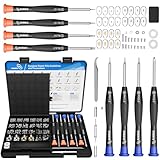
A Quality Multi-Bit Screwdriver Set: This is your foundation. Look for a set that explicitly states it includes Pentalobe (P2, P5, P6), Tri-point (Y000, Y00, Y1), and small Phillips (PH000, PH00). The bits should be made of good quality steel (like S2 steel) that won’t easily strip or deform. The handle should have a comfortable grip and, ideally, a swivel top so you can easily apply downward pressure while turning.
Magnetic Tips: This is a a must for me. When you’re dealing with screws that are smaller than a grain of rice, the last thing you want is for them to ping off your screwdriver and disappear into the abyss of your carpet. A magnetic tip holds the screw securely to the bit, making it much easier to place it back in its hole or carry it over from where you just removed it. It’s a small feature, but it saves countless dropped screws.
A Screw Organizer (Highly Recommended): This is where things get really practical, especially if you’re doing a complex repair or working on multiple devices. I initially just put screws in little piles on my desk, which was a disaster. I ended up mixing them up, or worse, losing them. Investing in a small magnetic project mat with labeled sections, or even a small compartmentalized organizer box, is a lifesaver. When you remove a screw, immediately place it in its designated spot corresponding to its location in the phone. This is how you avoid putting a long screw into a short hole, which can puncture the logic board or battery – a catastrophic mistake.
Tweezers: You’ll need fine-tipped tweezers for handling small screws, especially if they’re not magnetized, or for picking up and placing components. Ceramic-tipped tweezers are great if you’re worried about static discharge, though for most common repairs, good quality stainless steel ones are fine.
A Magnifying Glass or Magnifier Lamp: For older eyes (or just to be absolutely sure), being able to see the details of the screw head and the screw hole is invaluable. A good magnifying lamp can keep your workspace well-lit and magnified.
Here’s a quick comparison of what to look for in a decent kit:**
| Screw Type | Common iPhone Use | What to Look For in a Bit | My Verdict |
|---|---|---|---|
| Pentalobe (P) | External, screen assembly | 5-pointed star, snug fit, specific sizes (P2, P6) | Key. Get the right size for your model! |
| Tri-point (Y) | Internal components, connectors | 3-pronged Y shape, precise fit, very small sizes (Y000, Y00) | Absolutely a must for internal work. |
| Phillips (PH) | Internal brackets, older models | Cross shape, perfect fit, tiny sizes (PH000, PH00) | Still needed, but must be exact size and shape. |
I remember a time when I was halfway through replacing my wife’s iPhone 11 screen. I had Pentalobe bits, Tri-point bits, and Phillips bits. I got the screen off, but then I encountered this tiny, almost microscopic Phillips screw holding a bracket for the front-facing camera. It was so small, my standard PH00 bit felt like a bulldozer. I dug out an older kit and found a genuine PH000 bit. It fit perfectly, and the screw came out. The lesson? Even within the Phillips category, size and precision are most important. Don’t skimp on the quality of the bits themselves. (See Also: How Measure Metric Computer Screws )
Common Mistakes and How to Avoid Them
You’ve got the right tools, you’ve identified the screw type, but you still manage to mess it up. How? This is where experience (and a few painful lessons) comes in. Let’s talk about the classic blunders and how to sidestep them.
1. Using the Wrong Bit Size/Type: We’ve hammered this home, but it bears repeating. A Pentalobe bit that’s too small won’t grip. A Pentalobe bit that’s too big will strip the head. A Phillips bit in a Tri-point screw? Instant disaster. Always double-check your bit against the screw head. It should look like a perfect match, with no gaps or play. If it feels loose, stop. Get the right bit. It’s far cheaper to buy a new bit than to replace a stripped screw or damaged component.
2. Applying Too Much Force (or Not Enough): This is a delicate dance. You need enough downward pressure to seat the bit firmly into the screw head, preventing it from camming out and stripping. But if you press too hard, you risk damaging the surrounding component or the screw itself. Conversely, if you don’t apply enough pressure, the bit will spin freely in the screw head. The key is a steady, firm downward force combined with a slow, controlled turning motion. Think of it like turning a stubborn jar lid – steady pressure, not brute force.
3. Mixing Up Screws: This is probably the most common internal repair mistake. iPhones use screws of different lengths. A screw that looks identical to another but is just a millimeter longer can cause catastrophic damage if inserted into the wrong hole.
It can puncture the logic board, the battery, or damage an internal flex cable. This is why a magnetic mat or a labeled organizer is so important.
As soon as a screw comes out, put it where it belongs. I learned this the hard way trying to fix my friend’s iPhone 6. I got cocky, thought I remembered where each screw went, and ended up putting a slightly longer screw into a spot near the camera. It didn’t immediately kill the phone, but the flash stopped working.
Took me ages to figure out which screw was the culprit. Lesson learned: meticulous organization saves lives (of phones).
4. Over-tightening: Just because you managed to get a screw in doesn’t mean it needs to be cranked down. These are tiny screws in delicate housings. Over-tightening can strip the threads in the housing, crack plastic components, or even damage the screw head itself, making it impossible to remove later. Tighten until you feel a slight resistance, then give it just a tiny bit more. You should not have to exert significant force to get it to stop turning.
5. Using Damaged Tools: Inspect your screwdriver bits before you start. If a bit is worn, chipped, or the tip is even slightly deformed, throw it away and get a new one. Using a damaged bit is the fastest way to damage a screw head, creating a problem where none existed.
Contrarian Opinion: Everyone says you need a $100+ iFixit Pro Tech Toolkit for a simple iPhone repair. Honestly? For most common repairs like a battery or screen replacement on a single device, that’s overkill. You can get away with a good quality, but significantly cheaper, kit from reputable brands online that includes the key Pentalobe, Tri-point, and Phillips bits. You might not get all the extra spudgers and prying tools, but if your main goal is just screwing and unscrewing, a focused, good-quality bit set will serve you just fine. Save your money for when you really need specialized tools for more complex repairs.
When Precision Matters Most: Internal Components
If you’re just trying to get the screen off your iPhone 4 to replace it, you’re primarily dealing with Pentalobe screws, which are relatively straightforward once you have the right P2 bit. The real challenge, the part where understanding how to differentiate iPhone screws becomes absolutely important, is when you venture inside the device. This is where Apple’s design gets particularly intricate, and where a single wrong move can cost you dearly.
Inside an iPhone, you’ll find a dense arrangement of components, all secured by various tiny screws. The logic board itself is held down by a series of incredibly small Tri-point screws. These screws often have very fine threads and are designed to hold down delicate, sensitive electronics. If you use a Phillips head, even a small one, you’re not going to get proper engagement. The driver will want to slip out of the cross shape and wander into the surrounding area. This can cause:
- Stripped Screw Heads: The most immediate and common problem. Once a Tri-point screw head is stripped, it’s extremely difficult to remove. You might need specialized screw extractors, which are often too large for iPhone screws, or you might have to resort to drilling it out – a risky procedure.
- Damaged Components: The flex cables that connect components like the display, battery, cameras, and sensors are incredibly fragile. If your screwdriver slips because the bit isn’t seated correctly, you can easily tear these cables. Repairing or replacing these can be more expensive and difficult than the original component.
- Punctured Logic Board or Battery: This is the big one. As mentioned before, using screws that are too long for their intended hole can lead to them piercing vital internal components. The logic board is the brain of your phone, and puncturing it is usually a death sentence. The battery, while less prone to immediate catastrophic failure, can be punctured, leading to swelling, fire hazards, or just a dead battery.
The specific types of screws you’ll encounter internally are usually:
- Tri-point (Y000, Y00): These secure many of the primary connectors for the logic board, cameras, Taptic Engine, and speakers. The Y000 is exceptionally tiny and is used for many of the most sensitive connections.
- Phillips (PH000, PH00): You’ll find these for securing small brackets, sometimes over camera modules, or for holding down parts of the logic board itself. Even though it’s a Phillips, the size is important.
- Occasionally, tiny 2.5mm or 3mm hex screws: Though less common in iPhones compared to some Android devices or iPads, some specific internal brackets might use them. However, for standard iPhone repairs, focus on Pentalobe, Tri-point, and Phillips.
A personal anecdote: I was swapping out the charging port on an iPhone 7. This involves disconnecting almost everything on the logic board. I was using a decent kit, but I was rushing.
I used a PH00 bit for a screw that was just slightly too small. It felt a little loose, but I pushed through. (See Also: How To Adjust Eyeglass Screw )
The screw went in okay, but when I went to reassemble, the display connector cable snagged on something. I looked closely and realized that tiny Phillips screw I’d forced in had slightly lifted a small metal shield just enough to impede the seating of the display cable. It took me an extra hour to backtrack, remove that one screw, and reseat everything properly.
That hour was a masterclass in patience and the importance of perfect screw fit.
So, when you’re inside, take your time. Lay out your screws. Use a magnetic mat. And for the love of all that is holy, use the correct Tri-point bit for those Y-shaped screws. It’s not just about making the repair easier; it’s about making it possible without breaking your phone.
Faq: Your iPhone Screw Questions Answered
What Are the Different Types of iPhone Screws?
The most common types of screws you’ll find in iPhones are Pentalobe (P-type), which have a five-pointed star shape and are typically used on the exterior, and Tri-point (Y-type), which look like a three-pronged Y and are used extensively for internal components. You will also encounter very small Phillips head screws, especially on older models or for specific internal brackets.
How Do I Know Which Screwdriver Bit to Use for an iPhone Screw?
You need to visually identify the screw head. Pentalobe screws are easily recognizable by their star shape. Tri-point screws have a distinctive Y shape. Phillips screws have a standard cross shape. It’s important to use the correct type and size of bit that matches the screw head precisely to avoid stripping it. Investing in a specialized iPhone repair toolkit is highly recommended.
Can I Use a Phillips Screwdriver on a Tri-Point Screw?
No, absolutely not. While Tri-point screws may resemble a Phillips head at a glance, they have three slots instead of four. Using a Phillips screwdriver, even a small one, on a Tri-point screw will almost certainly strip the screw head, making it very difficult or impossible to remove without causing further damage.
Why Does My iPhone Have So Many Different Types of Screws?
Apple uses different types and sizes of screws to maximize internal space, secure components effectively, and prevent casual disassembly. The variety allows them to pack more functionality into a thinner device. For users attempting repairs, this means specialized tools are required to differentiate and handle the specific screw types used.
What Happens If I Use the Wrong Size Screw in My iPhone?
Using the wrong size screw, particularly a screw that is too long for its designated hole, can cause significant damage. It can puncture or short-circuit the logic board, damage internal flex cables, or even pierce the battery, posing a safety hazard. Always make sure you are using the exact screw that came from that specific location during reassembly.
The Bottom Line: Patience and the Right Bits Win
Look, I get it. You want to fix your iPhone, save some cash, and feel like a tech wizard. That’s totally achievable. But the journey there is paved with tiny, precisely engineered screws. Understanding how to differentiate iPhone screws isn’t about memorizing obscure codes; it’s about recognizing shapes and sizes. Pentalobe for the outside, Tri-point for the inside. And for both, the fit has to be perfect. I’ve wasted more money on cheap, ill-fitting screwdriver sets than I care to admit, only to end up frustrated, with stripped screw heads and a phone I couldn’t fix.
The real takeaway here is preparation and respect for the engineering. Apple makes these phones incredibly complex and compact. You can’t just brute-force your way through a repair. You need the right tools, specifically the right bits that match those Pentalobe and Tri-point heads. And you need to be organized. I can’t stress that enough. Mixing up screws is a death sentence for your phone. A magnetic mat or a simple labeled organizer will save you from costly mistakes. It adds maybe five minutes to your process but saves you potentially hours of debugging and hundreds of dollars in replacement parts.
So, before you even pick up a pry tool, make sure you have a good quality set of precision screwdrivers that includes those key Pentalobe and Tri-point bits. Pay attention to the tiny details. Take your time. It’s the only way to successfully differentiate iPhone screws and complete your repair without turning your expensive device into a very pretty paperweight. It’s a small investment that pays off big in frustration saved and successful repairs.
Verdict
So, there you have it. Differentiating iPhone screws boils down to recognizing the Pentalobe star on the outside and the Tri-point Y on the inside, and always, always using the exact correct size and type of bit. It’s not rocket science, but it requires a bit of attention to detail and the right tools.
Don’t be like me and waste money on generic kits that promise the world but deliver frustration. Invest in a decent set of specialized bits. Your future self, wrestling with a stubborn screw at 11 PM, will thank you profusely.
The next time you have to open up an iPhone, remember this. Take your time, be organized, and use the right bit. It’s the simplest way to avoid a headache and successfully navigate how to differentiate iPhone screws.
![AXTH 25-in-1 Small Precision Screwdriver Set, Professional Magnetic Mini Repair Tool Kit for Phone, Computer, Watch, Laptop, Macbook, Ring Doorbell, Eyeglass, Electronic, [Bearing Steel] Screw Driver](https://m.media-amazon.com/images/I/518YlLmPTcL._SL160_.jpg)
