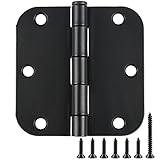
I remember staring at a sagging 6-foot wooden gate, a project I’d promised myself I’d fix last summer. It was leaning so hard it looked like it was about to confess its deepest secrets to the neighbor’s prize-winning petunias. The question that plagued me was whether the three measly 60lb hinges I’d bought on sale were actually going to cut it. Spoiler alert: sometimes, you get what you pay for, and sometimes, you need to learn the hard way.
So, are 3 60lb hinges sufficient for a 6 ft gate? It’s a question that has more variables than a high school algebra exam, and frankly, a lot of the online advice feels like it was written by someone who’s only ever seen a gate in a catalog. Let’s cut through the BS.
Weight Calculations: More Than Just Guesswork
Look, when you’re talking about hinges for a gate, especially a 6-foot behemoth that’s going to face wind, rain, and the occasional enthusiastic dog trying to greet visitors, weight is king. But it’s not just about the static weight of the gate itself. You’ve got to factor in dynamic loads. Think about it: when the wind catches that big wooden surface, it’s like a sail. That’s a whole lot of extra force pushing and pulling on those hinges.
A 6-foot gate, depending on its construction – whether it’s solid wood, a simple frame with pickets, or something heavier like cedar or redwood – can easily tip the scales at 100-150 pounds, sometimes even more. If you’re using a denser hardwood, or if it’s a double gate where you have two of these swinging, that number climbs fast.
Now, a single hinge rated at 60 pounds might seem okay for a third of that weight, right? That’s 20 pounds per hinge. Too simple.
That calculation assumes the weight is perfectly distributed and there are no external forces. That’s rarely the case in the real world. A common mistake is just looking at the gate’s dead weight and dividing by the number of hinges.
You’re basically setting yourself up for sag, struggle, and eventual failure if you do that.
When I first tackled my gate, I did exactly that. I had a roughly 120lb gate, three hinges, so 40lb per hinge capacity.
Seemed fine. But then a good gust of wind would hit, and the whole thing would groan and wobble. The wood around the hinge mounting points started to splinter.
That’s your first sign that the hinges are undersized and the gate is putting too much stress on the posts and the hardware. The goal is for the hinges to bear the load comfortably, not to be fighting it every second of the day.
You want a buffer. A good rule of thumb is to aim for hinge capacity that’s at least double the estimated weight of the gate, or more if you’re in a windy area.
So, for a 120lb gate, you’d ideally be looking at hinges that can handle at least 240lbs total, spread across all the hinges. This means each individual hinge should have a substantial rating, or you need more hinges.
The posts are also a huge factor. Even the strongest hinges won’t do much good if they’re attached to wobbly posts. The posts need to be substantial – usually 4x4s or larger, set deep in concrete. If your posts are weak, the hinges will just rip out. I’ve seen it happen. People invest in nice gates and hardware, only to have the whole setup fail because the foundation (the posts) was an afterthought. It’s like building a fancy house on sand. So, before you even think about hinge ratings, make sure your gate posts are solid and can take the strain. It’s a package deal, really.
Types of Hinges and What They Mean for Your Gate
So, you’ve got your gate weight figured out, and you’re starting to realize those 60lb hinges might be a bit light. Now, what kind of hinges are we even talking about? There are a bunch of them out there, and they’re not all created equal. The most common ones you’ll see for garden gates are strap hinges, T-hinges, and barrel hinges. For a 6-foot gate, you’re likely looking at strap hinges or T-hinges because they offer better support and spread the load more effectively than a simple butt hinge.
Strap hinges are long and thin, wrapping around the gate post. They provide a good amount of surface area for mounting and can distribute weight well.
T-hinges are a bit more traditional-looking, with a flat plate that mounts to the gate and a strap that goes around the post. Both are generally designed for heavier gates than your standard interior door hinges. Now, when a manufacturer rates a hinge at, say, 60lbs, what does that really mean? Usually, it’s a maximum load rating under ideal conditions, assuming perfect installation and no lateral forces. (See Also: A Box Without Hinges Key )
This is where the real-world application gets tricky. A 60lb rating on a T-hinge might feel substantial, but if it’s a cheap, thin metal casting, it might bend or break under stress much sooner than you’d expect.
I made the mistake of buying T-hinges once that looked beefy but felt a bit light when I held them. They were rated for 75lbs each. I figured three of them would be plenty for my 120lb gate. Big mistake.
They sagged within a month. The metal itself was too thin, and the pivot point wasn’t solid enough. The actual load-bearing capacity in real-world conditions, with wind and the gate swinging, was probably closer to 40lbs per hinge, if that.
It’s a classic case of marketing versus reality. You need to consider the material – forged steel is usually much stronger than cast iron or thin stamped steel.
You also want to look at the thickness of the metal and the quality of the pivot mechanism. A smooth, solid pivot is a good sign; a sloppy, loose one is a red flag.
Barrel hinges are another option, often seen on larger, more industrial gates. They’re usually more expensive but can be incredibly strong and allow for a very clean look. For a typical 6-foot wooden garden gate, though, strap or T-hinges are generally the go-to. When you’re shopping, pay attention to the specific type of hinge.
A 60lb-rated strap hinge might perform very differently from a 60lb-rated T-hinge due to the way the load is distributed. Strap hinges, with their longer contact points, can often handle lateral forces better, which is a big deal with a 6-foot gate exposed to the elements. I once saw a gate with simple butt hinges, rated higher than my T-hinges, fail spectacularly because they couldn’t handle the sideways push from the wind.
The hinges themselves were fine, but the way they were mounted and the forces applied just overwhelmed them. That’s why understanding how the hinge works and how it’s mounted is just as important as its weight rating.
Common Mistakes and How to Avoid Them
Alright, let’s talk about the screw-ups. Because I’ve made them, and I’ve seen others make them, and it’s usually the same old song and dance.
The biggest mistake, as we’ve touched on, is underestimating the weight and the forces involved. People see a 6-foot gate, they think it’s just a few planks of wood, and slap on some hinges that look about right. They don’t account for the wind, the moisture that makes wood swell, or the sheer use a tall gate has.
This leads to sag, which then leads to the gate dragging on the ground, making it harder to open and close, which puts even more stress on the hinges and posts. It’s a vicious cycle, and it all starts with insufficient hardware.
Another huge mistake is the installation itself. You can have the best hinges in the world, but if you don’t install them properly, they’re useless. This means using the right fasteners. For wooden posts and gates, you want lag screws or bolts, not just wood screws.
Lag screws have a thicker shank and a coarser thread, providing much greater holding power. For a 6-foot gate, especially if it’s heavy, you’re looking at at least 1/4-inch or 5/16-inch diameter lag screws, and they need to be long enough to go deep into the post – at least 2 to 3 inches of penetration into the solid wood of the post. And you need enough of them.
Don’t skimp. A hinge typically comes with mounting holes; use all of them.
Space them out to distribute the load. (See Also: Are Integrated Washing Machine Door Hinges Standard )
I remember a buddy of mine installing a new gate. He used some short, thin screws that came with the hinges. Looked okay at first.
Within two weeks, the gate was hanging crooked. Turns out, the screws had pulled out of the softer wood of the gate frame.
He had to go back, drill out the holes, use larger lag screws, and reinforce the gate frame itself. It was a painful lesson for him. Also, make sure the gate is plumb and level when you’re attaching the hinges. If you hang a gate that’s already crooked, the hinges will be under constant, uneven stress from day one.
Use a level, check your measurements, and get the gate in the right position before you mark and drill for the hinges.
The third big pitfall is not considering the type of gate and post connection. For a 6-foot gate, the hinges on the gate leaf (the part attached to the gate) need to be mounted securely to the gate’s structural members, usually the vertical stiles or a solid frame.
Don’t just screw them into a thin horizontal picket. Similarly, on the post side, you want the hinge strap to wrap around or attach to a solid part of the post. If you’re using a sleeve or a decorative cap on your post, you need to make sure the hinge is still anchored to the main structural post underneath.
I once saw a gate where the hinge was bolted to a decorative wooden cap, which then sat loosely on the post. The first strong wind took the gate and the cap right off. It’s the little details, the things that seem obvious when you’re building a house, but get overlooked in a weekend DIY project, that can cause major headaches.
Real-World Scenarios: My Gate Saga
Okay, so let’s get personal. My own backyard gate project was a perfect storm of underestimation and overconfidence. I had this beautiful, 6-foot tall, roughly 5-foot wide wooden gate I built myself from sturdy pine. Solid frame, decent spacing of planks. I weighed it after it was built, and it was a solid 140 pounds. That felt heavy, but I figured, hey, it’s a gate, it’s supposed to be solid. I went to the hardware store and grabbed three T-hinges. The packaging said ‘Heavy Duty,’ and they looked pretty substantial, rated at 75lbs each. Three of them would give me a theoretical capacity of 225lbs. Plenty, right?
Wrong. So very wrong. I mounted them carefully, used decent lag screws (about 2 inches long, 1/4 inch diameter), and the gate hung beautifully for about two weeks. Then, the summer storms started rolling in. We get some serious wind here. That gate, being a solid panel, acted like a giant kite. I’d hear it creaking and groaning with every gust. Sure enough, by the end of the first month, the bottom corner of the gate was noticeably lower than the top. The hinges were starting to bend inwards, and the lag screws were pulling out of the pine frame. The gate was sagged so bad it was digging into the grass.
My solution? I bought three more hinges, bringing the total to six. I also upgraded the screws to 3-inch, 5/16-inch lag screws. This definitely helped distribute the load better, and the longer screws bit much deeper into the frame. The sagging stopped, but the gate still felt a bit wobbly in strong winds. It was a band-aid, not a fix. The real problem was the hinges themselves. Even at 75lbs each, under that kind of constant stress, they were just not solid enough for a 140lb gate in a windy environment. The metal was too thin, the pivot point wasn’t tight. They simply weren’t designed for that kind of sustained, dynamic load.
Eventually, I bit the bullet and bought some seriously heavy-duty, forged steel strap hinges. These things were beasts.
Rated at 150lbs each. I only used three of them, two on the bottom and one on the top, because they were so substantial.
Mounted them with 1/2-inch galvanized bolts going all the way through the gate stiles and the post. That gate now swings like a dream.
It feels solid, stable, and even in the worst winds, it barely budges. The lesson learned: don’t skimp on the hinges, especially for a gate of this size.
Those ‘heavy duty’ 75lb hinges were a waste of money and a major headache. For my 140lb gate, six 75lb hinges (total 450lb capacity) still weren’t enough for reliable long-term performance. Three 150lb hinges (total 450lb capacity) was the ticket. It’s not just about the total weight rating, but the quality and design of each individual hinge and how it’s anchored. (See Also: Are Hinges Wheeels )
What to Look for When Buying Hinges
So, you’ve decided that maybe those 60lb hinges aren’t the best bet for your 6-foot gate. What should you be looking for instead? First off, forget the 60lb rating unless you’ve got a feather-light gate made of hollow plastic. For a wooden 6-foot gate, you should be aiming for hinges that are rated significantly higher, and you need to consider the total load capacity across all hinges.
I’d say for a standard, solid wood 6-foot gate weighing around 100-150 lbs, you should be looking at hinges with a minimum rating of 100lbs each, and ideally more. If you’re using three hinges, that means a total capacity of 300lbs, giving you a much-needed buffer. If you’re in a windy area or have a particularly heavy gate (think solid hardwood or metal infill), you might even want to go for 150lb or 200lb rated hinges. It sounds like overkill, but trust me, it’s not.
Beyond the weight rating, pay attention to the material and construction. Look for forged steel or heavy-duty cast iron. Avoid anything that feels too light, looks cheaply made, or has a lot of flex in the metal. The pivot point should be smooth and tight, not sloppy. Check the thickness of the metal plates and straps. Thicker is generally better. For a 6-foot gate, strap hinges or heavy-duty T-hinges are usually the best bet because they provide good support and spread the load across a wider area of the gate and post.
Consider the finish too. If the gate is exposed to the elements, you’ll want galvanized, powder-coated, or stainless steel hinges to prevent rust. Rust not only looks bad but can seize up the hinge and weaken it over time. My first set of cheap hinges started rusting within months, making them stiff and noisy. It’s worth spending a little extra for a good finish that will last.
Finally, look at the mounting hardware recommendations. Good hinges will come with suggestions for the type and size of screws or bolts to use. If they don’t, assume you’ll need lag screws or through-bolts and plan accordingly. Don’t just grab whatever random screws you have lying around. The hardware store is your friend here. Talk to someone in the gate hardware section. Tell them the size and approximate weight of your gate, and ask for their recommendations. It’s better to ask and get it right the first time than to have to redo the job later.
| Hinge Type/Rating | Typical Gate Weight Range (6ft) | Opinion/Verdict |
|---|---|---|
| 3 x 60lb Hinges | Up to 70 lbs | Avoid for 6ft gates. Likely to sag quickly and fail under wind load. Only suitable for very light, small gates. |
| 3 x 100lb Hinges | 70 – 120 lbs | Bare minimum, maybe. Requires very sturdy gate construction and posts. Best in low-wind areas. Still a risk for longevity. |
| 3 x 150lb Hinges | 120 – 180 lbs | Good starting point. Provides a solid buffer for most standard 6ft wooden gates. Look for forged steel. |
| 4 x 150lb Hinges | 180 – 250 lbs | Excellent for heavy gates. Offers solid support, ideal for solid wood, hardwood, or gates in windy conditions. |
| Heavy-Duty Specialty Hinges (e.g., barrel) | 250+ lbs | Overkill for most wooden gates, but necessary for very large, heavy, or metal gates. Expensive but incredibly durable. |
How Many Hinges Do You Really Need?
The standard advice you’ll see everywhere is three hinges for a gate. And for a lot of smaller, lighter gates, that’s perfectly fine. But for a 6-foot gate? That’s where things get a bit more nuanced, and frankly, the default ‘three hinges’ rule often falls short. The decision on the number of hinges isn’t just about following a general guideline; it’s about load distribution and stability. A 6-foot gate has significant use. If you’re only using three hinges, the top hinge takes a lot of the strain, especially when the gate is open and the wind catches it. This can lead to that dreaded sag we’ve talked about, where the bottom of the gate starts to droop.
For most standard 6-foot wooden gates, I’ve found that three high-quality, heavy-duty hinges (think 150lb+ rating each) are usually sufficient, provided your gate posts are strong and well-set. However, if your gate is on the heavier side (over 150lbs), if it’s made of dense hardwood, or if you live in an area with frequent strong winds, you should seriously consider using four hinges. Distributing the weight and stress across four mounting points, especially on a tall gate, makes a huge difference in stability and longevity. The extra hinge at the bottom or the top can significantly reduce the bending moment on the middle hinge and the overall strain on the gate structure and posts.
When I upgraded my gate, I initially stuck with three hinges, but I opted for the super-heavy-duty ones. It worked, but I still felt a slight wobble in really strong winds. If I were doing it again, knowing what I know now, and if the gate was over 150lbs, I’d absolutely go for four heavy-duty hinges. It’s like adding an extra support beam to a bridge. The cost difference for one extra hinge and a few extra screws is minimal compared to the potential headache and cost of repairing a sagging or broken gate.
Some people even go for five hinges on very wide or heavy gates, particularly double gates. For a single 6-foot gate, however, four hinges are generally the maximum you’d need, and often overkill if you’ve selected three sufficiently solid ones. The key is to match the number of hinges to the weight and expected forces, and then double-down on the quality and rating of each hinge. Don’t just add more cheap hinges to compensate for poor quality; that’s a recipe for disaster.
It’s better to have fewer, but significantly stronger and better-made, hinges. Think fewer, but better. The goal is a gate that swings smoothly, closes securely, and stands tall against the elements, not one that complains every time you open it.
Are 60lb Hinges Strong Enough for a 6 Ft Gate?
Generally, no. While three 60lb hinges theoretically offer 180lbs of support, this rating is often for ideal conditions. A 6ft wooden gate can easily weigh 100-150lbs and is subject to wind forces that significantly increase the load. These hinges are likely to cause sagging and potential failure over time. It’s advisable to opt for hinges with a much higher individual rating, such as 100lb-150lb each.
What Is the Weight Limit for a 6 Ft Gate Hinge?
The weight limit for a 6ft gate hinge depends entirely on the specific hinge’s rating. However, for a standard 6ft wooden gate, you should be looking for hinges rated at least 100-150lbs each. For heavier gates or windy areas, 200lb+ rated hinges might be necessary. Always check the manufacturer’s specifications, but remember to factor in real-world stresses beyond just static weight.
How Do I Prevent My 6 Ft Gate From Sagging?
Preventing sag involves using heavy-duty hinges with a sufficient weight rating (at least 100-150lbs each), making sure they are properly installed with solid fasteners like lag screws or bolts, and using enough hinges (three to four for a 6ft gate). Make sure your gate posts are sturdy and well-anchored. Regularly checking and tightening hardware can also help. If the gate is already sagging, reinforcing the mounting points or adding an extra hinge might be necessary.
What Kind of Hinges Are Best for a Heavy 6 Ft Gate?
For heavy 6ft gates, strap hinges or heavy-duty T-hinges made from forged steel or solid cast iron are typically best. Look for individual hinge ratings of 150lbs or higher. Using four hinges instead of three can also significantly improve support and distribute the load more effectively. Stainless steel or galvanized finishes are recommended for durability and rust resistance.
Conclusion
So, to circle back to the burning question: are 3 60lb hinges sufficient for a 6 ft gate? My honest, lived-in answer is a resounding no, for most practical applications. You’re setting yourself up for disappointment, sag, and extra work down the line. Think of it like this: you wouldn’t put tiny tires on a monster truck, right? The same principle applies to gate hardware.
My own gate saga taught me that the weight rating on the package is just a starting point, and often, a generous one. You need to consider the actual weight of your gate, the forces of nature (hello, wind!), and the quality of the hinge itself. Investing in heavier-duty hinges, ideally rated at 100lbs to 150lbs each, and making sure you have at least three of them, is the smart play. If your gate is particularly heavy or in a windy spot, don’t shy away from four hinges.
The bottom line is that for a 6-foot gate, cheaping out on hinges is a false economy. It’s a small part of the overall gate project, but it’s one of the most important. Spend a little more upfront on good hardware, and you’ll save yourself a lot of frustration, and probably money, in the long run. Next time you’re building or fixing a gate, just remember to go for overkill on the hinges; it’s the most sensible kind of overkill.