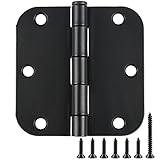
I was staring at a brand-new, ridiculously expensive cabinet door. It swung open smoothly, almost silently. And I thought, is this thing basically a wheel? It felt like a silly question, but then I started thinking about how we define things. For years, I’ve been tinkering with stuff, building things, and frankly, wasting money on products that didn’t deliver. This whole debate about whether hinges are considered wheels got me thinking about function over form, and what really matters when you’re trying to get something to move.
Let’s cut to the chase: are hinges considered wheels? My gut says no, but the physics of motion, and some common sense, make it a lot more interesting than a simple yes or no. I’ve seen plenty of ‘experts’ get this stuff wrong, so let’s get real about how these mechanical components work and what makes them different, or maybe surprisingly similar.
What’s the Actual Difference? Movement vs. Rotation
Alright, let’s get down to brass tacks. When we talk about hinges and wheels, we’re both talking about things that allow movement, right?
But that’s where the similarities pretty much end. A wheel’s primary job is to help rolling motion. Think about a car tire, a skateboard wheel, or even a potter’s wheel. They spin on an axle.
The whole point is to reduce friction by allowing a surface to roll over another surface, rather than sliding. This rolling action is key. It’s about continuous, often significant, displacement.
My first bike had these clunky metal wheels that, even with a bit of rust, let me coast downhill for what felt like ages. That’s pure rolling.
The reduction in friction is what makes them so efficient for covering distance.
Hinges, on the other hand, are designed for rotational movement around a fixed axis. That’s the core distinction.
A door hinge, for instance, lets a door swing open and closed. It pivots. The axis is the pin, and the two leaves of the hinge rotate relative to each other, but the entire unit doesn’t typically travel across a surface like a wheel does.
My garage door opener, which I swear I’ve had to jiggle more times than I care to admit, uses hinges to allow the segmented panels to fold and unfold. There’s rotation, yes, but the door itself isn’t rolling anywhere. The movement is constrained to an arc.
It’s about allowing access or closure, not about efficient locomotion across a distance. So, while both involve motion, the type and purpose of that motion are fundamentally different. One aims for efficient transport; the other, for controlled articulation.
People sometimes get confused because both mechanisms often involve metal parts and are engineered for smooth operation. You might oil a squeaky hinge just like you might lubricate a wheel bearing. Both require some level of maintenance to function optimally. But the underlying principle of movement is distinct. A wheel wants to keep going in a straight line (or curve, if steered) with minimal effort once it’s rolling. A hinge wants to stay attached to two objects while allowing them to change their relative angular position. It’s the difference between a sled and a merry-go-round. Both spin, but their primary function and how they achieve motion are worlds apart.
When You Think About Function: Doors vs. Vehicles
Let’s be blunt: the context in which you find these mechanical components tells you everything. You don’t see wheels on your cabinet doors (unless it’s some fancy hidden sliding system, which is a different beast), and you don’t see hinges on the bottom of a car to make it turn. (See Also: A Box Without Hinges Key )
The function dictates the form. Hinges are all about connecting two rigid bodies and allowing them to pivot relative to each other. Think of a book’s spine, the lid of a piano, or even the cover of your laptop. These are all applications where controlled, limited angular movement is needed.
The hinge provides that connection and that pivot point. It’s a joint, basically. A very well-engineered, durable joint, but a joint nonetheless.
Wheels, however, are all about overcoming friction for locomotion. They are designed to reduce the force required to move a load. Imagine trying to push a heavy refrigerator across your kitchen floor versus putting it on a dolly. The dolly’s wheels make all the difference. Their design—a circular shape, a central point of rotation—is optimized for rolling. This allows for continuous displacement across a surface. My first apartment had these ancient wooden floors, and moving furniture without something with wheels was a Herculean effort. The wheels on that dolly I bought for $30 were a lifesaver. They weren’t just about letting something move; they were about letting it move easily and efficiently over a distance.
So, when we ask, ‘are hinges considered wheels?’, the answer really hinges (pun intended) on what we mean by ‘wheel’. If a wheel is anything that allows movement, then maybe there’s a blurry line. But in practical, mechanical terms, a wheel’s defining characteristic is its ability to roll and help transportation. A hinge’s defining characteristic is its ability to create a pivot point for articulation. They are engineered for fundamentally different tasks. One is about getting from A to B smoothly; the other is about letting A and B change their angle relative to each other without coming apart.
My Own Stumble: The Sliding Door Debacle
I learned this lesson the hard way a few years back when I was building a custom entertainment center. I wanted this sleek, modern look with sliding cabinet doors.
Sounds simple, right? I figured, ‘How different can it be from a regular door? Just needs to slide.’ So, I went and bought what I thought were heavy-duty hinges.
The salesman was a bit cagey, but I figured he was just trying to upsell me. I got them installed, and man, what a disaster.
The doors didn’t slide; they sort of juddered and scraped. It looked like a drunk robot was trying to open my TV cabinet.
I spent a solid afternoon wrestling with them, adjusting screws, lubricating them, even adding extra support. Nothing worked.
Turns out, the ‘hinges’ I bought were actually part of a sliding door hardware kit – they were more like tracks and rollers. The rolling components were definitely wheel-like, but they were integrated into a system designed for sliding, not swinging. They weren’t designed to be independent pivoting mechanisms like a traditional hinge. My mistake was thinking of ‘movement’ as a single concept.
I was so focused on getting the door to move that I didn’t stop to consider how it was supposed to move and what hardware was designed for that specific type of motion. The salesman tried to explain it, but I was too proud to listen. That mistake cost me about $150 in hardware and a full weekend of pure frustration.
This whole experience hammered home that the terminology and the specific engineering matter. You don’t use a wheelbarrow’s wheel as a hinge, and you certainly don’t use a door hinge to try and make a car move. Each has a specialized role. My DIY project taught me a valuable lesson: understand the mechanism of movement you need before you start buying parts. Are you aiming for smooth rolling over distance, or controlled pivoting in place? The answer to that question determines whether you’re looking at wheels or hinges. It’s not just semantics; it’s about the physics and the engineering. (See Also: Are Integrated Washing Machine Door Hinges Standard )
The Science of Motion: Friction and Force
Let’s get a little nerdy for a second, because understanding the physics is where the real clarity comes in. A wheel’s genius lies in its ability to drastically reduce sliding friction.
When two surfaces slide against each other, the force required to keep them moving is relatively high. This is called kinetic friction. A wheel, however, converts this into rolling resistance, which is significantly lower, especially on smooth surfaces. When a wheel rolls, it’s constantly lifting itself slightly off the surface and then coming back down.
The contact point is always changing. Think of the microscopic bumps and valleys on both surfaces. With sliding, these imperfections grind against each other.
With rolling, the wheel rolls over them with much less resistance.
For example, I remember trying to drag a heavy toolbox across a gravel driveway once. It was a nightmare. Every pebble was an obstacle. Then I put it on a small cart with wheels, and it was like night and day. The wheels just spun over the gravel, overcoming the resistance with far less effort. This is the fundamental advantage of a wheel for transportation. It’s all about minimizing the energy loss due to friction, allowing for sustained motion with applied force.
A hinge, conversely, is designed to manage rotational friction. When a hinge pin rotates within its barrel, there’s friction. But this friction is typically much lower than the force required to overcome the inertia and sliding friction of a large, un-wheeled object.
The goal of a hinge isn’t to help continuous, long-distance travel; it’s to allow precise, controlled angular displacement. The forces involved are usually about overcoming the weight of the object being hinged and the air resistance, not the massive sliding friction of moving a large object across a surface. The design of a hinge emphasizes durability and smooth pivoting, not the reduction of friction for efficient locomotion.
So, while both involve friction, the type of friction and the engineering objective to manage it are completely different. Hinges manage rotational friction for articulation; wheels manage sliding friction for transport.
Contrarian View: When a Hinge seems Like a Wheel
Now, here’s where I’ll stick my neck out a bit, because common sense can be a bit too simplistic sometimes. Everyone says hinges aren’t wheels, and they’re mostly right. But what if you have a very specific type of hinge, used in a very specific way, that functions like a wheel? I’m thinking about things like zero-radius hinges or certain types of specialized robotic joints. These can achieve near-continuous rotation or very large degrees of angular movement, and in some very niche applications, they might be used in a context where the result is similar to a wheel helping movement.
For instance, imagine a robotic arm. It has multiple joints, and some of these joints allow for a very wide range of motion, close to 360 degrees. If that arm is designed to move a payload from one point to another, and one of its ‘joints’ is the primary component enabling that horizontal or vertical translation by rotating through a huge arc, could you argue it’s acting like a wheel in that specific context? It’s not a traditional wheel, certainly. It doesn’t roll on an axle in the same way. But its function in that moment is to enable a large-scale positional change, which is what wheels are for.
This is where the ‘strict definition’ breaks down. If we define a wheel purely by its circular shape and rolling motion, then hinges are never wheels. But if we consider the functional outcome – enabling easy movement or displacement – then in very specific, perhaps unconventional, engineering scenarios, a component that is technically a hinge might be employed in a way that mimics the purpose of a wheel.
My dad, a retired engineer, always used to say, ‘It’s not what it is, it’s what it does.’ And in rare cases, a highly specialized hinge might be doing something wheel-like. I wouldn’t call a standard door hinge a wheel, not by a long shot. (See Also: Are Hinges Wheeels )
But engineering is full of grey areas and clever workarounds where a component’s function can blur its strict classification. It’s the exception that proves the rule, and the rule is: hinges are not wheels, but context can get weird.
Practical Tips: Choosing the Right Hardware
Look, the question of ‘are hinges considered wheels’ is mostly academic for everyday folks. What you really need to know is how to pick the right hardware for your project, whether it’s a door, a box, or something more complex. The biggest mistake I see people make, and yes, I’ve made it myself, is buying hardware based on looks or a vague idea of ‘strength’ rather than understanding the actual load and motion required.
Here’s a quick cheat sheet:
| Component | Primary Function | Typical Application | My Verdict |
|---|---|---|---|
| Traditional Hinge (Butt, Ball Bearing) | Pivoting, controlled rotation around a fixed axis | Doors, lids, gates, cabinets | Definitely NOT a wheel. Key for articulation. |
| Wheel (Solid, Pneumatic, Caster) | Rolling motion for transportation, reducing friction | Vehicles, dollies, furniture, machinery | The quintessential movement facilitator. No question. |
| Sliding Door Hardware (Track & Roller) | Linear motion along a track, using rollers (wheel-like) | Wardrobes, pocket doors, barn doors | Uses wheels, but the system isn’t a ‘wheel’ itself. It’s a sliding mechanism. |
| Specialized Robotic Joint (e.g., Harmonic Drive) | Precise, high-torque rotational movement over large angles | Robotics, industrial automation | Functions like a joint, but can achieve massive rotation. Not a wheel, but its role can be to move something like one. Grey area. |
When you’re choosing, always ask yourself: Am I trying to make something swing or rotate in place (hinge territory), or am I trying to make something move easily from one spot to another (wheel territory)? For doors, think about weight and swing arc. A heavy exterior door needs sturdy, often ball-bearing hinges.
A small jewelry box lid might only need a simple butt hinge. For moving things, consider the surface you’ll be moving on and the weight. Casters are great for furniture on smooth floors, while pneumatic tires are better for rougher terrain.
Don’t be afraid to look at manufacturer specs or even ask a knowledgeable salesperson. I used to just grab whatever looked strong, but spending an extra ten minutes researching saved me hours of headaches and money on botched projects. It’s about understanding the mechanics, not just the appearance.
What Is the Main Difference Between a Hinge and a Wheel?
The main difference lies in their primary function and the type of motion they help. A wheel is designed for rolling motion to enable transportation and reduce friction for covering distance. A hinge is designed for pivoting motion, allowing two objects to rotate relative to each other around a fixed axis, typically for opening and closing or controlled articulation. While both involve mechanical movement, their engineering purpose is distinct.
Can a Hinge Be Considered a Type of Wheel in Some Contexts?
Strictly speaking, no. However, in highly specialized engineering applications, such as certain robotic joints that allow for extremely large degrees of rotation (near 360 degrees), a component that is technically a hinge might be employed in a way that functionally mimics some aspects of a wheel’s role in enabling displacement. This is an exception, not the rule, and depends heavily on the specific context and definition of ‘wheel’.
How Does Friction Differ Between Hinges and Wheels?
Wheels are engineered to minimize sliding friction by converting it into rolling resistance, which is significantly lower. This allows for efficient movement over distances. Hinges, on the other hand, manage rotational friction at the pivot point. While this friction is generally low and allows for smooth articulation, it’s not optimized for the kind of continuous, low-effort locomotion that wheels provide. The objective for hinges is controlled rotation, not distance travel.
What Are the Practical Implications of Confusing Hinges and Wheels?
Confusing hinges and wheels in a practical application, like DIY projects, can lead to significant problems. Using hinges where wheels are needed will result in difficulty moving an object, excessive force required, and potential damage to the item or the surface. Conversely, trying to use wheels as hinges would likely result in instability, lack of controlled pivot, and failure of the mechanism. It means the wrong hardware is used for the intended motion, leading to poor performance or complete failure.
Verdict
So, are hinges considered wheels? In any standard, practical sense, the answer is a resounding no. They are engineered for fundamentally different tasks: hinges for pivoting, wheels for rolling. My own cabinet door fiasco, though frustrating, taught me that understanding the specific mechanism of movement is key. Don’t just think ‘it needs to move’; think ‘how does it need to move?’
The nuance comes in when we talk about specialized engineering, where the lines can blur a little in function, but the core design principles remain distinct. For your everyday projects, though, stick to the basics: if it swings, it’s probably a hinge. If it rolls to get you from here to there, it’s a wheel.
Next time you’re building something, take that extra five minutes to really look at the hardware. It’ll save you time, money, and a whole lot of head-scratching. And remember, sometimes the simplest question has the most interesting answer when you dig a little deeper into what makes things work.