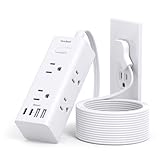
You know that feeling? You’ve got a brand-new gadget, a fancy gaming PC, or maybe just a ridiculously large TV, and you realize you’re about three outlets short. So, what’s the first thing most people grab? That power strip that also happens to have a long cord. But then the nagging question pops up: are surge protector extension cords safe? I’ve been down this road, plugging in everything from ancient VCRs to my current streaming rig, and let me tell you, it’s not as simple as just plugging it in and forgetting about it.
I’ve seen more than a few sketchy setups, and frankly, I’ve made some boneheaded mistakes myself. The reality is, while they promise protection, they can also be a fire hazard if you’re not careful. So, let’s cut through the marketing fluff and talk about what you really need to know.
What’s Actually Inside That Plastic Box?
Look, most of us just see a power strip with a cord and a bunch of sockets. We plug things in, and if nothing sparks or smokes, we assume it’s fine. But here’s the deal: a true surge protector extension cord isn’t just a glorified splitter. It’s designed to absorb or divert sudden, powerful spikes in voltage that can fry your electronics. Think lightning strikes nearby, or even the power grid doing its own thing during a brownout.
The magic happens with components like Metal Oxide Varistors (MOVs). When the voltage goes too high, these MOVs act like a pressure relief valve, shunting the excess juice away from your precious devices and into the ground wire.
It’s a clever bit of engineering, but it’s not infinite. Every time an MOV absorbs a surge, it degrades a little.
Eventually, it wears out. And once it’s toast, you’re just left with a regular, unprotected extension cord, but with the false sense of security that you’re still protected.
I learned this the hard way after a minor storm fried my old sound system, even though it was plugged into a surge protector. Turns out, the MOV was long gone from previous, smaller surges I hadn’t even noticed.
The joule rating is the big number you’ll see advertised. Higher is generally better, indicating how much energy it can absorb before giving up the ghost. For basic stuff, 600-1000 joules might suffice. For your expensive home theater or gaming PC, you’re looking at 2000-3000 joules or more. Don’t be fooled by insanely high numbers that sound too good to be true; they often are, or they’re achieved with less durable designs. Another key spec is the clamping voltage – this is the voltage level at which the surge protector actually starts doing its thing. A lower clamping voltage means it reacts faster to protect your gear.
Beyond MOVs, some higher-end units might incorporate gas discharge tubes or silicon avalanche diodes for even faster response times or higher energy absorption. But for the average consumer, the MOV-based protectors are what you’ll find everywhere. And remember, these aren’t magic shields. They are consumable items. They do a job, and then they need to be replaced. I’ve got a sticky note system on mine now, marking the date of purchase. When it hits two years, I start looking for a replacement, just to be safe. It feels a bit neurotic, but better safe than sorry when it comes to my tech.
The ‘extension Cord’ Part: Where Things Get Tricky
Here’s where a lot of confusion and danger creeps in. A true surge protector extension cord is a bit of a misnomer for many products you see on shelves. Often, what people are buying is simply a power strip with surge protection features, attached to a cord that looks like an extension cord. The real danger comes when people try to use a standard extension cord with a separate surge protector power strip plugged into it. That’s a recipe for disaster.
Why? Because extension cords themselves aren’t designed for sustained use, and they certainly don’t have the built-in safety features of a proper surge protector. They can overheat, especially if they’re underrated for the load you’re putting on them. If you plug a high-draw appliance, like a space heater or a power-hungry amplifier, into a flimsy extension cord, the cord itself can become the weak link. It might melt, spark, and start a fire long before any surge protection is even relevant. The cord is just a conduit; it doesn’t offer any absorption or diversion of voltage spikes. So, you’re not just adding length; you’re adding a potential point of failure.
The common advice you’ll hear is to avoid using extension cords as permanent wiring. And I agree wholeheartedly. They’re meant for temporary use. Think of it like using a band-aid to fix a broken bone – it’s a quick fix, but it’s not the right solution for the long haul. If you find yourself constantly reaching for an extension cord to power your main entertainment center or your home office setup, you need to address the root cause: a lack of permanent outlets. Get an electrician to install more. It’s a one-time cost that’s far cheaper than replacing fried electronics or, worse, dealing with a house fire. (See Also: Can Extension Cords Short Out )
I once saw a setup where someone had daisy-chained three cheap extension cords together to reach a TV in the far corner of a room. The cords were warm to the touch, and the picture flickered intermittently. It looked like a fire hazard waiting to happen. They were lucky nothing worse occurred.
The key takeaway here is that if your surge protector is the extension cord, it needs to be a heavy-duty, properly rated unit. If it’s a separate power strip plugged into a separate extension cord, you’ve already stepped onto shaky ground. Stick to using surge protectors that have the cord integrated into the unit, and make sure that cord is in good condition and rated for the electrical load.
What to Look for (and What to Ignore)
When you’re out shopping, it’s easy to get overwhelmed. Every box screams ‘PROTECTION!’ and ‘ADVANCED TECHNOLOGY!’. But let’s boil it down to what actually matters. First, the joule rating. As I mentioned, aim for a higher number for sensitive electronics. 2000+ joules is a good starting point for a home office or entertainment system. Don’t waste your money on cheap ones with ratings under 1000 joules if you’re protecting anything valuable.
Second, the number of outlets. Do you need six? Twelve? Make sure it has enough for your current needs and a little wiggle room for that inevitable new gadget. Also, consider the spacing. Some surge protectors cram outlets so close together that you can’t plug in even a standard power brick without blocking two slots. Look for models with wide-spaced outlets, especially if you use a lot of adapters.
Third, indicator lights. Most surge protectors have lights that tell you two things: power is on, and surge protection is active. If the surge protection light goes out, the unit is no longer protecting your devices. This is a vital feature. Some also have an overload indicator light, which is useful but less important than the surge protection indicator.
Now, what to ignore? Overly flashy designs or claims of ‘unlimited protection’. If a surge protector promises to protect against ‘all electrical damage’ or uses buzzwords like ‘nano-crystal frequency alignment,’ run the other way. Stick to reputable brands known for electrical safety. UL certification is a must. This means the product has been tested by Underwriters Laboratories and meets specific safety standards. Don’t buy anything without it. While not a guarantee against all failure, it’s a baseline for safety.
Also, be wary of price. The cheapest option is rarely the best. You can find decent surge protectors for $30-$50, and higher-end ones for $70-$100+. If you’re seeing something that looks like a surge protector for $10, it’s almost certainly just a basic power strip and a marketing gimmick. I once bought a super cheap one because I was in a pinch, and within six months, the surge indicator light died. I replaced it with a mid-range model from a well-known brand, and it’s been chugging along perfectly for years. You get what you pay for, and with surge protection, that old adage is particularly true.
Surge Protector vs. Power Strip
This is a common point of confusion. A power strip is simply an extension cord with multiple outlets. It provides no protection against voltage surges. A surge protector, on the other hand, contains electronic components (like MOVs) designed to absorb or divert excess voltage. All surge protectors are power strips, but not all power strips are surge protectors. Always check the packaging and product description for the joule rating and surge protection indicator.
Common Mistakes That Land You in Trouble
Mistake number one, and I’ve seen this a million times: plugging too much into one strip. Most surge protectors have a maximum amperage rating. If you plug in a space heater (which draws a lot of power), a computer, a monitor, and a lamp all into the same strip, you can overload it. Overloading doesn’t just mean the surge protector might fail; it means the cord itself can overheat, melt, and potentially start a fire. This is why the amperage rating is just as important as the joule rating, and it’s often overlooked. A common mistake is assuming that because it has multiple outlets, it can handle anything you throw at it.
My friend once tried to run his entire workshop setup – a compressor, a welder, and a bench grinder – off a single surge protector strip plugged into one outlet. It was a disaster waiting to happen. The strip got so hot I could feel the heat radiating from it from across the room.
He was lucky he didn’t burn his house down. The compressor alone would have been pushing the limits of a standard strip. When in doubt, check the appliance’s power draw (usually listed in watts or amps on the device itself) and compare it to the surge protector’s rating. (See Also: Can Extension Cords Be Use With Electric Heaters )
If the appliance draws more than 1500 watts, it’s usually best to plug it directly into a wall outlet if possible, or use a heavy-duty extension cord specifically rated for high loads.
Mistake number two: forgetting they wear out. As I mentioned, MOVs degrade with each surge they absorb.
Many surge protectors don’t have a way to tell you when their protection has failed, other than the indicator light going out. If that light is off, you might as well be plugging directly into the wall, but with the added risk of a potentially damaged surge protector itself being a fire hazard. People often leave them plugged in for years, thinking they’re still protected.
A good rule of thumb is to replace them every 2-3 years, or sooner if you live in an area with frequent thunderstorms or power fluctuations. The cost of replacement is peanuts compared to the cost of damaged electronics or a house fire.
Mistake number three: using them for the wrong things. Surge protectors are designed for electronics – computers, TVs, gaming consoles, audio equipment. They are NOT designed for high-power appliances like refrigerators, air conditioners, microwaves, or space heaters. These appliances have motors or heating elements that draw a massive amount of power and can create electrical noise that prematurely wears out the surge protector’s components, or they can simply overload the strip. Always read the manual or the label on your appliance and your surge protector to make sure they’re compatible. Plugging a space heater into a surge protector is a classic blunder that can lead to meltdowns, literally.
Real-World Use: My Setup and What I’ve Learned
I’ve got a pretty mixed bag of electronics at home, from a high-end gaming PC to a collection of vintage synthesizers and a smart home hub that controls everything. My approach now is layered and, frankly, a little paranoid, but it’s born from experience. For my main workstation – the PC, dual monitors, speakers, and various peripherals – I use a heavy-duty surge protector with a high joule rating (around 3000) and plenty of widely spaced outlets. It also has USB ports, which is convenient. I bought this one specifically because I noticed my old setup was getting a bit crowded, and I didn’t want to risk overloading anything. The cord itself feels substantial, not flimsy.
For less important, but still valuable, items like my smart TV and soundbar, I use a slightly less beefy surge protector, maybe in the 2000-2500 joule range. It still has the indicator lights, and I’ve made it a habit to check that surge protection light every few months. If it’s off, the unit is replaced immediately. I learned this lesson after a power surge took out a TV that was plugged into a surge protector whose protection light had long since gone out. It was a $600 lesson I didn’t want to repeat. That’s why I now have a little calendar reminder to check those lights.
For things that are really just basic loads, like a desk lamp or a phone charger that isn’t connected to anything else, I often just use a basic, non-surge-protected power strip. The logic here is that a simple lamp or a charger isn’t going to be sensitive to minor voltage fluctuations in the same way a sensitive circuit board in a PC is. However, I make sure these basic power strips are still UL-listed and of decent quality, not the absolute cheapest thing I can find.
They still need to be safe from overheating or short circuits. I used to have a cheap power strip powering a bunch of LED strip lights behind my TV, and one of the outlets just melted. No surge involved, just poor internal construction. So, even for ‘dumb’ loads, quality matters.
The one thing I absolutely refuse to do anymore is use a regular extension cord as a permanent power solution for anything important. If I need to reach something far away, I’ll buy a purpose-built, heavy-duty extension cord and treat it as a temporary fix, or better yet, get an electrician to install an outlet. The risk just isn’t worth the convenience. My wiring philosophy is simple: protect sensitive electronics with good surge protectors, use basic power strips for low-demand items, and avoid extension cords for anything other than truly temporary needs. This approach has saved me money and headaches.
Here’s a quick look at how I categorize my power needs: (See Also: Are Outdoor Extension Cords 10 Or 12 Gauge )
| Device Type | Recommended Protection | Why | My Verdict |
|---|---|---|---|
| Gaming PC / High-End Workstation | High Joule Surge Protector (2500+ J) | Sensitive components, high cost of replacement | Key. Don’t skimp. |
| TV / Sound System / Game Console | Mid-Range Surge Protector (1500-2500 J) | Valuable electronics, moderate sensitivity | Highly Recommended. |
| Desk Lamp / Phone Charger | Basic Power Strip (UL Listed) | Low demand, low sensitivity to fluctuations | Acceptable, but make sure quality. |
| Space Heater / Microwave / Refrigerator | Direct Wall Outlet / Heavy-Duty Extension Cord (if unavoidable and rated) | High power draw, can overload/damage surge protectors | Never plug into a standard surge protector. |
| General Extension Cord Use | Heavy-Duty, Purpose-Built Extension Cord (Temporary Use) | Not intended for permanent wiring, can overheat | Avoid for permanent solutions. |
Safety First: Practical Tips for Peace of Mind
Beyond buying the right gear, there are simple habits that significantly boost the safety of your surge protector extension cords. First and foremost: inspect your cords regularly. Look for any signs of wear and tear – nicks, cuts, frays, or melted spots on the cord or the plug. If you see any damage, stop using it immediately and replace it. A damaged cord is a major fire risk. I once found a cord on an old power strip that had a small melted section near the plug. It wasn’t sparking, but it was a clear warning sign that the insulation was compromised. I tossed it without a second thought.
Second, don’t overload the outlets on the surge protector. This means avoiding plugging in too many devices, especially high-wattage ones. As a general rule, if you’re plugging in appliances that generate heat (like a toaster or a hair dryer) or have motors (like a fan or a small appliance), it’s often best to plug them directly into the wall or use a heavy-duty extension cord rated for that specific load. Overloading is one of the most common causes of electrical fires, and surge protectors are not immune to this. The rating is there for a reason.
Third, keep them away from moisture and flammable materials. Never place a surge protector or its cord where it could come into contact with water, or near curtains, bedding, or other items that could easily catch fire. Bathrooms, kitchens, and laundry rooms are particularly risky areas due to the presence of water. If you need to use a power strip in a kitchen, make sure it’s rated for that environment and kept well away from the sink or any potential splashes. I always make sure my surge protectors have a bit of breathing room around them, not tucked away behind furniture or stacked with other items.
Fourth, consider replacing them every few years. As mentioned, surge protectors aren’t immortal. Their ability to absorb surges degrades over time. Even if the indicator light is still on, the protection might be diminished. A general recommendation is to replace them every 3 to 5 years, or sooner if you experience frequent power surges or lightning storms. It’s a small investment for continued protection and safety. Think of it like changing the batteries in your smoke detector; it’s preventative maintenance. I’ve got a mental note to replace mine around the 3-year mark, just to be on the safe side. It’s easy to forget, so setting a calendar reminder is a good idea.
Can I Plug a Surge Protector Into an Extension Cord?
No, you generally should not plug a surge protector into an extension cord. This creates a compounding risk. The extension cord itself may not be rated for the load, and if it fails or overheats, it bypasses any protection the surge protector offers. Furthermore, some jurisdictions and electrical codes may prohibit this practice due to the increased fire risk. It’s always best to plug a surge protector directly into a wall outlet.
How Do I Know If My Surge Protector Is Working?
Most surge protectors have indicator lights. Typically, there’s a light that shows the unit is receiving power and another light that indicates the surge protection circuitry is active. If the surge protection indicator light is off or unlit, the unit is no longer providing surge protection and should be replaced immediately. Regularly check these lights to make sure your devices are still being safeguarded.
What’s the Difference Between a Surge Protector and a Power Strip?
A power strip is basically an extension cord with multiple outlets. It simply splits one wall outlet into several. It offers no protection against power surges. A surge protector, however, contains specialized components (like Metal Oxide Varistors or MOVs) that detect and divert sudden, high-voltage spikes, protecting connected electronics from damage. All surge protectors are power strips, but not all power strips are surge protectors. Look for a joule rating and surge indicator lights to identify a true surge protector.
How Long Do Surge Protector Extension Cords Last?
Surge protector extension cords do not last forever. The components that protect against surges, such as MOVs, degrade with each surge they absorb. While they might continue to function as basic power strips after their surge protection fails, they are no longer safeguarding your electronics. A general lifespan for a surge protector is between 3 to 5 years, but this can be shorter if it’s subjected to frequent or powerful surges, or if it’s used in a high-humidity environment. It’s wise to replace them periodically and to check their indicator lights regularly.
Final Thoughts
So, are surge protector extension cords safe? The short answer is: yes, when used correctly and when you understand their limitations. They aren’t magic boxes that will protect against every electrical anomaly forever. They are consumable safety devices with a finite lifespan. Your biggest risks come from overloading them, using them improperly, or forgetting that their protection wears out over time.
My advice? Treat them with respect. Buy from reputable brands, check those indicator lights religiously, and don’t be afraid to replace them every few years. If you find yourself constantly needing to extend power, address the lack of outlets first. Ultimately, knowing the difference between a cheap power strip and a genuine surge protector is key to protecting your gear and your home.
Take a peek behind your entertainment center or your computer desk. When was the last time you checked those surge protectors? It might be time for a quick inspection, and maybe even a replacement.