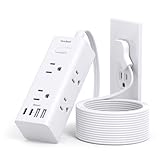
I remember the sheer panic. My brand-new 65-inch TV, the one I’d saved up for months to buy, was finally mounted. But the wall outlet? Barely accessible behind the behemoth. My immediate thought was, ‘Okay, I need an extension cord.’ Then I remembered that power strip sitting on my desk, the one with six outlets. Could I just… use that? It felt like a dumb question, but honestly, when you’re staring at a tangle of wires and a shiny new appliance, you question everything. So, are power strips technically extension cords? Let’s get this sorted out, because nobody wants to fry their expensive gear over a misunderstanding.
It’s a distinction that trips a lot of people up, myself included in my early days of tech hoarding. We see a cord, we see multiple outlets, and we assume it’s all the same thing. But there’s a difference, and understanding it could save you from a smoky disaster or a fried circuit breaker. This isn’t just about semantics; it’s about safety and functionality for your precious electronics.
What Exactly Makes a Power Strip… a Power Strip?
Let’s cut to the chase. A power strip, at its core, is a block of electrical sockets that provides multiple outlets from a single power source.
Think of it as a multi-tool for your wall socket. The common advice is that they are, in essence, a type of extension cord, and that’s not entirely wrong, but it’s also not the whole story. They both take power from one wall outlet and distribute it.
However, the key difference often lies in their intended design and features. While a basic extension cord is just a flexible wire with a plug on one end and a socket on the other, a power strip usually includes surge protection, circuit breakers, and yes, multiple outlets branching off. This added functionality is what separates them in the minds of many, and in my experience, it’s the surge protection that’s the real MVP. I once lost a whole batch of experimental code and a few hours of freelance work because of a minor power flicker that a cheap, non-surge-protected strip couldn’t handle.
Lesson learned the hard way. The cord itself is usually shorter and heavier-duty than a typical extension cord, designed to sit more or less permanently behind a desk or entertainment center, not snake across a room.
The ‘extension cord’ part comes from the fact that they extend the reach of a single outlet. That’s the fundamental shared purpose.
But most power strips are built with the expectation that they’ll be powering multiple devices simultaneously, often sensitive electronics. This is where the added features come in.
A simple extension cord might be fine for a lamp or a vacuum cleaner, but you wouldn’t plug your entire home office setup into one without some form of protection. The common advice to treat them similarly for safety purposes isn’t entirely off base, especially concerning their load capacity. You still need to be mindful of how much wattage you’re drawing. I’ve seen folks daisy-chain power strips, which is a surefire way to invite trouble.
It’s like trying to squeeze a gallon of water through a drinking straw – eventually, something’s gotta give, and it’s usually your wiring or your devices.
The physical construction often gives it away too. A power strip is typically a rigid bar or block, designed to sit flat and stable. Extension cords, especially the heavy-duty ones, are designed for flexibility and to be moved around. Think about those orange, heavy-duty cords you see on construction sites. That’s an extension cord built for abuse and high power draw. A power strip is more for a stationary setup where you’ve got several gadgets that all need juice from one spot. It’s this permanence and the multiple output points that define it, even if it shares the basic function of extending reach.
The Real Deal: Functionality and Protection
This is where the rubber meets the road. The primary reason I opt for a power strip over a simple extension cord for my tech setups is the built-in protection. We’re not just talking about plugging things in; we’re talking about keeping those things alive. Surge protectors are a godsend.
Lightning strikes miles away can cause power surges that fry sensitive electronics. A simple extension cord offers zero protection against this. It’s just a wire. My first decent surge protector cost me about $35, and it’s saved my bacon more times than I can count, not just from storms but from the everyday electrical hiccups that happen in older houses.
I’ve seen folks argue that surge protectors are a scam, that they don’t really do anything. Those people either live in a magical world of perfect power grids or they’ve been lucky so far. I’m not willing to gamble my $1000 laptop or my gaming rig on luck. (See Also: Can Extension Cords Short Out )
So, yes, technically they both extend the reach of an outlet. But the intended functionality of a power strip is often more sophisticated. Many power strips come with diagnostic lights that tell you if the protection is active or if the unit is overloaded. This is information you simply don’t get from a basic extension cord. It’s like comparing a basic flashlight to a headlamp with multiple brightness settings and a red light option. Both provide light, but one is designed for more nuanced and demanding tasks. When you’re powering multiple devices, especially things like computers, routers, and smart home hubs, the risk of damage from a power anomaly is significantly higher.
The wiring inside a power strip is also usually designed to handle the combined load of multiple outlets. A cheap, flimsy extension cord might only be rated for a few hundred watts, whereas a decent power strip can handle thousands.
Overloading an extension cord can lead to overheating and, in the worst-case scenario, fire. This is why the common advice often bundles them: be mindful of the total wattage.
But it’s the presence of that surge-protection circuitry and the multiple outlets that makes a power strip a distinct category. It’s not just about reaching the outlet; it’s about what happens to the power once it gets to the strip and how it’s managed before it hits your devices.
That management layer is the important differentiator.
Common Mistakes and Why They Matter
The biggest mistake I see people make, and honestly, I’ve been guilty of it myself, is thinking a power strip is an unlimited power buffet. You plug in your laptop, your monitor, your printer, your desk lamp, your phone charger, and maybe even a mini-fridge. Suddenly, you’re drawing way more power than that strip – or the outlet it’s plugged into – was designed to handle. I learned this the hard way when I overloaded a power strip that was powering my old desktop computer, a monitor, and a couple of external hard drives.
The strip started to get warm, then noticeably hot. A quick sniff confirmed a distinct burning plastic smell. I unplugged everything immediately, heart pounding. Thankfully, nothing was damaged, but it was a stark reminder that power strips, while convenient, aren’t magic.
They have limits.
Another common error is confusing a basic power strip with a surge protector. Many cheap power strips are just glorified outlet splitters. They give you more sockets, but they offer absolutely no protection against power surges or spikes.
So, if you’re plugging in anything valuable or sensitive, you need to make sure it explicitly states ‘surge protection’ and, ideally, lists a joule rating. A higher joule rating means it can absorb more energy before failing. I’ve seen people buy a $10 power strip thinking it’s protecting their $2,000 gaming PC.
That’s like putting a screen door on a submarine. It’s not going to do the job. This is where the technicality really bites: are they technically extension cords?
Yes, they extend the reach. But do they function like a simple extension cord? Absolutely not, if you buy one with proper surge protection.
Then there’s the issue of condition. People hang onto power strips and extension cords forever. (See Also: Can Extension Cords Be Use With Electric Heaters )
If the cord is frayed, the plastic is cracked, or the outlets are loose, it’s a fire hazard waiting to happen. I had a friend whose old extension cord, used for an outdoor Christmas light display, had a cracked casing. A bit of rain got in, and poof – a small electrical fire started in their bushes.
It was easily contained, but it could have been catastrophic. Just because it still works doesn’t mean it’s safe. I make it a point to inspect my power strips and cords annually and replace any that show signs of wear and tear.
It’s a small investment for peace of mind. And for goodness sake, don’t run extension cords under carpets or rugs. They can get damaged, overheat, and you won’t see it until it’s too late. These are basic electrical safety rules that apply to both, but the complexity of a power strip means there are more failure points.
Power Strips in the Real World: My Tech Sanctuary
My home office is a prime example of where power strips earn their keep. I’ve got my main PC, two monitors, a printer, a network switch, a NAS drive, a webcam, and various chargers all clustered around my desk. Plugging all of that into individual wall outlets would be a nightmare, assuming I even had that many available. Instead, I have two high-quality surge-protected power strips neatly tucked away.
One handles the core computer components, and the other manages peripherals and network gear. The key is understanding the power draw of each device.
My PC alone can pull a decent amount of wattage under load, so I’ve made sure the strip it’s connected to is rated for it, and that the wall outlet itself is on a dedicated or lightly loaded circuit. This is where the ‘technically extension cords’ question gets fuzzy. While they extend the reach, their capacity and protection features make them a distinct product class for specific applications.
I’ve learned to be quite picky about the power strips I buy. Forget the super cheap, no-name brands. I look for reputable manufacturers, at least a thousand joules of surge protection (more is better for sensitive gear), and outlets spaced far enough apart to accommodate bulky power bricks without blocking adjacent sockets.
Some strips even have USB ports built-in now, which is handy, though I tend to stick to dedicated USB chargers for my phones and tablets. The physical design matters too.
I prefer strips with keyhole slots on the back so I can mount them to the underside of my desk or to the wall, keeping them out of the way and preventing them from sliding around. This stability is part of why they feel different from a floppy extension cord.
Here’s a little anecdote. I was setting up a new home theater system, complete with a soundbar, subwoofer, Blu-ray player, and streaming box. All of them needed power. I impulse-bought a fancy-looking power strip that promised all sorts of filtering and protection for an ‘audiophile’ experience.
It was probably $60. Within a month, I noticed my sound was a bit… off. A slight hum.
After much troubleshooting, I ended up swapping out that fancy strip for a well-regarded, albeit less ‘gimmicky,’ surge protector. The hum disappeared.
Lesson learned: sometimes the simplest, most reputable designs are the best. Functionality over flashy features. And it reinforced my belief that these aren’t just glorified extension cords; they are integral parts of a device’s ecosystem, designed for specific jobs. (See Also: Are Outdoor Extension Cords 10 Or 12 Gauge )
A Comparison: Strips vs. Cords
To really nail this down, let’s put them side-by-side. It’s not always a black and white issue, but the differences are significant enough to warrant careful consideration. When you’re choosing between the two, you’re usually making a decision based on what you need to power and what level of protection you require.
| Feature | Basic Extension Cord | Power Strip (with Surge Protection) | Verdict |
|---|---|---|---|
| Primary Function | Extend outlet reach | Extend outlet reach AND protect devices | Power strip wins for electronics |
| Number of Outlets | Typically 1 | Multiple (3-12+) | Power strip is far more convenient |
| Surge Protection | None | Yes (varies by joule rating) | Important for sensitive electronics |
| Overload Protection | None (relies on circuit breaker) | Often includes a built-in circuit breaker/reset button | Power strip offers an extra layer |
| Cost | Low ($10-$30 for decent ones) | Moderate to High ($25-$100+) | Protection and convenience cost more |
| Typical Use Case | Temporary power for appliances, tools, lamps | Home/office electronics, entertainment centers, computer setups | Power strip is the go-to for tech |
| Physical Form Factor | Flexible cord, plug, socket | Rigid bar/block, plug, multiple sockets | Power strip is more stable and permanent |
As you can see, while they share the fundamental task of extending power, the power strip brings a lot more to the table. That’s why, when people ask me if power strips are technically extension cords, my answer is always a qualified ‘yes, but…’ The ‘but’ is the important part. They are extension cords in the sense that they extend the reach of a wall outlet, but the added features, particularly surge protection and multiple outlets, position them as a distinct and often superior solution for powering multiple electronic devices simultaneously. The common advice that you should be mindful of the load capacity applies to both, but the consequences of ignoring it can be far more severe with a power strip due to the sheer number of devices usually connected.
If you’re just plugging in a single lamp in a corner where the outlet is just out of reach, a basic extension cord is perfectly fine and cheaper. No need to overcomplicate it. But for anything with a circuit board, a screen, or a microchip, you’re doing yourself a disservice by not opting for a quality power strip with surge protection. It’s not just about preventing a total meltdown; it’s about extending the lifespan of your devices by shielding them from the electrical noise and spikes that are an inevitable part of living in the modern world. This is why I always recommend getting a power strip with a decent joule rating; it’s the main guard against those sneaky electrical fluctuations.
Are Power Strips Technically Extension Cords? The Verdict
Let’s get this straight. Are power strips technically extension cords?
Yes, in the most fundamental sense. They both plug into a wall outlet and provide power to another device or devices.
They both extend the reach of a single wall socket. However, this definition is so broad that it becomes almost meaningless in practical terms. Comparing a power strip to a simple extension cord is like comparing a Swiss Army knife to a butter knife. Both can spread butter, but one is designed for a much wider range of tasks and comes with a lot more tools.
The added features – multiple outlets, surge protection, circuit breakers, often better build quality for stationary use – are what define a power strip and make it a fundamentally different product for a different purpose.
My personal take? If you’re dealing with anything more complex than a single appliance that doesn’t have sensitive electronics, you should be using a power strip. Specifically, a surge-protected one. It’s not just about convenience; it’s about protecting your investment. I’ve seen too many gadgets die prematurely due to power issues that a decent strip would have handled. The initial cost difference between a cheap extension cord and a good power strip is minimal compared to the cost of replacing a fried laptop, television, or gaming console. It’s a no-brainer for me. The common advice often overlooks the distinct protective capabilities that lift power strips beyond mere cord extenders.
So, while the technical answer is yes, they are a type of extension cord, the practical answer is no, they are much more. They are power management hubs designed for the modern, multi-device household. Think of it this way: an extension cord is a one-trick pony. A power strip is a multi-tool. And when it comes to your valuable electronics, you want the multi-tool every single time. The question of whether power strips are technically extension cords often leads to underestimating their value and protective capabilities, which is a mistake many people make.
Do Power Strips Have Built-in Circuit Breakers?
Many modern power strips do come with a built-in circuit breaker. This is a safety feature designed to protect against overcurrents. If too much power is drawn through the strip, the breaker will trip, cutting off the electricity to prevent overheating and potential fires. Typically, there’s a small reset button on the power strip itself that you can press to restore power once the overload condition has been resolved. This adds another layer of protection that a simple extension cord lacks.
Can I Plug an Extension Cord Into a Power Strip?
Technically, yes, you can plug an extension cord into a power strip, but it is generally a bad idea and strongly advised against for safety reasons. This practice, known as ‘daisy-chaining,’ can overload both the power strip and the extension cord, leading to overheating and a significant fire hazard. It also bypasses the intended surge protection of the power strip, as the surge protection is designed to be the first line of defense. Always plug power strips directly into a wall outlet, and avoid plugging extension cords into them.
Are All Power Strips Surge Protectors?
No, absolutely not. This is a common and dangerous misconception. Many power strips are simply outlet expanders or ‘multi-taps’ that provide multiple sockets but offer no protection against power surges or spikes. To make sure you have surge protection, you must look for power strips that explicitly state ‘surge protection’ on the packaging and often list a ‘joule rating.’ A higher joule rating indicates greater surge-absorbing capacity, offering better protection for your valuable electronics.
Final Thoughts
So, to circle back to the initial question: are power strips technically extension cords? Yes, they extend the reach of a wall outlet. But that’s like saying a sports car is technically a car. They share a core function, but the added engineering, features, and intended use make them vastly different. The surge protection alone is a big deal that lifts a power strip far beyond the capabilities of a simple extension cord. I’ve learned through experience and a few close calls that skimping on quality power protection is a fool’s errand.
When you’re outfitting your home office, entertainment center, or any area with multiple electronic devices, choose wisely. Don’t just grab the cheapest thing that offers more holes to plug things into. Look for reputable brands, decent joule ratings for surge protection, and enough outlets spaced appropriately for your gear. If you’re still on the fence, think about the value of the devices you’re powering. It’s a small price to pay for peace of mind and protection. My rule of thumb is simple: if it’s got a processor or a screen, it gets plugged into a quality power strip.
Next time you’re at the store, take a good look at the options. You’ll see the difference, and you’ll understand why I always recommend a good surge protector over a basic cord for anything important. Your electronics will thank you, and your wallet might too in the long run.