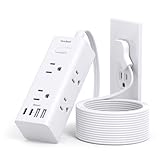
I remember the first time I tried to set up my workshop in the garage. It was a mess of cords, and I needed every outlet I could get. My brain immediately went to the power strip sitting on my workbench and the long extension cord snaking across the floor. ‘Can extension cords be plugged into power strips?’ I muttered, more to myself than anyone else, as I eyed the familiar plug.
We’ve all been there, staring at a tangle of cables and wondering if we’re about to cause a fire or just get a little more juice where we need it.
The honest truth? It’s not a simple yes or no. It depends on a few things that most people, including myself for a long time, don’t really think about until a breaker trips or something smells funny.
When Two Plugs Are Better Than One (maybe)
Let’s get straight to it: yes, you can plug extension cords into power strips, but should you? That’s the million-dollar question, and frankly, my answer is usually ‘try not to unless you have to, and even then, be smart about it.’
I’ve seen more than a few DIY setups that looked like a fire hazard waiting to happen. My own early attempts weren’t much better. I once daisy-chained three surge protectors together, thinking more outlets meant more power. Big mistake.
That little stunt nearly fried my vintage stereo receiver and definitely cost me a few hours troubleshooting why half the house’s lights kept flickering. The real problem wasn’t just the number of outlets, but the total load those cheap power strips and the subsequent extension cords were trying to handle.
The fundamental issue is that both power strips and extension cords are designed to carry a certain amount of electrical current, measured in amperes (amps). When you plug an extension cord into a power strip, you’re basically creating a junction point. If the total demand from all the devices plugged into the power strip, and then whatever is plugged into the extension cord, exceeds the rating of either the power strip or the extension cord (whichever is lower), you’re asking for trouble. This can lead to overheating, which is the fast track to melting plastic, tripped breakers, or, in the worst-case scenario, a fire. It’s like trying to pour a gallon of water through a drinking straw – eventually, something’s gotta give.
Think of it this way: your electrical panel is the main water reservoir, and the outlets in your wall are the main pipes. A power strip is like a splitter attached to one of those pipes, and an extension cord is another pipe attached to that splitter. If you attach too many splitters and pipes, or if any single pipe isn’t rated for the flow, you’re going to have a problem. My workshop setup was a classic case of this.
I had a fridge, a compressor, a welder, and a bunch of lights all on one circuit, all trying to go through a couple of power strips and extension cords. It was a recipe for disaster, and thankfully, I figured it out before anything actually caught fire.
The advice you’ll get from the manufacturer of your power strip or extension cord will almost always lean towards ‘don’t do it’ or ‘use only for low-power devices.’ They’re not trying to be difficult; they’re trying to cover their butts and, more importantly, keep you safe. But real life in a workshop, office, or even a busy home entertainment setup often demands more flexibility than those warnings allow.
What to Look for So You Don’t Burn Your House Down
Alright, so you’ve got a situation where you need to extend the reach, and plugging an extension cord into a power strip seems like the only option. Before you go jamming that plug in, let’s talk about what to actually look for. It’s not rocket science, but it requires paying attention to a few key details that get overlooked. I’ve learned the hard way that the cheapest, thinnest cord is almost never the right choice when you’re talking about combining power strips and extension cords.
First and foremost, you need to check the amperage rating. This is usually printed right on the plug end of both your power strip and your extension cord. Your power strip will have a maximum amperage it can handle.
Your extension cord will also have a rating, and this rating often changes based on the cord’s length and gauge (thickness). A shorter, thicker (lower gauge number) extension cord can handle more amps than a longer, thinner one. You need to make sure the total amperage of all the devices plugged into the power strip, plus the devices plugged into the extension cord, does not exceed the lowest amperage rating of any component in the chain – that includes the wall outlet’s circuit breaker rating, the power strip’s rating, and the extension cord’s rating.
Here’s a practical tip: most standard household circuits are 15 amps. You need to be conservative.
If your power strip is rated for 10 amps and your extension cord is rated for 7 amps, you can only safely draw a maximum of 7 amps through that setup. That means you can’t plug in a high-draw appliance like a space heater or a powerful vacuum cleaner into the end of that chain. I’ve got a couple of heavy-duty extension cords, the kind that look like they could survive a bear attack, that are rated for 15 amps even when they’re 50 feet long. These are gold for workshop use, but they cost more than the flimsy orange ones you might find at the grocery store. (See Also: Can Extension Cords Short Out )
Another important factor is the quality of the power strip itself. Are you using a cheap, no-name strip with flimsy internal wiring and no surge protection? Or are you using a reputable brand surge protector that’s built to handle a bit more abuse and offers some protection against power spikes? If you’re going to combine cords, you absolutely want to use a quality surge protector, ideally one that’s UL-listed or ETL-certified.
That little certification mark means it’s been tested by an independent lab and meets safety standards. I’ve seen too many cheap power strips melt or spark because they weren’t built with good internal components.
A good surge protector is an investment in not having to buy a new appliance or, worse, call the fire department.
The physical connection matters, too. Make sure the plug fits snugly into the outlet or the power strip socket. A loose connection is a prime spot for resistance to build up, which generates heat. I had a cheap extension cord once where the prongs were a bit loose, and it would always feel warm to the touch after a few hours of use. I tossed it immediately. Safety first, always.
The Common Mistakes That Make This a Bad Idea
Okay, so I’ve already confessed to my own early blunders, but let’s talk about the absolute, hands-down most common mistakes people make when they try to plug extension cords into power strips. These are the things that have burned into my memory (metaphorically, thankfully) because I’ve either done them or seen them happen.
The biggest one, by far, is the ‘more is better’ mentality regarding outlets and length. People see a power strip with six outlets and think, ‘Great, I can plug in six things!’ Then they plug in a powerful laptop, a monitor, a printer, a desk lamp, a phone charger, and a fan. That might be fine for a low-power setup.
But then they add an extension cord to reach the outlet, and maybe they plug that into another power strip because the cord isn’t long enough. Suddenly, you’ve got a dozen devices drawing power through a single wall outlet, and the chain of connections is getting long and convoluted. Each connection point adds resistance, and the total load is likely exceeding the circuit’s capacity, let alone the power strip’s rating.
It’s a recipe for overloaded circuits and potential fire hazards. I’ve learned that if I have more than a couple of modest electronics on a power strip, especially if it’s extended, I’m already pushing it.
Another huge mistake is using the wrong type of extension cord. We’ve touched on this, but it bears repeating: not all extension cords are created equal. Many people grab the lightest, cheapest cord they can find for convenience.
These are often thin-gauge cords (high gauge numbers like 16 or 18) meant for very light loads like a single lamp or a Christmas light display. They are absolutely not designed to handle the combined load of multiple devices that might be plugged into a power strip, especially if that power strip is powering things like space heaters, power tools, or kitchen appliances. Using a light-duty cord for a heavy-duty job is a classic way to cause overheating. I once saw a friend’s workshop extension cord start to smoke because he was running a small air compressor and a soldering iron through it.
The cord was visibly warped and blackened by the time he unplugged it.
Then there’s the issue of ‘daisy-chaining’ – plugging a power strip into an extension cord, which is then plugged into another power strip, which is then plugged into the wall. While technically you can do this, it’s almost always a terrible idea. Each connection adds a point of failure and resistance.
Plus, it becomes incredibly difficult to track the total power draw and make sure you’re not exceeding any component’s rating. It’s a tangled mess waiting to cause problems. My rule of thumb now is: one extension cord to a power strip, and that’s it.
No more than one extension cord, and no more than one power strip in that chain. And ideally, no extension cord at all, if I can help it. (See Also: Can Extension Cords Be Use With Electric Heaters )
Finally, people often ignore the environment. Is the extension cord or power strip going to be in a damp area? Is it going to be stepped on frequently? Is it near something flammable? Using indoor-rated cords outdoors, or leaving cords where they can be easily damaged, dramatically increases the risk of electrical faults and fires. I learned this the hard way when a garden hose accidentally sprayed onto an outdoor-rated extension cord that was powering some holiday lights. It didn’t cause a fire, but it did trip the breaker and made me realize how important environmental considerations are. Always match the cord and strip to the intended location and usage.
Real-World Scenarios and What Actually Works
Let’s talk about where this question actually comes up for most people, beyond just hypothetical worst-case scenarios. The most common place I’ve found myself needing to figure out if extension cords can be plugged into power strips is in my home office and my garage workshop. These are places where, let’s be honest, the available outlets are rarely enough for everything you want to plug in.
In my home office, I have a desk with a built-in power strip. It’s convenient, but it’s also often maxed out with my computer, two monitors, a printer, a charging station for my phone and tablet, and a desk lamp. The wall outlet is on the other side of the room.
For a long time, I just ran a heavy-duty extension cord directly from the wall to the desk. That was simple and safe. However, a few months ago, I reorganized, and now the power strip at the desk is still near the wall outlet, but I wanted to power a secondary lamp and a small fan that were further away.
My immediate thought was to plug another extension cord into the desk’s power strip. I paused, remembering all the advice. Instead of doing that, I decided to invest in a longer, heavier-duty extension cord that ran directly from the wall outlet to where the fan and lamp were needed, bypassing the desk power strip entirely for those items. It’s cleaner, safer, and I can sleep at night knowing I’m not overloading anything.
My garage workshop is a different beast. I’ve got tools that draw a lot of power: a table saw, a welder, a large air compressor. These are often used one at a time, but they can’t all be on the same circuit, let alone daisy-chained. Here, I’ve learned to invest in dedicated circuits for the high-draw tools.
But for the smaller stuff – battery chargers, bench grinder, shop lights, a small fridge – I use a heavy-duty power strip mounted to the wall, and I make sure it’s plugged into a properly rated extension cord that goes directly to a wall outlet. I also have a separate, very solid extension cord that I use for temporary hookups for larger tools, but it never goes through a power strip. It connects directly to a heavy-duty outlet. For instance, I have a 12-gauge, 50-foot extension cord that I use for my welder when I need to set it up away from its usual spot.
It’s rated for 20 amps, and I only plug the welder into it, and it goes straight to the wall.
I also encountered a situation recently when setting up a temporary event space. We had a large number of small devices – speakers, lighting controllers, laptops for mixing music – that needed power. The venue had limited outlets. We ended up using several heavy-duty power strips, and each strip was plugged into its own dedicated, properly rated extension cord that ran to separate wall outlets.
We were careful to group devices with similar power needs and distribute the load across multiple circuits. We absolutely avoided plugging any power strip into another extension cord or another power strip.
This strategy made sure that no single connection point or circuit was overloaded. It took more careful planning, but it was the only way to do it safely. The key takeaway from my own experience is to always prioritize direct connections to wall outlets when possible, and when extension cords and power strips are necessary, use them judiciously with high-quality, appropriately rated equipment, and never chain them together.
The “experts” and Why They’re Often Wrong (or Just Too Cautious)
Here’s where I tend to go against the grain a bit. You’ll hear a lot of official-sounding advice, often from people who have never actually had to wire up a home office or a DIY workshop with more extension cords than outlets. They’ll tell you in no uncertain terms: ‘NEVER plug an extension cord into a power strip.’ And yes, from a purely technical, liability-avoiding standpoint, they are correct. It’s the safest, most universally applicable advice.
But here’s the rub: it’s often impractical for real people in real situations. My contrarian take is that while you should avoid it if you can, and you must be incredibly smart about it if you can’t, it’s not an absolute, fire-starting sin every single time. The difference between a safe setup and a dangerous one often boils down to the quality of the gear and the total power draw, not just the act of plugging one into the other.
Think about it. What’s the difference between plugging a power strip into a wall outlet and plugging an extension cord into that same wall outlet, and then plugging a power strip into the end of the extension cord? Structurally, it’s not that different. (See Also: Are Outdoor Extension Cords 10 Or 12 Gauge )
Both are adding a connection, both are extending reach. The danger comes from the total load and the quality of the components.
If you’re plugging a laptop, a monitor, and a phone charger into a power strip that’s plugged into a decent extension cord that’s running directly to a wall outlet on a 15-amp circuit, you are likely well within safe limits. The power strip and extension cord are probably rated for more than the combined draw of those few low-power devices.
The problem is that most people don’t know or don’t check those ratings. They grab whatever’s handy. They might plug a 1500-watt space heater into a power strip, plug that into an extension cord, and then plug that into another power strip. That is a recipe for disaster, and it’s why the blanket ‘never’ advice is so prevalent. The manufacturers and safety organizations are trying to prevent the worst-case scenario for the broadest audience. They can’t account for every user’s setup or intelligence.
My advice is to treat the ‘experts’ guidance as a baseline for caution, not an absolute rule for everyday life. Understand why they say not to do it – it’s about managing electrical load and minimizing connection points. Then, apply that understanding.
If you must plug an extension cord into a power strip, use a heavy-duty, well-made extension cord and a quality surge-protected power strip. Make sure the total power draw is well within the limits of both devices.
Don’t push it. If you have any doubt, err on the side of caution and find another solution, like running a separate extension cord directly from the wall for that extra device. It might be less convenient, but it’s infinitely safer than a potential fire.
Faq: Your Burning Questions Answered
Can I Plug a Power Strip Into an Extension Cord?
Yes, but with significant caveats. You can plug a power strip into an extension cord, but you must make sure the total electrical load of all devices plugged into the power strip does not exceed the amperage rating of both the extension cord and the power strip. It’s generally safer to use a heavy-duty extension cord and a quality power strip and to avoid this setup if possible, especially for high-draw appliances.
Is It Safe to Plug Multiple Extension Cords Into Each Other?
No, it is generally not safe to plug multiple extension cords into each other, a practice often called ‘daisy-chaining.’ Each connection point increases resistance, the risk of overheating, and the potential for electrical faults. It also makes it very difficult to track the total power draw and stay within safe limits.
What Is the Maximum Number of Devices I Can Plug Into a Power Strip?
There isn’t a fixed maximum number of devices that can be plugged into a power strip; it entirely depends on the total power consumption (wattage or amperage) of those devices and the power strip’s own maximum rating. You must calculate the combined draw and make sure it stays below the strip’s limit. Overloading is the primary concern, not just the quantity of plugs used.
Can Extension Cords Be Plugged Into Power Strips for High-Power Devices?
It is strongly advised not to plug extension cords into power strips for high-power devices like space heaters, hair dryers, or power tools. These devices draw significant current, and combining them through multiple connections significantly increases the risk of overheating and fire. Always plug high-power devices directly into a wall outlet or a heavy-duty extension cord rated for their specific needs.
What Gauge Extension Cord Should I Use with a Power Strip?
The gauge of the extension cord you use with a power strip depends on the total amperage draw and the length of the cord. For general use with a power strip powering moderate loads, a 14-gauge cord is a good starting point for shorter runs (up to 50 feet). For longer runs or higher loads, you should opt for a 12-gauge cord. Always check the cord’s rating and the power strip’s rating to make sure compatibility and safety.
How Do I Know If My Power Strip Is Overloaded?
Signs that your power strip is overloaded include it feeling warm or hot to the touch, a burning smell emanating from the strip, or the circuit breaker tripping frequently. If you notice any of these symptoms, immediately unplug devices from the power strip and either reduce the load or use a different power source. It’s important to be aware of the wattage or amperage requirements of your connected devices.
Final Thoughts
So, can extension cords be plugged into power strips? The short answer, as you’ve probably gathered, is that it’s a ‘yes, but be extremely careful’ situation. My years of fiddling with wires and outlets have taught me that while the official advice is there for good reason, sometimes practicality forces our hand. Just remember to always prioritize quality gear – a good extension cord and a reputable power strip are a must.
Always do the math on your power draw. Seriously, grab a calculator if you have to. If you’re powering a few lamps and chargers, you’re probably fine. If you’re thinking about running a space heater or a power tool through that chain, stop right there and rethink your setup. Better to run another cord directly from the wall than to risk a fire.
Ultimately, the decision rests on your shoulders. Just make sure you’re making an informed one. If you’re ever in doubt about whether your setup is safe, it’s almost always better to err on the side of caution and find a more direct power solution.