I remember the first time I decided to hang a heavy mirror in my apartment. The instructions said to find a stud, but my drill kept hitting… nothing. Just hollow wall. Panicked, I grabbed some generic anchors from the hardware store, hammered them in, and screwed the mirror on. It looked fine for about a week. Then, one morning, crash. The mirror was on the floor, shattered, and the drywall was a mess. That’s when I learned that the question of whether are anchors needed for studs isn’t always a simple ‘no’. Sometimes, the stud isn’t where you think it is, or what you’re hanging is heavier than you expect.
It’s a common situation, and one that leads to a lot of confusion. You read conflicting advice online, see fancy tools marketed for ‘stud finding,’ and then you’re left staring at a bare wall, wondering what the heck to do.
Let’s cut through the noise.
Finding the Actual Stud (and What If You Can’t)
Look, if you can reliably find a solid wooden stud behind your drywall, you’re golden. That’s the dream scenario for hanging anything heavier than a picture frame. A screw or nail driven directly into a stud provides the most secure hold.
Think about it: you’re anchoring into solid wood, not just the thin layer of gypsum board that makes up drywall. This is where the common advice – ‘always hit a stud’ – comes from, and it’s good advice… if you can actually do it. My own early attempts were comically bad.
I’d buy those little magnetic stud finders that claimed to locate the screws holding the drywall to the studs. Half the time, they’d beep over a void.
I’d drill, hit plaster, curse, and try again, moving a few inches over. It was a frustrating dance.
The reality is, not all walls are perfectly framed, and sometimes the studs are spaced wider than you expect, or there’s an electrical wire or pipe exactly where you want to drill. So, what do you do then?
This is where the ‘anchors’ part of the ‘are anchors needed for studs’ question really comes into play. If you’ve genuinely exhausted your stud-finding efforts and come up empty, you need something else to support the weight. Relying on drywall alone for anything substantial is a recipe for disaster, as my shattered mirror can attest. I’ve learned to be patient. (See Also: Can Concrete Anchors Be Used In Brick )
I’ll often use a thin drill bit to probe for that satisfying feeling of hitting solid wood. If I don’t feel it after a few inches, I stop. No point making unnecessary holes.
The key is understanding that ‘stud’ means solid wood framing. Drywall is just the cover. If you hit a stud, you typically don’t need a separate anchor. The screw or nail goes directly into the wood. If you miss, or if the wall construction is different (like metal studs, which require specific fasteners), then you absolutely need an anchor. It’s not about bypassing studs; it’s about securing your item when a stud isn’t an option or isn’t where you need it.
The Different Types of Wall Anchors: My Experience
Alright, so you’ve tried finding a stud, and it’s just not happening. Now what? This is where the world of wall anchors opens up, and frankly, it can be a bit of a minefield. I’ve wasted money on cheap, flimsy plastic anchors that looked like they’d hold a feather, only to see them pull out under the weight of a small shelf.
Then there are the more solid ones, the ones that require drilling a larger hole and feel substantial. My go-to has always been the ‘toggle bolt’ or ‘molly bolt’ style anchors. They’re not for every situation, mind you, but for hanging shelves, bathroom fixtures, or anything that needs to bear some real weight when there’s no stud, they’ve been my reliable friends.
Here’s the lowdown on what I’ve found useful, and what’s usually a waste of time:
- Plastic Expansion Anchors: These are the most common and cheapest. You drill a hole, hammer them in, and screw into them. They work for very light items – think a small framed picture or a coat hook that won’t see heavy use. For anything more, they’re often a gamble. I’ve had these rip out of the drywall countless times. Avoid them for anything more than a pound or two.
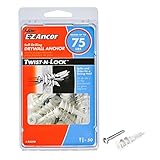
- Self-Drilling Anchors (Often called ‘Screws’ Anchors): These are like screws with a plastic or metal body. You just screw them directly into the drywall. They’re a step up from basic plastic anchors and good for medium-duty tasks, like hanging a lightweight TV mount or a moderately filled shelf. They provide a bit more surface area contact. I use these for things where I’m not 100% sure about the stud but don’t want to go through the hassle of a toggle bolt.
- Toggle Bolts/Molly Bolts: These are the heavyweights for hollow walls. You drill a larger hole, push the anchor through, and it has a spring-loaded ‘wing’ or ‘toggle’ that expands behind the drywall. You then screw into that. These are fantastic for significant weight – think heavy shelving units, large mirrors, or even light fixtures. The expanded wings distribute the weight over a much larger area of the drywall. I once hung a full-sized bookcase on a wall with no studs using a dozen of these, and it’s still rock solid years later. It took some effort to get them in right, but worth it.
- Strap Toggles (e.g., Toggler Anchors): Similar to toggle bolts, but often easier to install. They use a strap system that expands behind the wall. I find these very secure and a good alternative if you’re intimidated by traditional toggle bolts.
When you’re deciding, always check the weight rating on the anchor’s packaging. And remember, those ratings are usually for ideal conditions. If your drywall is old or crumbly, expect less holding power.
The ‘stud Finder’ Debate: Are They Worth It?
Okay, let’s talk about stud finders. There are two main types: magnetic and electronic. Magnetic ones, as I mentioned, look for the nails or screws holding the drywall. They’re cheap, but I’ve found them hit-or-miss. Electronic stud finders use sensors to detect changes in density behind the wall. They can detect studs, pipes, and sometimes even wiring. I’ve owned a few electronic ones over the years. My first one was a cheap model that beeped erratically, often false positives. It made me doubt its readings. My current one is a bit more sophisticated, and it’s pretty accurate, but you still have to learn to ‘read’ it properly.
The thing is, no stud finder is infallible. Walls are not uniform. (See Also: Can Cords Be Used To Make Anchors Climbing )
You might have insulation, wiring, plumbing, or even just variations in the drywall thickness that can fool the sensors. My contrarian opinion here is that sometimes, the old-fashioned methods, combined with a bit of common sense, are just as good, if not better, than a fancy electronic gadget.
What do I mean? Well, if you know standard construction practices, studs are typically spaced 16 or 24 inches apart on center.
If you find one stud, you can often estimate where the next one should be. You can also use a thin drill bit to ‘probe’ the wall.
Drill a small hole in an inconspicuous spot (like inside a closet or behind where furniture will go). If you hit solid wood, you’ve found a stud.
If you drill through and hit nothing but air, you haven’t. Repeat every few inches until you find it. This is tedious, but it’s often more reliable than a gadget that might be giving you false positives or negatives.
I once spent an hour trying to find a stud for a curtain rod in a bedroom. The electronic stud finder kept giving me mixed signals. I was about to give up and use anchors when I remembered the standard spacing. I found one stud near a corner, measured 16 inches, and probed. Bingo. Found the next one. The rod was up in minutes after that. So, are stud finders needed? Not strictly, but they can speed up the process if you learn to use them well and verify their readings. If you’re going to buy one, invest in a decent, well-reviewed model, and always, always verify its findings with a small probe hole if you’re hanging anything remotely heavy.
The Weight Bearing Myth: What ‘heavy Duty’ Really Means
This is where people really get tripped up. They see an anchor labeled ‘heavy duty’ or ‘supports X pounds’ and assume it’s foolproof. But that weight rating is often under ideal conditions and assumes you’re screwing directly into solid wood, or that the anchor itself is embedded perfectly into a strong substrate. When you’re dealing with hollow walls and anchors, that number needs to be taken with a huge grain of salt. My rule of thumb? Whatever the packaging says, assume you have about half that much reliable holding power, especially if you’re not using a toggle bolt or strap anchor.
Consider this: if you’re hanging a shelf that you plan to load with books, you’re not just dealing with the weight of the shelf itself. You’re dealing with the cumulative weight of all those books. A single shelf can easily hold 30-50 pounds of books, and that’s on the low end. If you’re using those cheap plastic anchors for that, you’re asking for trouble. I made this mistake early on by thinking a few plastic anchors would hold up a small collection of paperbacks. They held for a week, then gave way, scattering books across the floor. It wasn’t dangerous, but it was messy and annoying. (See Also: Can Anchors In Your Shoulder Break )
The question ‘are anchors needed for studs’ needs to be rephrased slightly for clarity. It’s more like, ‘are anchors needed when you can’t find a stud?’ Or, ‘are anchors needed for the weight you are hanging?’ If you’re hanging a very light object, like a small picture frame with a wire, and you can’t find a stud, a well-placed drywall anchor (even a good quality plastic one) might be sufficient.
But for anything that has significant weight or could cause injury or damage if it falls (like a TV mount, a heavy mirror, or a medicine cabinet), you absolutely want the most solid solution possible. This usually means finding a stud, or using a heavy-duty anchor like a toggle bolt or strap toggle. Don’t be tempted by the cheapest option; it’s almost always the most expensive in the long run when it fails.
Practical Tips for Anchoring: What I Wish I Knew Sooner
I’ve learned a few things the hard way about hanging things on walls, especially when studs are elusive. Here’s my distilled advice:
- Always Read the Instructions: This sounds obvious, but seriously. Different anchors require different drill bit sizes, different hole depths, and have specific installation methods. Trying to wing it often leads to frustration and failure.
- Use the Right Drill Bit: Using a bit that’s too small means you’ll struggle to get the anchor in. Too large, and it’ll be loose. The anchor packaging will usually specify the correct size.
- Feel for Resistance: When you’re screwing into an anchor, you should feel solid resistance. If it spins freely or feels too loose, the anchor isn’t seated properly. This is a sign it might fail.
- Don’t Over-Tighten: For plastic anchors, over-tightening can strip the plastic, making it useless. For toggle bolts, snug is good, but don’t force it to the point where you’re damaging the drywall around the hole.
- Consider the Substrate: If your drywall is old, crumbly, or in poor condition, your holding power will be significantly reduced, no matter what anchor you use. In such cases, it might be worth exploring other mounting options or reinforcing the wall if possible.
- Test Before Loading Fully: Once an anchor is installed, and before you put the full weight on it, give it a gentle tug. For shelves, place a few heavier items on it and leave it for a while to see if it holds.
- When in Doubt, Use a Stud: This is the golden rule. If you can find a stud, use it. It’s always the most secure method. If you can’t, use a heavy-duty anchor. My experience tells me that cheaping out on anchors is a false economy.
I remember trying to hang a heavy wall-mounted desk. I found what I thought was a stud, but it turned out to be a metal conduit pipe. My drill bit got stopped dead. I nearly gave up, but then I remembered I had some heavy-duty strap toggles. I drilled the correct size hole, installed the strap toggles on either side of where the pipe was, and mounted the desk. It’s been holding my computer and work essentials for over a year without a creak. It was a bit more work than just screwing into a stud, but it worked.
| Anchor Type | Best For | My Verdict |
|---|---|---|
| Plastic Expansion | Very light items (pictures, small hooks) | Generally avoid for anything substantial. Cheap and unreliable. |
| Self-Drilling | Light to medium duty (light shelves, small wall decor) | Decent option for convenience, but check weight limits. Better than basic plastic. |
| Toggle/Molly Bolt | Heavy duty (shelves, mirrors, light fixtures) | My preferred choice for hollow walls and significant weight. Very secure when installed correctly. |
| Strap Toggle | Heavy duty (similar to toggle bolts, easier install) | Excellent, reliable alternative to toggle bolts. Easy to use. |
People Also Ask: Can You Hang Heavy Items Without Studs?
Yes, you can hang heavy items without studs, but you absolutely need to use the correct type of heavy-duty wall anchor. Simple plastic anchors won’t cut it. You’ll need anchors designed for hollow walls, such as toggle bolts, molly bolts, or strap toggles. These anchors work by expanding or distributing their holding power on the backside of the drywall, providing a much stronger grip than anchors that only rely on the drywall itself. Always check the weight rating and consider using more anchors than you think you might need for added security.
Final Thoughts
So, to circle back to the original question: are anchors needed for studs? If you find a solid stud, then no, you typically don’t need a separate anchor. The screw or nail goes directly into the wood. However, the real world of home improvement rarely offers such straightforward answers. You’ll encounter situations where studs are elusive, or where the weight of what you want to hang simply demands more than a direct screw into wood might safely provide.
My personal journey with anchors and drywall has been one of trial and error, often with a side of frustration and sometimes, a bit of damage. But the lesson is clear: understanding your wall type, the weight of your item, and the capabilities of different fasteners is most important. For anything beyond the lightest decorations, if a stud isn’t an option, you absolutely must use a solid anchor designed for the job.
The next time you stand there with a drill and a wall full of uncertainty, remember that the right anchor can make all the difference between a secure mount and a trip to the hardware store for repairs.