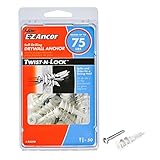
You see them advertised everywhere: those little gadgets claiming to be the ultimate fix for keeping stuff from sliding down your walls. Shelf fell? Picture frame a disaster? Someone’s going to tell you a ‘can anchor’ is the answer. I’ve been there, staring at a wall full of holes and half-hearted anchors that just… didn’t work. It makes you wonder, can anchors in your shoulder break? Well, not literally break your shoulder, but they can definitely break your spirit if you pick the wrong ones or use them like a hack job.
I’ve wasted more money than I care to admit on cheap multipacks that seemed like a bargain until the drywall crumbled around them like ancient parchment. It’s a frustrating dance, trying to get something to actually stay put without looking like a five-year-old did the decorating.
The Truth About What These Wall Anchors Actually Do
Let’s cut to the chase. When we talk about wall anchors, particularly for drywall, we’re usually talking about devices designed to give screws something solid to grip onto where there’s just flimsy plaster and paper. Think about your walls: they’re basically a sandwich. You’ve got the drywall board, then a good chunk of empty space, and then usually a stud if you’re lucky. Most screws, when you just drive them into that empty space, have nothing to hold onto except the thin drywall itself. That’s why they pull out so easily, taking chunks of your wall with them.
Wall anchors are designed to expand, wedge, or brace themselves within that empty space, creating a stronger point of purchase. Some are made of plastic, some of metal. Some you hammer in, some you screw in, and some you twist. The goal is the same: to bear weight that the drywall alone can’t handle.
I remember the first time I encountered what I thought was a ‘can anchor,’ though it wasn’t exactly a can. It was one of those plastic ribbed things you shove into a pre-drilled hole, and then you screw into it. Seemed simple enough. I hung a lightweight mirror, and it held.
Great! Then I tried hanging a slightly heavier shelf with a few books on it.
About a week later, I heard a sickening little ‘pop’ followed by a thud. The mirror was fine, but the shelf and its contents were on the floor, with the anchor ripped halfway out of the wall, looking like a sad, mangled plastic worm.
The common advice often glosses over the fact that not all anchors are created equal, and importantly, not all walls are created equal. A plaster wall behaves differently than modern drywall, and an anchor that works perfectly in one might be useless in another. The real magic, or lack thereof, is in how the anchor interacts with the material it’s going into. The simpler plastic ones, the ones that just expand slightly, are generally for very light loads. Anything heavier, and you’re asking for trouble unless you’re hitting a stud. And let’s be honest, finding studs consistently is a whole other adventure.
My own mistake was assuming a pack of 50 plastic anchors for $5 was a good deal. They were the kind that look like little mushrooms when you screw them in. They worked for pictures and maybe a very light decorative shelf. But the moment I tried to put anything with actual weight – like a spice rack in the kitchen or a hook for my heavy winter coat – it was a disaster waiting to happen. The plastic would either sheer off or the drywall would just crumble around the anchor’s threads. It felt like I was just making bigger holes.
When the Anchor Gets the Upper Hand: Understanding Load Ratings
Here’s where things get dicey, and where the marketing can really mislead you. Most anchor packaging will give you a ‘weight rating’ – something like ‘holds up to 20 lbs’ or ’50 lbs’. Sounds straightforward, right? Well, it’s not. That number is usually an ideal scenario, often when the anchor is installed directly into a solid stud, or under very specific laboratory conditions. In the real world, especially with drywall, that number is often optimistic, to say the least. I’ve seen anchors rated for 30 pounds fail spectacularly with less than 10 pounds hanging on them. Why? Because drywall is brittle, and the ‘holding power’ isn’t just about the anchor; it’s about the material it’s trying to hold into.
Think about it like this: if you have a piece of paper and try to hang a brick on it using a tiny nail, the paper will tear. The nail might be strong, but the paper can’t support it. Drywall is a bit like that paper. The anchor itself might be solid, but if the surrounding drywall can’t take the stress, it’s all for naught.
The stress isn’t always just a straight downward pull. Vibration, accidental bumps, or even just the weight settling over time can put shear or torque forces on an anchor that it wasn’t designed to handle. This is a key reason why anchors can fail, and why you might have heard anecdotal stories of them ‘breaking’ or giving way unexpectedly.
I learned this the hard way when I decided to mount a fairly substantial bookshelf to a wall that I was sure had studs where I needed them. I used heavy-duty metal toggle bolts, the kind that have wings that spread out behind the drywall. The package said ‘holds hundreds of pounds’.
Fantastic! I loaded up the shelf with my collection of hardback novels, feeling pretty smug. A few days later, I woke up to a crash. (See Also: Can Concrete Anchors Be Used In Brick )
The shelf, and all my books, had come down. Upon inspection, the toggle bolts hadn’t actually gone into studs, they’d just expanded into the empty space.
The drywall, stressed by the weight and the spread of the toggles, had basically disintegrated around the anchor points. It wasn’t the anchor that ‘broke,’ but the wall around it failed, taking the anchor with it. So, can anchors in your shoulder break?
Not your actual shoulder, but they can certainly fail in a way that makes you feel like you’ve injured your DIY confidence.
The lesson here is to always be skeptical of those high weight ratings for drywall. Assume they’re about half, or even a third, of what’s listed, unless you’re absolutely certain you’re going into solid wood framing. And even then, you’re limited by the strength of the screw itself and the integrity of the drywall. For anything truly heavy, like a TV mount or a substantial cabinet, finding studs is a must. Using anchors as a substitute for proper framing is a recipe for disaster. My go-to advice now is: if you’re unsure, over-engineer it. Better safe than sorry, and better to have a slightly more involved installation than a hole in your wall and broken possessions.
| Anchor Type | Common Claimed Use | My Real-World Verdict | Typical Load Limit (Drywall) |
|---|---|---|---|
| Plastic Ribbed/Expansion | Light pictures, small decor | Okay for very lightweight items (under 5 lbs). Prone to crumbling drywall. | 5-15 lbs (optimistic) |
| Screw-in Plastic (e.g., Toggle-Lok) | Medium decor, small shelves | Better than ribbed, but still limited. Wall material integrity is key. | 15-30 lbs (optimistic) |
| Metal Expansion (e.g., Molly Bolt) | Heavier shelves, small cabinets | Good for moderate loads IF installed correctly. Can strip drywall if over-tightened. | 25-50 lbs (optimistic) |
| Toggle Bolt (Spring or Wing) | Heavier items, large shelves, TVs (with caution) | Can hold a lot, but requires a larger hole and proper placement. Best if you can hit a stud. | 50-100+ lbs (optimistic, depends heavily on drywall size/thickness) |
| Strap/French Cleat System | Heavy cabinets, large furniture, TVs | The most secure for heavy items, but requires finding studs for the cleat. | 200+ lbs (when attached to studs) |
Common Mistakes That Lead to Anchor Failure
It’s not just about picking the wrong anchor; it’s how you use it. I’ve seen people do some truly baffling things that are practically guaranteed to lead to a collapsed fixture.
One of the most common mistakes, which I admit I’ve made in a moment of impatience, is not drilling the correct size hole. The anchor needs a snug fit. If the hole is too big, the anchor won’t expand or wedge properly, and it’ll just spin or fall out. Too small, and you’ll struggle to get it in, potentially damaging the anchor or the drywall in the process.
Manufacturers usually specify the drill bit size needed for their anchors. Follow it. Seriously, it’s usually printed right on the package in tiny letters that you’ll need a magnifying glass to read, but it’s there.
Another big one is over-tightening. This is especially true for the screw-in types and some of the metal expansion anchors. You crank on that screw, thinking you’re making it secure, but instead, you’re just stripping the threads in the drywall or the anchor itself. Once those threads are gone, there’s no grip left. It’s like trying to screw into mush. You need just enough torque to feel resistance and know it’s seated, not to feel like you’re trying to fuse it to the wall permanently.
I had a particularly embarrassing incident with a picture light. I wanted it perfectly flush against the wall. I screwed and screwed, and suddenly, there was no more resistance. I pulled it away, and a good 4-inch circle of drywall had just… detached. The anchor, a simple plastic one, was buried in the dust and debris. I ended up having to patch the wall and reposition the fixture. It looked fine from a distance, but up close, you could see the faint outline of my failure. This is a classic example of how a small error in technique can lead to a much bigger problem.
Then there’s the ‘wrong tool for the job’ dilemma. People try to use anchors designed for masonry (like concrete walls) in drywall. These often have aggressive threads or require hammering and can shatter drywall.
Or they use anchors meant for very light loads for things that are clearly too heavy. Everyone says ‘just use an anchor,’ but they don’t explain the nuances.
My advice? Read the damn instructions. And if you don’t have them, do a quick online search for the specific type of anchor you’re holding. It takes an extra two minutes, but it can save you hours of patching and frustration.
And for the love of all that is holy, if you’re hanging anything that’s valuable or heavy, find a stud. Anchors are a supplement, not a replacement, for structural support. (See Also: Can Cords Be Used To Make Anchors Climbing )
One contrarian thought: many people over-rely on anchors when a simpler solution exists. For instance, if you’re hanging a curtain rod and don’t want to hit a stud, a good quality curtain rod bracket that screws directly into the drywall with multiple screws, each with its own anchor, is often more secure than one central anchor. Distributing the load is key. So, while the question is ‘can anchors in your shoulder break?’, the more pertinent question is ‘can the wall around your anchor break?’ And the answer to that is a resounding yes if you’re not careful.
Real-World Use Cases: When Anchors Actually Shine
Despite all my gripes, wall anchors are not inherently evil. There are absolutely times when they are indispensable. The most obvious, and often the most successful, use case is for hanging lightweight decorative items. Think framed photos, small mirrors, lightweight wall art, or decorative wall plates. For these, the common plastic expansion anchors or the screw-in types are usually perfectly adequate. They provide just enough grip to keep the item from falling off the wall due to gravity alone, and they are simple to install.
Another excellent use is for temporary installations or when you simply can’t locate studs and the load is minimal. For example, if you’re renting and want to hang a few shelves for books or plants, but you don’t want to do extensive damage or invest in finding studs, appropriate anchors can get the job done. I’ve used the metal expansion anchors (Molly bolts) to hang shelves for my vinyl collection, which has a decent amount of weight, but I made sure to use multiple anchors spread out across the shelf’s length, and critically, I made sure the drywall was in good condition. The key here is distributing the weight across several anchor points rather than relying on one or two.
I’ll also give a nod to the heavy-duty toggle bolts for situations where studs are genuinely impossible to find and the weight is significant. I used them once to hang a large, antique leaning mirror that I didn’t want to lean against the wall. I drilled the holes, pushed the toggles through, and screwed them in.
They felt incredibly solid. The mirror has been hanging there for two years without an issue.
It required a much larger hole and more careful installation than a plastic anchor, but the result was worth it. The trick with these is understanding that the toggles need a good amount of space behind the drywall to open up and grip properly.
If you have shallow walls or obstructions, they might not work.
Finally, when it comes to certain types of fixtures, like smoke detectors, carbon monoxide detectors, or even lightweight light fixtures where the wiring isn’t heavy, anchors are often the intended mounting solution. These items are designed with the assumption that they will be mounted into drywall using appropriate anchors, and their weight is factored into the anchor’s capability. It’s always worth checking the manufacturer’s installation guide for any fixture, as they will usually specify the type of mounting hardware required.
My first-hand story of success involved hanging a series of small, framed botanical prints in a hallway. The walls were old plaster, and studs were inconsistently spaced. I used a good quality screw-in anchor designed for plaster, pre-drilled carefully, and screwed them in just tight enough. Each print weighed maybe 2 pounds. They’ve been hanging for three years, undisturbed. It wasn’t glamorous, but it was effective. It proved to me that when used appropriately for the right load and material, anchors are incredibly useful tools.
Finding the Right Anchor for the Job
So, how do you avoid the pitfalls? It boils down to understanding your wall material and the weight of the item you’re hanging. For modern drywall, start with the simplest: plastic expansion anchors for anything under 5 pounds. If it’s slightly heavier (say, up to 15-20 pounds) and you can’t find a stud, consider a screw-in plastic anchor or a metal expansion anchor (Molly bolt). For anything heavier, or for peace of mind, toggle bolts are a good option, but be aware they create larger holes.
The Stud Finder Dilemma and When to Just Drill
Let’s talk about stud finders. Oh, the promises they make! I’ve owned about three different kinds over the years, from the cheap magnetic ones that find nails to the electronic ones that beep and flash. Some are better than others, but none are foolproof. The electronic ones can be fooled by pipes, wires, or even just variations in the wall density. I’ve spent more time than I care to admit waving an electronic stud finder around, getting conflicting signals, and finally just giving up and drilling a pilot hole where I thought a stud should be, only to find solid wood. Conversely, I’ve also drilled what I thought was a stud, only to hit empty air or a pipe.
My most reliable method, surprisingly, involves a small drill bit and patience. Once I’ve marked where I want to hang something, I take a very thin drill bit – like a 1/16th inch – and drill a series of small pilot holes in a grid pattern where the item will eventually be. This is best done when you can hide the holes, like behind a shelf or a picture frame. If you hit solid wood, you’ll feel resistance immediately and the wood shavings will come out.
If you hit empty space, the drill bit will go in easily, and you might just get drywall dust. This method is a bit more invasive than a stud finder, but it’s far more accurate. (See Also: Can Anchors In Your Shoulder Break )
I find it’s the only way to be truly confident, especially when the stakes are high.
The other aspect of this is knowing when not to rely on anchors even if you can’t find a stud. If you’re hanging something that will be bumped frequently, or something where a failure would be catastrophic (like a heavy mirror over a bed), anchors alone are a gamble. In these situations, if studs are impossible, you might need to look into a French cleat system or other heavy-duty mounting hardware that distributes weight across a larger area and uses multiple secure points, ideally attached to framing members even if they aren’t traditional wall studs.
I remember trying to hang a large, unwieldy television. The wall I wanted it on had no studs in the right place. The TV mount instructions were adamant about mounting into studs.
I briefly considered using a bunch of heavy-duty anchors, thinking I could spread the load. Thankfully, a friend talked me out of it. We ended up having to reroute some framing and install blocking – a much bigger job – but it was the only way to make sure that TV wasn’t going to end up on the floor, potentially taking a chunk of my wall with it.
It hammered home the point that anchors are for moderate loads, not for important safety items or very heavy objects. The adage ‘measure twice, cut once’ applies here, but it’s more like ‘plan twice, drill once’ when it comes to wall mounting.
This is also where that common advice about ‘just use an anchor’ really falls apart. It’s like telling someone to just ‘use a band-aid’ for a deep gash. Sometimes, the situation calls for stitches, or in our case, a stud. If you’re not comfortable finding studs or doing the necessary prep work, it might be worth hiring someone. The cost of a handyman is usually far less than the cost of repairing a damaged wall or replacing broken items.
Faq: Your Burning Questions About Anchors
Can Drywall Anchors Hold a TV?
Generally, no. While some heavy-duty toggle bolts are rated for high weights, most standard drywall anchors are not designed to safely support the dynamic forces and sheer weight of a television, especially one that might be bumped. Always mount TVs directly into wall studs using the appropriate hardware provided with your TV mount. If studs aren’t in the right place, you may need to install blocking.
How Do I Know If I Hit a Stud?
The most reliable way is to use a thin drill bit (1/16th to 3/32nd inch) and drill a series of small test holes in the area where you want to mount something. If you feel immediate resistance and the drill bit comes out with wood shavings, you’ve hit a stud. If the drill bit goes in easily and only produces drywall dust, you’re in the hollow space. Electronic stud finders can be helpful for locating the general area, but they aren’t always perfectly accurate.
Are Plastic Anchors Strong Enough for Shelves?
It depends entirely on the shelf and what you plan to put on it. For very light decorative shelves holding items like small knick-knacks or perhaps a single paperback book, some stronger plastic anchors might suffice. However, for shelves intended to hold books, plants, or anything with significant weight, plastic anchors are usually not recommended. Metal expansion anchors, toggle bolts, or direct mounting into studs are far more appropriate.
What’s the Difference Between a Wall Anchor and a Screw?
A screw is a fastener that creates its own threads in a material. A wall anchor is a device inserted into a wall (like drywall or masonry) that provides a stronger, more stable base for a screw to grip onto. In drywall, screws alone have very little holding power because they’re only gripping the paper and gypsum. Anchors expand, wedge, or brace themselves within the wall cavity to provide that necessary support.
Can I Reuse Wall Anchors?
It’s generally not recommended. When you remove a screw from an anchor, you often deform or damage the anchor’s ability to grip effectively. Plastic anchors can become brittle, and metal ones can lose their springiness or wedging action. For the sake of security and to avoid potential failure, it’s best to use new anchors for each installation, especially for anything more than a very lightweight picture.
Final Verdict
So, to circle back to the original question: can anchors in your shoulder break? No, not literally. But the frustration and potential damage caused by poorly chosen or improperly installed anchors can certainly feel like a setback. My biggest takeaway from years of wrestling with these things is that anchors are a tool, and like any tool, they have their limitations and require understanding.
Don’t just grab the cheapest multipack. Take a moment to assess the weight of what you’re hanging and the material of your wall. If you’re unsure, err on the side of caution and find a stud. It might take a little extra effort, but it beats the disappointment and repairs that come from a failed anchor. Ultimately, a little knowledge and the right anchor for the job can save you a lot of headaches.