I’ve spent enough Saturdays wrestling with stubborn car doors and fiddling with house doors to know a thing or two about how things swing open and shut. And let me tell you, the question of whether hinges on doors are considered wheels is one that pops up more often than you might think, especially when you’re trying to diagnose a squeak or a sag.
It’s not a stupid question, not at all. We’re talking about things that pivot, things that allow movement. It’s easy to get them mixed up in your head, especially if you’re not someone who’s spent years getting grease under your fingernails.
So, let’s get straight to it. Are hinges on doors considered wheels? My honest answer, based on what I’ve seen and what actually matters when you’re fixing something, is a pretty firm no.
Why the Confusion? It’s All About the Spin
Look, I get where this whole hinges-on-doors-considered-wheels thing comes from. Both hinges and wheels are about allowing things to move relative to a fixed point. A wheel rolls, a hinge swings or pivots.
They both help motion, and in the grand scheme of mechanics, that’s a big deal. If you’re talking about the fundamental principles of how things move, you can see the connection.
For instance, in some really basic physics discussions about rotational motion, you might even hear analogies that touch on both. Think about a simple axle and a wheel – it rotates around a central point.
A door hinge also rotates around a pin, which is its central point. So, conceptually, there’s a shared idea of rotation around an axis. This is why someone might scratch their head and wonder if they fall into the same broad category. I remember a few years back, I was trying to explain the concept of bearings to my nephew, and I used the analogy of a wheel on an axle and then a hinge on a door, highlighting the common element of reduced friction through rotation.
He got it, but the question still lingered for him: are they fundamentally the same kind of thing?
But here’s where the rubber meets the road, or rather, where the metal meets the frame. When we talk about ‘wheels’ in the common, practical sense, especially in the automotive world where I cut my teeth, we’re talking about components designed specifically for rolling motion. Cars, bikes, carts – they all rely on wheels to travel distance. Their primary job is to reduce friction and allow for efficient linear movement across a surface.
They have a specific shape, often a circular cross-section, and are designed to interact with the ground (or a track) in a rolling manner. They’re built to withstand significant forces and wear from this constant rolling action. Think about the tires on a car; they are a massive part of the ‘wheel’ system, designed for grip, longevity, and comfort during rolling.
Hinges, on the other hand, are built for pivoting or swinging. Their primary function is to attach two objects (like a door to a frame) and allow one to move through a specific arc relative to the other. While they do involve rotation, it’s typically a limited, controlled arc.
They don’t help travel across a surface. Their design is focused on strength to support the weight of the door and resistance to the forces of opening and closing, not on overcoming friction for continuous rolling. The materials, the joint design, and the way they are mounted are all optimized for this specific type of movement.
It’s a different engineering problem with a different solution. The way a hinge operates is more about controlled oscillation than continuous locomotion.
So, while there’s a conceptual link in terms of rotational mechanics, their practical applications and design intent put them in very different buckets.
What Actually Makes a Wheel a Wheel?
Let’s break down what really defines a wheel. At its core, a wheel is a circular object that is mounted on an axle so that it can rotate. Its main purpose is to reduce friction by allowing movement or transportation of an object. Think about the earliest carts – they were basically platforms on axles with wooden discs acting as wheels. The entire point was to make it easier to move heavy loads by rolling them instead of dragging them. This is the fundamental principle. The circular shape is key because it allows for continuous contact with a surface while rotating, meaning the point of contact is constantly changing, which is incredibly efficient for overcoming static friction and enabling movement.
In the automotive context, wheels are far more than just simple circles. They are complex assemblies. You have the rim, which is the metal part that holds the tire, and then the tire itself, which is made of rubber and has a tread pattern for grip and shock absorption. The entire assembly is designed to bear the weight of the vehicle, provide traction for acceleration and braking, and absorb road imperfections.
When a car tire rolls, the rubber deforms and reforms, dissipating energy and providing a relatively smooth ride. The bearings inside the wheel hub are also important; they are specifically designed to handle high rotational speeds and the loads associated with a moving vehicle. These bearings are a key component that allows the wheel to spin freely and efficiently, minimizing resistance. The entire system is geared towards enabling the vehicle to move easily over distances. (See Also: A Box Without Hinges Key )
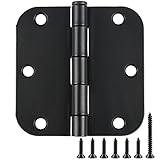
Now, compare that to a hinge. A door hinge typically consists of two or more plates connected by a pin. The plates are attached to the door and the frame, and the pin allows the plates to pivot relative to each other.
There’s no expectation for this rotation to be continuous or for it to overcome significant inertia for locomotion. The forces involved are primarily static loads (holding the door up) and dynamic loads during the swing (the force of opening or closing). While there are often bushings or bearings within the hinge pin assembly to reduce friction and wear, their purpose is to help smooth, controlled swinging over a limited arc, not to enable rolling motion across a surface.
The design is about durability and smooth articulation within that arc. The materials, like brass, steel, or stainless steel, are chosen for strength and corrosion resistance. You wouldn’t put a door hinge on a car wheel, and you certainly wouldn’t expect a car wheel to function as a door hinge.
They serve fundamentally different mechanical purposes.
Hinges vs. Wheels: A Practical Showdown
Let’s get down to brass tacks, or rather, metal on metal. I’ve personally dealt with my fair share of sticky car doors that needed new hinges. It’s a pain. You replace them, and suddenly the door swings smooth as butter, no squeaks, no sagging. The hinge’s job is done. It’s about supporting weight and allowing a controlled swing. That’s it. On the other hand, I’ve also spent hours trying to get stubborn lug nuts off wheels, or dealing with a tire that’s lost all its air. Those are problems related to rolling, traction, and maintaining pressure – entirely different issues.
I remember one time, I was helping a buddy move. We were loading furniture into a truck, and one of the truck’s side doors was sticking bad. We were jiggling it, pulling it, cussing at it.
My first thought was the hinges. They looked a bit bent. So, we ended up having to take the door off, unbolt the hinges, and try to straighten them.
It was a total nightmare. The entire time, my buddy kept saying, ‘Why don’t we just grease it up like a wheel bearing?’
I just looked at him and said, ‘Because it’s not a wheel, you muppet! It’s a hinge. It swings, it doesn’t roll.’
He eventually got the picture after we spent an extra hour wrestling with a door that was clearly damaged at the pivot point, not the rolling mechanism. The whole ordeal cost us nearly $180 in replacement parts and a lot of sweat. If it had been a wheel issue, say a flat tire, that would have been a completely different repair job, probably involving a tire shop and a couple of hours.
This brings me to my contrarian opinion. Everyone talks about how wheels are the epitome of mechanical ingenuity for transport.
And yeah, they’re great. But I think hinges are incredibly underrated. They are the unsung heroes of accessibility and functionality in our homes and vehicles. Without them, doors would be impossible to open and close smoothly.
They bear significant weight and endure constant stress without complaint. The engineering that goes into a heavy-duty gate hinge, for instance, is pretty darn impressive.
It needs to support hundreds of pounds and swing smoothly in all sorts of weather. It’s a different kind of engineering challenge than a wheel, but no less important. People focus on the ‘rolling’ aspect of wheels for travel, but the ‘pivoting’ aspect of hinges is just as fundamental to how we interact with our environment.
Comparison: Hinges vs. Wheels
| Feature | Door Hinge | Vehicle Wheel | Verdict |
|---|---|---|---|
| Primary Function | Pivoting, swinging motion; supporting weight | Rolling motion; enabling transport and reducing friction for travel | Different core purposes |
| Type of Movement | Rotational arc, limited swing | Continuous rotation for linear travel | Fundamental difference |
| Design Focus | Strength, durability for static and dynamic loads during swing | Low friction rotation, load bearing, traction, shock absorption | Specialized engineering |
| Friction Reduction | Bushings/bearings for smooth pivot | High-quality bearings for high-speed, low-resistance rolling | Different scales and applications |
| Interaction with Surface | Attaches to frame/door; no ground contact | Direct contact with road surface for traction and movement | No overlap in function |
What to Look for: Beyond the Obvious
When you’re dealing with hinges, especially on vehicles, you’re not just looking for something that spins. You’re looking for durability, smooth operation, and the right kind of support. For car doors, I always check the pins and bushings. If there’s slop, if the pin feels loose within the hinge, that’s a problem.
It means wear, and that wear will lead to sagging doors, misaligned panels, and potential issues with the door latches. I’ve seen doors sag so much they wouldn’t close properly, all because of worn-out hinges. It’s not rocket science, but it requires a keen eye for detail. (See Also: Are Integrated Washing Machine Door Hinges Standard )
The material matters, too. Stainless steel is great for corrosion resistance, but sometimes a good quality steel or even brass (for lighter applications) can be just as effective if maintained. The size and strength of the hinge need to match the weight of the door. A tiny hinge on a heavy truck door is a recipe for disaster, and vice-versa.
For common household doors, the same principles apply, though usually to a lesser degree. You’re looking for hinges that operate smoothly without squeaking. A little lubrication often does the trick, but if a hinge is genuinely rusted or bent, it needs replacement.
I’ve learned over the years that cheap, thin hinges are a false economy. They might save you a dollar or two upfront, but they’ll warp, rust, or bind much faster, leading to more hassle and expense down the line. For a solid wood interior door, a standard steel hinge is usually fine, but for exterior doors or heavier doors, you want something more solid.
The number of hinges also matters. A standard interior door might only need two, but a heavier exterior door might benefit from three to distribute the weight more evenly.
This is about load distribution, which is a concept that also applies to wheels, but in a very different way.
With wheels, you’re looking at tire tread depth, pressure, and the condition of the sidewalls. You’re checking for uneven wear, which can indicate alignment issues. You’re listening for any grinding sounds from the wheel bearings, which, if ignored, can lead to catastrophic failure.
You’re checking the rims for dents or cracks. The whole system needs to be in sync for safe and efficient operation. A worn wheel bearing, for example, can cause a wheel to wobble and eventually seize, which is a far more dramatic failure than a squeaky hinge. The stakes are just higher when you’re dealing with components designed for high-speed travel.
The underlying principle of rotation is there for both, but the operational demands and failure modes are worlds apart.
Common Mistakes and Misconceptions
The biggest mistake people make, and it’s a common one that fuels the ‘are hinges on doors considered wheels’ debate, is thinking that because something rotates, it’s fundamentally the same as a wheel. They see the pivot, they see the spin, and they stop thinking. This leads to applying the wrong solutions.
For instance, someone might try to ‘lubricate’ a sticky door hinge with the same kind of grease you’d use on a wheel bearing. Wheel bearing grease is thick and designed for extreme pressure and continuous high-speed rotation.
For a hinge, it’s overkill and can actually attract dirt and gunk, making the problem worse. A light oil or even a spray lubricant designed for metal-on-metal contact is usually what’s needed. I learned this the hard way on a set of antique cabinet hinges; I used way too much heavy grease, and they ended up looking worse than before.
It took me three tries to get it right with a lighter oil.
Another common misconception is the idea that hinges are ‘maintenance-free’ until they break. This is rarely true. Like any mechanical component, hinges benefit from occasional attention. A quick shot of lubricant, a check for loose screws, or making sure they are properly aligned can prevent much larger problems down the line.
People often only think about hinges when they start squeaking loudly or the door starts to sag significantly. By then, the wear and tear might be substantial.
It’s like ignoring dashboard warning lights on your car; by the time something catastrophic happens, the repair bill is much higher. On the flip side, people can obsess too much over wheels. They might replace perfectly good tires because they’re a few years old, even if the tread is still excellent.
The lifespan of a tire is dependent on mileage, driving habits, and environmental conditions, not just age. You need to assess the actual condition, not just guess. (See Also: Are Hinges Wheeels )
Then there’s the confusion about the different types of hinges and wheels. For doors, you have butt hinges, ball-bearing hinges, continuous hinges, barrel hinges, and more. Each has a specific application. Similarly, wheels come in various forms: spoke wheels, solid wheels, pneumatic tires, solid tires, mag wheels, steel wheels. Each is designed for a particular purpose and environment. To lump all these variations under a single, simplistic definition like ‘rotating components’ misses the nuance of their engineering and application. The question ‘are hinges on doors considered wheels’ is often asked by someone who isn’t thinking about these specific design intents and functional differences. They’re looking for a broad, almost philosophical categorization, when in reality, it’s a very practical, engineering-based distinction.
Real-World Applications: Where the Distinction Matters
The distinction between hinges and wheels matters every single day, in ways big and small. In automotive repair, for instance, a mechanic will diagnose a ‘door hinge problem’ very differently from a ‘wheel bearing problem.’ The tools, the techniques, and the parts are entirely different.
If a car door is hard to open or making noise, you check the hinges. If the car is making a humming or grinding noise that changes with speed, or if the steering feels loose, you check the wheel bearings and the overall wheel assembly. Mistaking one for the other would lead to incorrect repairs, wasted money, and potentially unsafe situations.
Imagine telling a mechanic to ‘fix the wheels’ on a sagging door – it makes no sense. They’d look at you like you had two heads.
In home construction and maintenance, the difference is equally clear. When building a house, you install hinges on doors and windows to allow them to function. You install wheels on anything that needs to move easily, like drawer slides, casters on furniture, or, of course, the wheels on vehicles. If you tried to use door hinges as casters for a heavy tool cart, you’d likely end up with a broken cart and a mess.
The hinges aren’t designed to roll, and they’d bind up, break, or seize under that kind of continuous movement and load. Conversely, you wouldn’t use wheel bearings to hang a shed door; they’re not designed for the static load and the specific pivot motion required.
The functionality is just too different.
Even in broader mechanical engineering, while concepts like rotational mechanics apply to both, the specific design and application are what define them. The Society of Automotive Engineers (SAE) has extensive standards for wheel bearings and chassis components, all focused on rolling motion and vehicle dynamics. There aren’t comparable ‘hinge standards’ in the same vein because their function is so distinct. While there might be standards for metal fatigue or material strength that apply to both, the specific engineering problems they solve are different.
Hinges are about controlled articulation and support, while wheels are about locomotion and dynamic interaction with surfaces. The practical implications of this distinction are significant for everything from product design to everyday repairs.
Understanding this difference is key to fixing things correctly and appreciating the specific engineering that goes into each component.
Do Hinges Enable Movement Like Wheels?
Yes, both hinges and wheels enable movement, but in fundamentally different ways. Wheels are designed for rolling motion, helping travel and reducing friction for locomotion across surfaces. Hinges are designed for pivoting or swinging motion, allowing one object to move through an arc relative to another, typically for access or operation. While both involve rotation around an axis, their purpose, design, and application are distinct.
Are There Any Similarities Between Hinges and Wheels?
The primary similarity lies in the principle of rotation. Both components involve rotation around an axis. They both also often incorporate elements to reduce friction, such as bearings or bushings, to allow for smoother movement. However, the scale, design, and intended outcome of this rotation are vastly different, making them serve very different mechanical functions in practice.
Can a Hinge Be Considered a Type of Wheel in Some Contexts?
In highly abstract or theoretical mechanical discussions about rotational motion, one might draw conceptual parallels. However, in any practical, real-world application, especially in engineering, automotive, or construction contexts, hinges and wheels are considered entirely separate categories of components due to their distinct functions, designs, and applications. The common usage and technical definition of ‘wheel’ specifically refers to components designed for rolling.
What Is the Main Difference Between How a Hinge Works and How a Wheel Works?
The main difference is the type of movement and its purpose. A hinge allows for a controlled, limited swing or pivot, typically to open or close something like a door or lid. A wheel is designed for continuous rotation that enables an object to roll along a surface, helping movement and transportation over distances. Hinges support static loads and allow articulation, while wheels are important for dynamic motion and overcoming inertia.
Final Verdict
So, to put it plainly: no, hinges on doors are not considered wheels. While they both involve rotation, their jobs are completely different. One lets you get into your car or house, the other lets you drive there. It’s like comparing a screwdriver to a wrench – both are tools, but you wouldn’t use one for the other’s job.
I’ve seen too many people waste time and money trying to fix one problem with the wrong mindset, usually because they’re oversimplifying the mechanics involved. Don’t be that person. Understand what a hinge is for and what a wheel is for.
Next time you’re dealing with a sticky door or a wobbly wheel, take a moment to identify the actual component at fault. It’ll save you a headache, a trip to the parts store, and probably some cash. And that’s what really matters.