I remember staring at a new, heavy mirror, a beautiful ornate thing I’d snagged on sale. The wall looked solid, right? So I figured, why bother with all that fiddly anchor stuff? Just screw it straight into the drywall. Big mistake.
That mirror lasted about three days before it decided gravity was a more compelling force. Luckily, nobody was around. That’s when I learned that sometimes, what feels like extra work is actually the only thing holding your life together – or at least, your wall decor.
So, are screw anchors necessary? The short answer is: usually, yes. But it’s not as simple as just grabbing any old plastic plug.
Why Drywall Alone Just Doesn’t Cut It
Let’s get real. Drywall is basically glorified cardboard. It’s great for making rooms, painting, and hiding wires, but it’s got the structural integrity of a wet paper bag when it comes to holding anything with real heft. When you drive a screw directly into drywall, you’re relying on the gypsum plaster and the paper facing to hold it. This stuff is crumbly. A screw in drywall by itself can only hold a few pounds, maybe ten at an absolute stretch if it’s a really good screw going into a solid stud. Anything heavier, like shelves, cabinets, curtain rods, or even a sturdy coat rack, and you’re asking for trouble.
I learned this the hard way with a floating shelf I wanted to put in my workshop. I loaded it up with my heavier hand tools – some nice old chisels, a couple of files. Within a week, the screws had pulled out, leaving gaping holes and a pile of tools on the floor. No damage to the tools, thankfully, but a solid dent in my confidence about DIY.
The problem wasn’t the screws; it was what they were screwed into. Drywall just doesn’t have the bite.
It crumbles around the threads, and before you know it, your prized possession is on the floor. Think about it: you wouldn’t hang a painting on a piece of tissue paper, would you?
Drywall is only marginally better for significant weight.
When you’re drilling into a wall, you’re hoping for one of two things: hitting a wooden stud or finding a solid material to grip. Studs are the studs of the wall, literally the framing. They’re solid wood, and a screw into a stud is as strong as the screw itself. But studs are usually spaced 16 or 24 inches apart. What do you do when your hook, shelf, or bracket needs to go somewhere in between? That’s where anchors come into play. They’re designed to spread the load or expand behind the drywall, giving the screw something substantial to bite into. Without them, you’re just punching holes in weak material and hoping for the best.
People often underestimate the weight of things. A seemingly light object can be surprisingly heavy. A full bookshelf, a mounted TV, even a large mirror can put immense stress on a wall. Relying on drywall alone for these items is like building a house on sand. It might look fine for a bit, but eventually, the foundation will give way. The science behind it is simple physics: distributed load. Anchors help distribute the weight over a larger area of the drywall or create a mechanical lock behind it, preventing the screw from ripping through.
When You Absolutely Should Reach for an Anchor
This is where it gets specific. If you’re hanging a picture frame that weighs less than a pound, maybe you can get away with just a nail or a small screw directly into the drywall. But for anything that has a bit of heft, or anything that’s going to be touched, bumped, or loaded repeatedly, an anchor is your best friend. Think about shelves that will hold books, spices, or toiletries. Think about curtain rods that will have fabric pulled on them. Think about towel racks in a bathroom, where they’ll be yanked on. These all need anchors.
My rule of thumb is this: if the item you’re hanging weighs more than a half-gallon of milk (which is about 4 pounds), start thinking about anchors. If it’s over 10 pounds, you’re definitely going to need a solid anchor, possibly even one designed for heavier loads. I once tried to hang a fairly heavy, antique cabinet door as a tabletop in my garage.
I just screwed it into the drywall, figuring it wouldn’t be supporting much weight. Within a month, the whole thing sagged, and I had to take it down. I ended up using toggle bolts, and that thing is solid as a rock now. (See Also: Can Concrete Anchors Be Used In Brick )
Toggle bolts are overkill for most things, but they illustrate the principle: you need a strong mechanical connection behind the wall.
Mounting a TV is a prime example. Those brackets are designed to take significant weight, and TVs themselves are heavy. You never screw a TV mount directly into drywall. You must hit studs. If the stud placement doesn’t work for your TV, you need to reinforce the wall or use specialized heavy-duty anchors that can handle the load. Even something like a wall-mounted desk or a workbench requires serious anchoring. The forces exerted on these items are not just downwards; they’re also pulled and pushed. Drywall alone can’t handle that kind of shear and tension force.
Here’s a little table to give you a rough idea of what needs what. Remember, this is a guideline, not gospel. Always check the weight rating of your anchor and the item you’re hanging. If in doubt, over-anchor. It’s better to have a hole that’s too big than a mess on the floor.
| Item | Weight (Approx.) | Anchoring Recommendation |
|---|---|---|
| Small Picture Frame | < 1 lb | Direct screw/nail (if into stud) or small plastic anchor |
| Mirror (medium) | 5-15 lbs | Sturdy plastic anchor or self-drilling anchor |
| Floating Shelf (light decor) | 5-10 lbs | Self-drilling or ribbed plastic anchor |
| Curtain Rod | 3-8 lbs (rod + fabric) | Self-drilling or plastic anchor, ideally into stud if possible |
| Towel Rack/Toilet Paper Holder | 2-5 lbs (static) | Plastic anchor; consider metal anchors for frequent use |
| Heavy Mirror / Wall Art | 15-30 lbs | Toggle bolt, molly bolt, or heavy-duty expanding anchor |
| Bookshelf (loaded) | 20+ lbs | Must hit studs or use very heavy-duty anchors (toggle/molly) |
| Wall-Mounted TV Bracket | 20-50+ lbs | MUST hit studs; specialized heavy-duty mounts if studs aren’t ideal |
Verdict
For anything beyond a postcard, anchors are your best bet. For anything remotely heavy or subject to stress, they are mandatory. The risk of a falling object is not just damage; it’s personal injury.
Not all anchors are created equal. The cheap little plastic ones you get in a bulk pack might be fine for a lightweight picture, but they’ll fail you fast with anything substantial. Understanding the different types is key to not wasting your money and, more importantly, not having your stuff fall off the wall.
First up, the classic: the plastic expansion anchor. You drill a hole, hammer the plastic plug in, and then screw into it. These work by expanding slightly within the hole. They’re cheap and readily available. They’re okay for very light items, like a small mirror or a lightweight shelf with minimal load. I’ve found they can also crumble if you over-tighten the screw or if the drywall is particularly soft. Their weight rating is usually pretty low, often just 10-20 pounds, and that’s a generous estimate.
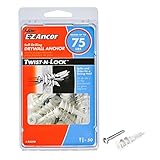
Next, self-drilling anchors, often called ‘E-Z Anchors’ or similar. These are fantastic for light to medium-duty jobs. They have a sharp point and threads that cut directly into the drywall as you screw them in. No pre-drilling required, which saves time. They generally hold more weight than basic plastic anchors, maybe up to 30-40 pounds depending on the size and the quality. I use these a lot for things like towel racks or small bathroom shelves. They’re quick, clean, and reasonably strong. Just make sure you don’t overtighten, as they can strip the drywall if you’re not careful.
Then we have metal expansion anchors. These are a step up. Common types include the ribbed plastic with a metal sleeve, or simple metal sleeves with a screw. They offer better grip and higher weight ratings. Some have wings that flare out behind the drywall for a more secure hold. These are good for medium-duty applications, like hanging heavier mirrors or larger shelves that won’t be overloaded. They generally require a pre-drilled hole, and you need to make sure you get the right size drill bit.
For really heavy stuff, you need toggle bolts and molly bolts. Toggle bolts have a spring-loaded wing that folds to go through a hole and then springs open behind the drywall, providing a huge surface area to distribute the weight. Molly bolts are similar, often with a metal sleeve that expands as you tighten the screw. These are the workhorses for heavy loads – think cabinets, large TVs, or heavy shelving units.
They require a larger hole to be drilled, and they can be a bit fiddly to install, especially in tight spaces. But when you need serious holding power, these are your go-to. I’ve used toggle bolts to hang a surprisingly heavy antique radiator cover, and it hasn’t budged in years.
Finally, there are specialized anchors for specific materials like plaster or masonry. Always match your anchor to your wall type. Using a drywall anchor in brick is a recipe for disaster, and vice-versa.
You’d think hanging something on a wall would be straightforward, but I’ve seen – and made – enough mistakes to fill a toolbox. The biggest one, hands down, is using the wrong anchor for the job. People grab the cheapest, smallest plastic anchors because they’re in the bargain bin, then wonder why their shelf collapses. It’s like trying to build a bridge with toothpicks. (See Also: Can Cords Be Used To Make Anchors Climbing )
Another huge error is not checking the weight rating. Those little numbers on the packaging aren’t suggestions; they’re limits. If an anchor is rated for 20 pounds, don’t hang 30 pounds on it. It might hold for a while, but it’s living on borrowed time. I’ve seen anchors fail because someone overloaded them by just a few pounds, and the result was a costly mess. Always err on the side of caution. Buy an anchor with a higher weight rating than you think you’ll need.
Drilling the wrong size hole is also a classic. Too small, and you won’t get the anchor in. Too big, and it will be loose and won’t hold. Always use the drill bit size recommended on the anchor packaging. If the packaging doesn’t specify, try to find it online or use a bit that’s just slightly smaller than the anchor’s diameter for a snug fit. For plastic anchors, you want them to require a bit of force to tap in; they shouldn’t just fall into the hole.
Over-tightening is another common pitfall. With plastic anchors, you can strip the threads or even crack the anchor itself. With self-drilling anchors, you can strip out the drywall. You want the anchor to be snug and secure, but not stressed. Feel the resistance and stop when it’s firm. The screw should also be snug, but again, don’t crank it down until the drywall groans.
People also fail to consider the wall material. While we’re talking drywall, remember that sometimes you’re drilling into plaster, which can be brittle, or even into a concrete block wall behind the drywall. Using a drywall anchor in concrete is utterly useless. Always know what your wall is made of. A quick test is to drill a small pilot hole and see what comes out – fine white dust is usually drywall, and larger chunks might be plaster or concrete.
My own screw-up involved a heavy antique mirror. I used what I thought were strong enough anchors, but I didn’t properly account for the sheer weight and the fact that the mirror was quite tall, creating use. The anchors pulled out because the force wasn’t just straight down; it had a rotational component. I should have used toggle bolts or found studs. It cost me a repaired drywall patch and a bruised ego.
Alright, let’s address the elephant in the room: the times you might not need anchors. This is a small club, and its membership requirements are strict.
The absolute number one condition is hitting a wall stud. If your screw or hook goes directly into a solid wooden stud, you have a very strong connection. Most modern construction uses 2×4 lumber for framing, which is plenty strong. A screw driven into a stud can hold significant weight, often hundreds of pounds for a single screw, depending on the screw type and length. This is why professional TV mount installations always aim for studs. You can find studs using a stud finder, or by tapping on the wall and listening for the change in sound (it sounds more solid over a stud).
If you’re hanging something extremely light, like a single piece of paper or a very thin, lightweight picture frame (think a business card holder or a small diploma frame), a small nail or screw directly into the drywall might suffice. We’re talking maybe a pound or two at most. But even then, if it’s in a high-traffic area where it could get bumped, an anchor provides peace of mind.
Another scenario is using very long, sturdy screws that can bite into the back of the drywall panel itself, or screws that are specifically designed for drywall without anchors. These often have very coarse threads and are meant to create their own grip. However, their holding power is still significantly less than hitting a stud or using a proper anchor, and they’re really only suitable for items that aren’t heavy and won’t be disturbed. I’ve seen people use these for hanging very lightweight decor, but I’m always a bit nervous about them.
Now, the contrarian view: everyone says you need anchors for everything heavier than a feather. And for most people, that’s probably good advice. But I’ve found that sometimes, a really well-placed, long, and sturdy screw can hold surprisingly well in drywall for lighter items, if you’re not going to put much stress on it. For example, I once hung a very thin, light piece of decorative metal art that was maybe 3 pounds. I used a couple of long, coarse-thread screws and pre-drilled pilot holes. It’s been up for two years and hasn’t moved. However, this is risky territory. If you misjudge the weight, or if the drywall is old and brittle, you’re asking for trouble.
The truth is, even in these ‘no anchor’ scenarios, a properly chosen anchor often provides a more reliable and long-lasting hold. It’s about trade-offs. If you’re saving a few cents and a few minutes by skipping anchors, what’s the cost if your item falls? Usually, it’s more than the cost of the anchors. So, while there are exceptions, especially when hitting studs, my default is always to use an anchor unless the item is exceptionally light and completely static.
If you can hit a stud, you’re usually in good shape. But most of the time, you can’t, and that’s precisely why anchors exist. (See Also: Can Anchors In Your Shoulder Break )
Beyond just picking the right anchor, how you use them makes a big difference. A good anchor installed poorly is still a liability. Here’s what I’ve picked up over the years.
- Read the Instructions (Seriously): I know, I know. But seriously, manufacturers put those instructions there for a reason. They’ll tell you the recommended drill bit size, the anchor’s weight limit, and any specific installation quirks. Don’t just eyeball it.
- Use a Level: This sounds obvious for hanging anything, but it’s especially important when using anchors. If your anchor is crooked, your screw will be crooked, and your item will be crooked. A level helps make sure the anchor goes in straight, which is key for maximum holding power and a professional look.
- Pre-drill Pilot Holes: Even for self-drilling anchors, a small pilot hole can make installation easier and cleaner. For most other anchors, it’s mandatory. Use the size specified on the packaging. If you don’t have the exact size, it’s better to be slightly undersized and force it a bit than to be too large.
- Tap, Don’t Hammer (for Plastic Anchors): When installing plastic anchors, use a hammer to gently tap them in, not to beat them into submission. You want them snug, not cracked or deformed. If it requires excessive force, your hole might be too small or you’re hitting something you shouldn’t.
- Don’t Overtighten: I’ve said it before, and I’ll say it again. Snug is good. Stripped is bad. Feel the resistance and stop when the anchor or screw is firmly in place.
- Consider the Screw Type: Make sure the screw you use is compatible with the anchor. Most anchors are designed for standard wood screws or machine screws. The screw needs to be the right diameter and length. For plastic anchors, a standard wood screw is usually fine. For toggle bolts, you’ll use a specific bolt that comes with the toggle.
- Test the Hold: Once everything is installed, give it a gentle tug. Don’t yank it, but apply some steady pressure to make sure it feels secure. For heavier items, it’s worth applying a bit more pressure than you expect the item to exert during normal use.
- Clean Up Debris: When drilling, especially into older walls, you’ll create dust and debris. Clean this out of the hole before inserting the anchor. This makes sure a better grip and prevents the anchor from being pushed out by loose material.
I once tried to hang a heavy mirror in a bathroom with old plaster walls. The plaster was crumbly. I kept drilling and the hole got bigger and bigger. I finally had to switch to a much larger toggle bolt and really spread the load. It was a pain, but the mirror is still up. It taught me that sometimes, the wall itself is the biggest challenge, and you need to adapt your anchor choice and installation method accordingly.
The screw is the delivery system for the anchor. Get it wrong, and the whole system fails. Always check compatibility.
Yes, but you absolutely need the right type of anchor. For heavy items like cabinets, large shelves, or TVs, you’ll need solid anchors like toggle bolts or molly bolts. These have mechanisms that spread the load behind the drywall. Simply driving a screw into drywall alone will not support significant weight.
The strongest drywall anchors are typically toggle bolts and molly bolts. Toggle bolts have a large, spring-loaded wing that opens behind the wall, distributing weight over a wide area. Molly bolts also expand behind the drywall with a metal sleeve. For very heavy loads, these are generally the go-to options.
The weight capacity of a screw anchor varies dramatically by type and size. Small plastic anchors might only hold 10-20 pounds, while self-drilling anchors can hold up to 40-50 pounds. Heavy-duty toggle or molly bolts can often support 75-100 pounds or more, but this is highly dependent on the specific product and the condition of your drywall.
Generally, no. If you are screwing directly into a solid wooden stud, the stud itself provides the necessary support. A screw driven into a stud is typically very strong. However, make sure your screw is long enough to pass through the drywall and get a good bite into the stud – at least 1 to 1.5 inches into the stud itself.
The terms are often used interchangeably, but ‘screw anchor’ is a broader category. A ‘wall plug’ usually refers to the common plastic expansion anchors that you hammer into a pre-drilled hole before inserting a screw. Screw anchors can also include self-drilling anchors, toggle bolts, molly bolts, and other devices designed to create a secure point in a wall for a screw.
Yes, molly bolts and toggle bolts are both excellent heavy-duty anchors for drywall. Molly bolts are often easier to install in tight spaces because they don’t require the toggle to spring open freely. Toggle bolts, with their wider wingspan, can sometimes distribute weight over an even larger area, making them ideal for very heavy items or weaker drywall.
So, are screw anchors necessary? For most projects involving anything heavier than a picture frame, the answer is a resounding yes. Cutting corners here isn’t saving time; it’s risking a trip to the hardware store for repairs and replacement items. Trust me, I’ve been there, and it’s never worth it.
The key is to understand your wall, the item you’re hanging, and then choose the right anchor for the job. Don’t be the person who blames the anchor when they used a tiny plastic plug for a 50-pound TV. It’s about matching the tool to the task.
Next time you’re planning a project, take a few extra minutes to research anchors. It’s a small investment that pays off in peace of mind and a secure wall. Now go forth and hang with confidence – just maybe double-check that stud finder.