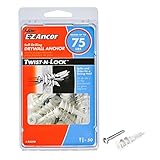
I remember staring at that pristine drywall, a heavy mirror in my hands, and thinking, ‘Easy peasy.’ Then I grabbed a handful of those plastic anchors that came with the mirror. Big mistake. Huge. They looked identical, right? Little ribbed tubes. How different could they be? Well, let me tell you, the answer to ‘are all wall anchors the same size?’ is a resounding ‘hell no,’ and that little misunderstanding cost me a cracked mirror and a whole lot of frustration. It’s not just about size, though that’s a piece of the puzzle. It’s about what they’re made of, how they work, and what kind of wall you’re actually dealing with.
Most people just grab whatever’s on the shelf, assuming they’re interchangeable widgets. That’s a gamble I’ve lost more times than I care to admit, usually when I’m in a hurry and just need something to hold my picture frame. This whole wall anchor game is more nuanced than it looks, and ignoring the details is a fast track to a hole in your wall and a dejected sigh.
Those Little Plastic Things: More Than Meets the Eye
Okay, let’s talk about the absolute workhorses of the DIY world: the basic plastic expansion anchors. You know the ones – usually white or off-white, with little fins or ribs running down the side. They’re cheap, they’re everywhere, and they’re what most people grab first. So, are all wall anchors the same size? Not even close, and more importantly, not all plastic anchors are the same type, even if they look similar. You’ve got your standard tapered ones, the ones that flare out a bit more, and then the ones with screw-in threads. The size difference might seem minor – maybe a millimeter or two in diameter or length – but that’s enough to matter.
The fundamental idea behind these is simple: you drill a hole, hammer the anchor in, and then drive a screw into it. The plastic expands or flares out behind the drywall, creating a friction fit. But here’s the rub: drywall isn’t some monolithic, indestructible material. It’s basically compressed gypsum between two sheets of paper.
Standard plastic anchors are really only meant for light-duty stuff. Think a small framed photo, a lightweight shelf that won’t hold much, or maybe a coat hook that’s only going to see a light jacket. If you try to hang something substantial, like a TV mount or a heavy bookshelf, you’re asking for trouble. I once saw a buddy hang a flat-screen TV using nothing but these, and the whole thing came crashing down.
Luckily, no one was hurt, but the TV was toast, and the hole in the wall looked like a small crater. That’s a mistake you only make once.
The common advice is to match the drill bit size to the anchor. Sounds straightforward, right? But even then, the density of your drywall, how old it is, and how many times it’s already been penetrated can affect how well that anchor holds. A slightly undersized hole might make it tough to get the anchor in, risking damage. An oversized hole means it won’t have anything to grip, and it’ll just spin. It’s a delicate balance. So, while many plastic anchors might look like they’re the same size, their design variations and how they interact with drywall mean you can’t just treat them as a one-size-fits-all solution.
When Metal Steps in: The Mighty Toggle Bolt and Molly Bolt
Alright, so those cheap plastic doodads aren’t cutting it for anything more than a postcard on the wall. What’s the next step up? This is where metal anchors come into play, and they’re a whole different ballgame. The two big players here are the toggle bolt and the molly bolt. They’re both designed to handle significantly more weight than plastic anchors, and they do it by creating a much more secure purchase on the back side of your wall material.
Let’s break down the toggle bolt first. These usually come as a bolt with a spring-loaded “wing” or “toggle” attached.
You drill a larger hole – usually a good inch or so in diameter. You then fold the toggle mechanism flat, push it through the hole, and let it spring open behind the drywall. Once it’s back there, it acts like a little parachute, distributing the weight over a much larger surface area.
Then you tighten the bolt. This is the kind of anchor you’d use for hanging a heavy mirror, a substantial shelf, or even some lighter cabinet installations. I used a set of heavy-duty toggle bolts to mount an old, cast-iron radiator cover to a plaster wall that was notorious for crumbling. (See Also: Can Concrete Anchors Be Used In Brick )
They held like a rock, even with the vibration from the heating system. Total game changer for that project.
Now, the molly bolt. These look a bit more like a traditional bolt with a metal sleeve. You drill a hole, insert the molly bolt, and then drive the screw. As you drive the screw, the sleeve on the back of the wall expands and often has little teeth or prongs to grip the drywall surface.
They’re also great for heavier items, and sometimes they’re preferred because the bolt can be removed and reinserted, leaving the sleeve in place. I’ve used molly bolts to hang heavy tool racks in my garage, and they’ve never budged. One thing to watch out for with molly bolts is that the sleeve needs to be fully seated before you start expanding it, otherwise, it can get wonky.
When comparing toggle and molly bolts, size is again a factor, but it’s more about the bolt diameter and the length of the sleeve or toggle wings. A longer sleeve will offer more support in thicker materials. But the real difference is in their holding power. Both are vastly superior to plastic anchors. So, to answer the underlying question about are all wall anchors the same size – these metal beasts are in a different league entirely, offering serious strength where plastic just fails.
Screw-in Anchors: The Quick Fix (sometimes Too Quick)
You see these everywhere now, especially in the hardware store’s aisles. They’re the screw-in anchors, often made of plastic or a composite material, that you just twist directly into the drywall. No pre-drilling required, or at least, that’s the promise. You just take a screwdriver or a drill with a screwdriver bit, and you spin the anchor in. They have these aggressive threads that are supposed to bite into the drywall. They look super convenient, and for certain applications, they can be. I’ve used them for hanging lightweight sound-dampening foam panels in my home office, and they worked perfectly for that. They held the foam securely without any fuss.
However, here’s where the contrarian opinion kicks in: I think screw-in anchors are massively overrated for anything beyond the lightest loads, and people often overestimate their strength. The common advice is that they’re a great alternative to traditional anchors because they’re easier and faster. But that ease comes at a cost.
The threads, while sharp, are only digging into the paper and a thin layer of gypsum. If you’re hanging something that has any significant weight, or if it’s going to be bumped or jostled, those threads can strip out of the drywall surprisingly easily. I had a friend who hung a small art piece using these, and after a few weeks, it started to sag. Turns out, the threads had slowly pulled out of the drywall.
The key issue is that they don’t engage the wall cavity in the same way that a toggle bolt or a molly bolt does. They rely entirely on the strength of the drywall itself to hold those threads. Think about it: you’re basically creating a bunch of small holes in the paper face of the drywall. While they might be the same ‘size’ in terms of the diameter of the hole they create, the way they grip is fundamentally different and, in my experience, less reliable for anything beyond decorative items. If you are going to use them, I’d strongly recommend sticking to very light-duty items, and maybe even pre-drilling a small pilot hole to make insertion easier and less likely to damage the drywall surface.
What About Those Heavy-Duty Metal Anchors?
When you’re facing a load that even your sturdiest toggle or molly bolt might struggle with, or if you’re working with materials other than just drywall – like plaster and lath, or even concrete block – you’re going to be looking at more solid metal anchors. These aren’t your everyday hardware store finds for hanging a picture frame. These are for serious business. We’re talking about things like concrete anchors, sleeve anchors, and wedge anchors.
Concrete anchors are designed specifically for masonry. They often require a hammer drill and a specific-sized hole. Once the anchor is inserted, you drive a lag screw into it, and it expands within the concrete or brick. I used a set of these to secure a heavy workbench to my garage floor, which is poured concrete. They felt incredibly solid, like they were part of the concrete itself. They can handle hundreds, if not thousands, of pounds of shear and pull-out force, depending on the type and size. (See Also: Can Cords Be Used To Make Anchors Climbing )
Sleeve anchors are versatile. They consist of a bolt and a metal sleeve. You drill a hole, insert the sleeve anchor, and as you tighten the bolt, the sleeve expands at the back of the material. These are great for concrete, brick, and sometimes even solid wood. Wedge anchors are similar but tend to be even more heavy-duty, designed for structural applications in concrete. These are definitely not for drywall; they’re for situations where you need absolute certainty that something isn’t going to move, ever.
The “size” of these anchors is usually measured by the diameter of the bolt and the length of the sleeve or the anchor itself. The variety is huge. You won’t find yourself asking if all wall anchors are the same size when you’re looking at a box of half-inch thick steel anchors designed to hold up a carport. These are engineered for extreme loads and require a much more involved installation process. For the average homeowner, these are likely overkill, but it’s good to know they exist for when you’re tackling a truly heavy-duty project.
The Truth About Load Ratings and When to Care
This is where a lot of DIYers, myself included in my early days, get it wrong. We see an anchor, we see a screw, and we assume it’ll hold. But every anchor has a load rating – a maximum weight it’s designed to support. This rating is usually given for shear strength (weight pulling down) and pull-out strength (weight pulling straight out). The problem is, these ratings are often for ideal conditions, using the anchor in a solid piece of material, not in the variable, often hollow, environment of drywall or plaster.
For example, a small plastic anchor might have a rating of 10-20 pounds. Sounds like a lot, right? But that’s often in solid wood. In drywall, that rating can be cut in half, or even more, especially if you’re not using it perfectly. A toggle bolt, on the other hand, can have ratings of 50, 100, or even 200 pounds, again, depending on the size and material. But even then, you have to consider the drywall’s own integrity. If the drywall is old, crumbly, or has been damaged, even a strong anchor might fail because the material it’s anchored to is weak.
Here’s a real-world scenario: I was building some simple shelves in my workshop. I had some decent-looking metal anchors and used them to attach the shelf brackets to the wall.
The shelves themselves were probably holding about 30-40 pounds of tools. For the first few weeks, everything was fine. Then, one morning, I noticed one of the brackets had pulled slightly away from the wall. The anchor itself was still in the wall, but the drywall around it had started to crumble.
The anchor’s rating was likely higher than 40 pounds, but the drywall couldn’t support the sustained load being transferred through it. I ended up having to move the brackets to a stud or use a heavier-duty anchor system that distributed the weight better.
It taught me that the anchor is only as good as the wall it’s going into.
So, when should you care about load ratings? Always. But especially for anything more than a very light decorative item. If you’re hanging a mirror, a shelf, a TV mount, or anything that could cause damage or injury if it falls, you need to pay attention. Always err on the side of caution. Using an anchor with a significantly higher load rating than you think you need is cheap insurance against disaster. Don’t just eyeball it; check the packaging. And if the packaging is vague or missing, consider it a red flag.
Common Mistakes and Practical Tips for Success
We’ve danced around some of the common pitfalls, but let’s nail them down. The biggest mistake? Assuming all wall anchors are the same size and type, and that they’ll work in any wall material. This leads to frustration, damaged walls, and failed projects. Another huge error is using the wrong anchor for the weight of the object. People see a plastic anchor and think, ‘It’s holding my cousin’s coat, so it’ll hold my 50-inch TV.’ That’s a recipe for disaster. (See Also: Can Anchors In Your Shoulder Break )
Over-drilling the hole is another common one. You drill, and it’s too big. You try to jam the anchor in, and it just spins or breaks apart. Or, conversely, not drilling the hole big enough, then trying to hammer the anchor in with excessive force, which can damage the drywall around the hole and weaken the anchor’s grip. And finally, not checking if you’re hitting a stud. Seriously, if there’s a stud available, use a screw directly into the stud. It’s the most secure method there is. Stud finders aren’t perfect, but they’re worth the $15 investment if you plan on hanging anything substantial.
Here are some practical tips:
- Know Your Wall Material: Is it drywall, plaster, concrete, brick, or wood? This is the FIRST thing to determine.
- Estimate the Weight: Get a rough idea of what you’re hanging. Weigh it if you can.
- Match Anchor to Load and Wall: For drywall and light loads (<10 lbs), basic plastic anchors might suffice. For medium loads (10-50 lbs), toggle bolts or molly bolts are usually good bets. For heavy loads (>50 lbs) or if you need extreme security, consider heavy-duty toggles, sleeve anchors (if working with masonry or wood), or mounting directly to studs.
- Follow Instructions: Seriously, read the back of the anchor package. It’ll tell you the recommended drill bit size and the load rating.
- Pilot Holes: For screw-in anchors or when inserting anchors into potentially brittle material, a small pilot hole can prevent splitting or crumbling.
- Don’t Be Afraid to Go Overboard: If you’re unsure, use a stronger anchor than you think you need. It’s better to have overkill than an anchor failure.
- Test Gently: After installing an anchor and screw, give it a gentle tug to make sure it feels secure before hanging the full weight.
Frequently Asked Questions About Wall Anchors
Are All Wall Anchors the Same Size?
No, absolutely not. Wall anchors come in a vast range of sizes, from tiny plastic ones for lightweight decorations to large metal anchors for heavy-duty applications. The size refers to both the diameter and the length, and it’s important for proper function and load-bearing capacity.
What Is the Strongest Type of Wall Anchor?
For drywall, toggle bolts and molly bolts are among the strongest common types because they distribute weight across a larger area on the back of the wall. For concrete or brick, heavy-duty concrete anchors or wedge anchors are significantly stronger.
Can I Use a Wall Anchor in Plaster?
Yes, but plaster can be more brittle than drywall. Toggle bolts are generally a good choice for plaster, as they spread the load. You might need to be more careful with installation to avoid cracking the plaster. Sometimes, plaster and lath walls require specialized anchors or even furring strips.
How Do I Know Which Anchor to Use?
Consider the weight of the item you’re hanging, the type of wall material you have, and the required holding power. Always check the anchor’s packaging for load ratings and installation instructions. When in doubt, opt for a stronger anchor than you think you need.
Verdict
So, the short answer to ‘are all wall anchors the same size?’ is a hard no. And it’s not just size; it’s material, design, and application. Relying on the wrong anchor is like using a toothpick to build a bridge – it’s just not going to end well. Take a moment to assess your wall, the weight of what you’re hanging, and choose accordingly. It’s the difference between a secure fix and a future repair job.
Next time you’re at the hardware store, look closer. You’ll see the vast differences. Think about the loads you’re dealing with and the integrity of your walls. A few extra minutes of research now can save you a lot of headaches (and drywall dust) down the line. Don’t be the person who learns the hard way.
What’s the most ambitious thing you’ve ever hung on a wall, and what anchor did you use?