I remember the first time I saw a car door sag so bad it barely cleared the fender. The hinges were shot. My buddy, bless his heart, was convinced it was some sort of advanced bearing system that had failed. I just shook my head. He was looking for a complex answer to a simple problem, and it got me thinking about how we classify things, especially when it comes to basic mechanics. So, the question is, are door hinges a type of wheel?
It’s a weird question, I know, but stick with me. We’re going to break down what makes a wheel a wheel and what makes a hinge a hinge, and see if there’s any overlap. It’s not as simple as a yes or no.
What Actually Makes a Wheel a Wheel?
Alright, let’s get this straight from the get-go. When most people think of a wheel, they’re picturing something round that spins. Think about your car tires, a bicycle wheel, or even the casters on your office chair. The primary function is to reduce friction and allow something to move easily by rolling. That rotational motion is key. It’s about transforming linear motion into rotational motion, or vice versa, with minimal resistance. The surface area in contact with the ground (or whatever it’s rolling on) is designed to be smooth and continuous, allowing for that effortless roll. The hub, spokes (sometimes), and rim all work together to achieve this.
The engineering behind a wheel is all about efficiency. Whether it’s the rounded profile of a tire gripping the road or the precision-machined surface of a bearing race, the goal is always the same: smooth, low-friction movement. Take a simple roller skate wheel. It’s a cylinder, usually with bearings inside, designed to spin freely on an axle. The whole point is to make you glide. Even something like a pulley, which is basically a grooved wheel, uses rotation to change the direction of force or gain mechanical advantage. The consistent, circular motion is what defines it.
I’ve spent more time than I care to admit wrestling with seized axles and worn-out bearings on various machines. The feeling when you finally get a wheel spinning freely again is pure satisfaction. It’s the promise of motion, of things working as they should. And it’s always that smooth, uninterrupted rotation that tells you you’ve done it right. If it grinds or catches, it’s not a proper wheel in action, plain and simple. The physics are pretty straightforward: less friction equals easier movement. That’s the magic of the wheel, and it’s been that way for millennia.
The whole concept of a wheel is so fundamental to mechanics that it’s easy to overlook its subtleties. It’s not just about being round; it’s about the way it interacts with its environment to help movement. Think about the difference between pushing a heavy box across the floor versus putting it on a dolly with wheels. The wheels don’t just roll; they lift the box slightly, reducing the direct friction between the box and the floor to a mere point of contact that rotates. This is the core principle. So, when we look at other mechanical components, we need to see if they’re operating on this same principle of low-friction rotation to enable movement.
Honestly, the common definition of a wheel is pretty simple: a circular object that revolves on an axle. But that’s a bit too basic, isn’t it? It doesn’t account for the purpose or the mechanism of that revolution. A grinding stone is round, and it revolves, but you wouldn’t call it a wheel in the same sense as a car wheel. The application matters. For something to be truly considered a ‘wheel’ in the functional sense we usually mean, it needs to be about enabling locomotion or continuous motion with reduced resistance.
What Exactly Is a Door Hinge Doing?
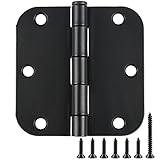
Now, let’s pivot to door hinges. What’s their job? Their primary function is to connect two objects (like a door to a frame) and allow one to pivot relative to the other. They’re designed for a specific type of movement: a swing. Most common door hinges, the kind you see on nearly every house and building, are called butt hinges. They consist of two leaves that attach to the door and the frame, and a pin that connects them. The pin rotates within the barrel of the hinge, allowing the leaves, and thus the door, to swing open and closed.
My first real DIY disaster involved trying to replace a warped door on an old shed. I’d never really looked closely at the hinges before. I assumed they were just metal bits holding it on. When I tried to put the new door up, one of the hinges was sticking. I tried to force it, and ended up bending the pin. It was a mess. I learned then that hinges aren’t just static connectors; there’s a mechanism in there, and that pin is doing some work. It’s a pivot point, and if that pivot isn’t smooth, nothing else works right.
The movement of a hinge is an arc. It’s not a continuous, 360-degree revolution like a wheel on a car axle. It’s a controlled, limited swing. The pin rotates, yes, but it rotates within a socket, held by the hinge leaves. This rotation is what allows the door to move, but it’s constrained. It’s about allowing rotational movement on a fixed axis, but not free-rolling locomotion. Think about it: a hinge pin doesn’t need to be round in the same way a wheel axle does. It needs to be stable and allow rotation, but its primary job isn’t to be the point of contact for rolling movement across a surface.
There are different types of hinges, of course. You have your standard butt hinges, but then there are strap hinges, T-hinges, concealed hinges, and even pivot hinges that are more complex. Some pivot hinges can allow for a much wider range of motion, even a full 360 degrees in some specialized applications. But even in those cases, the hinge is still acting as a controlled pivot point, not as a component designed for rolling locomotion. The mechanism is still about a pin rotating within a housing to help movement between two surfaces. (See Also: A Box Without Hinges Key )
So, the core difference boils down to purpose and operation. A wheel’s purpose is typically to help rolling motion, reducing friction over distance. A hinge’s purpose is to connect two objects and allow them to pivot relative to each other within a specific range. The pin in a hinge rotates, which is a similarity, but the overall system and its intended function are distinct. It’s like comparing a propeller to a fan. Both spin, but their end goals and how they achieve them are different.
Are Door Hinges a Type of Wheel? The Overlap and the Divide
This is where the question gets interesting. Are door hinges a type of wheel? Technically, and I stress ‘technically’ here, you could argue there’s a connection because the pin rotates. Rotation is a key characteristic of a wheel. However, the common understanding and functional definition of a wheel is tied to rolling locomotion. Hinges don’t roll; they pivot. The pin in a hinge is more like an axle, but it’s an axle that’s part of a joint, not an axle that supports a rotating disc designed for rolling movement.
Let’s look at it this way: A wheel allows movement across a surface by rolling. A hinge allows movement of one part relative to another by pivoting. The pin in the hinge is the central rotating element, similar to how an axle is the central rotating element for a wheel. But the hinge itself, the entire assembly, isn’t designed to roll. It’s designed to provide a controlled pivot. If you tried to use a door hinge as a wheel, it would be a disaster. It would bind, wear out incredibly fast, and wouldn’t provide any sort of smooth rolling motion. That’s because its design is optimized for a different kind of mechanical stress and movement.
I once saw a guy try to rig up a system for a sliding gate using what looked suspiciously like oversized gate hinges. He wanted it to swing open. He was trying to make the hinge leaves themselves pivot on some kind of rolling track. It was a Rube Goldberg contraption. The hinges were the pivot point, but they weren’t acting as wheels. They were helping the pivot, and the pivot was then moving along a track. This highlights the distinction: the hinge’s role is the pivot, not the roll.
The People Also Ask questions often touch on this. ‘What is the main function of a hinge?’ To connect and allow movement. ‘How do hinges work?’ Through a rotating pin within a barrel. These definitions focus on the connection and the pivot, not on rolling. The common advice, and my experience, confirms that hinges are about controlled rotation at a fixed point, not about enabling travel across surfaces. They are hinges, and wheels are wheels, and while they both involve rotation, their fundamental purposes are different.
The closest we get to an overlap is in the concept of a bearing. The pin inside a hinge, and the bearings within a wheel, both reduce friction to allow rotation. So, in a very abstract, mechanical sense, the principle of reduced friction through rotation is shared. However, the application and the overall system are what differentiate them. A wheel system is designed for locomotion; a hinge system is designed for articulation.
| Component | Primary Function | Type of Movement | Opinion/Verdict |
|---|---|---|---|
| Wheel | Help rolling locomotion, reduce friction over distance | Rotation on an axle, allowing rolling across a surface | Designed for movement; the core of transportation. |
| Hinge | Connect two objects, allow controlled pivoting | Rotation around a fixed axis within a specific arc | Designed for controlled articulation, not free movement. |
Common Misconceptions and Why They’re Wrong
One of the biggest misconceptions is equating ‘rotation’ with ‘wheel’. People see the pin spin in a hinge and think, ‘Hey, that’s like a wheel!’ But that’s like saying a doorknob is a type of steering wheel because they both rotate. The context and the engineering purpose are entirely different. A wheel’s design prioritizes minimizing rolling resistance for efficient travel. A hinge’s design prioritizes structural integrity and a controlled range of motion for joining two pieces that need to move relative to each other.
I’ve seen people try to use wheels in places where hinges would be better, and vice-versa. My cousin, bless his DIY heart, tried to put casters on the bottom of a heavy, ornate wooden gate he built. He wanted it to swing open. The casters kept getting bogged down in the gravel driveway, and the gate ended up dragging. He should have used heavy-duty gate hinges designed for that kind of load and pivot. He was trying to make something roll that was meant to pivot, and it just didn’t work. It looked ridiculous and barely functioned.
Another common confusion arises when we talk about parts within a wheel system, like bearings. Ball bearings, for example, are a series of small rolling elements (mini-wheels, if you will) that reduce friction between two surfaces. These bearings are absolutely key for a wheel to function efficiently. But the bearings themselves aren’t the wheel; they are a component that enables the wheel’s function. Similarly, the pin in a hinge is like a simple axle, enabling rotation, but it’s not a wheel.
The ‘People Also Ask’ section often brings up questions like ‘What is a pivot point?’ and ‘What are the parts of a hinge?’ These queries focus on the hinge’s role as a connector and a point of rotation, reinforcing its distinct function. They don’t usually ask ‘How do hinges enable rolling motion?’ because, well, they don’t. The advice, from mechanics to builders, consistently separates these two concepts based on their engineering purpose and how they are applied in practical situations. (See Also: Are Integrated Washing Machine Door Hinges Standard )
The confusion often stems from a superficial understanding of mechanics. If you’re just looking at the spinning part, you might draw a parallel. But when you look at the overall system, the forces involved, and the intended outcome, the distinction becomes clear. A wheel is about rolling distance. A hinge is about controlled articulation. They are fundamentally different tools for different jobs, even if both involve rotation.
Real-World Applications: Where They Shine (and Where They Don’t)
Let’s get down to brass tacks. Wheels are everywhere you need to move something easily over a distance. Cars, bicycles, shopping carts, skateboards, luggage, industrial machinery on wheels – the list is endless. Their success is in their ability to reduce friction and allow continuous motion. You wouldn’t put wheels on a door to make it swing open and closed; it would be impractical, unstable, and likely impossible to control effectively unless it was a very specific type of sliding or barn door mechanism, which uses a track, not rolling directly on the door’s edge.
Hinges, on the other hand, are specifically designed for doors, cabinets, gates, lids, and anything else that needs to open and close on a fixed axis. They provide the structural connection and the controlled pivot. Think about a heavy safe door. It uses massive, industrial-grade hinges because the weight and the need for precise, smooth opening are most important. You couldn’t substitute wheels for that; it would be absurd. The hinge provides the strength and the pivot point necessary for that kind of operation.
I had a project a few years back where I was building a custom workstation on casters. I needed it to be mobile and adjustable. I spent hours researching different types of casters, looking at load ratings, swivel capabilities, and wheel materials. I wanted something that would roll smoothly over my garage floor, even with tools on it. I bought some heavy-duty locking casters for about $180 for a set of four. They worked like a charm, transforming a heavy workbench into something I could reposition with one hand. That’s the power of well-chosen wheels.
Contrast that with replacing the hinges on my kitchen cabinets. The old ones were squeaking incessantly. A quick trip to the hardware store, a few bucks for a set of new, quiet-close hinges, and about thirty minutes of my time, and the problem was solved. It was a simple, direct application of a hinge for its intended purpose: smooth, quiet articulation of cabinet doors. No wheels involved, no rolling, just a clean pivot.
The distinction is clear in practice. When you need to move something from point A to point B with minimal effort, you use wheels. When you need to connect two parts so they can swing open and closed relative to each other, you use hinges. Trying to force one into the role of the other leads to frustration, wasted money, and poor performance. As the old adage goes, ‘When all you have is a hammer, everything looks like a nail.’ But here, when all you have is a wheel, not everything should look like a wheel.
Practical Tips: Choosing and Using Them Right
When you’re dealing with wheels, whether it’s for a piece of furniture, a tool cart, or even a child’s toy, consider the load capacity and the surface you’ll be rolling on. For rough surfaces, you’ll want larger wheels, possibly pneumatic (air-filled) if you can get away with it, or at least solid rubber with good shock absorption. For smooth, hard floors, smaller, harder wheels might be fine, but always check the weight rating. I learned this the hard way with some cheap office chair casters that snapped under the weight of my hefty frame and a pile of books. Spent $50 on replacements that held up much better.
For hinges, the main considerations are the size, weight capacity, and swing direction. Butt hinges come in various sizes and materials (steel, brass, stainless steel). You need to match the hinge size to the door and its weight. A heavy solid wood door needs much beefier hinges than a lightweight hollow-core interior door. Also, think about the finish – polished brass for a fancy look, brushed nickel for a modern feel, or plain steel for utility. And don’t forget to consider whether you need a left-hand or right-hand swing, though most common hinges are reversible.
I’ve found that a little bit of lubricant can go a long way for both. For wheels, check if the bearings need greasing periodically, especially on equipment that’s used heavily or exposed to the elements. For hinges, a drop of lightweight machine oil or even WD-40 (though it’s not a long-term lubricant) on the pin can stop squeaks and make them swing smoother. A little maintenance prevents bigger headaches down the line. It’s the difference between a smooth operation and a frustrating grind.
When installing hinges, precision matters. Make sure your mortises (the cutouts for the hinge leaves) are the correct depth. If they’re too deep, the door might sag. If they’re too shallow, the door might bind. Use a good marking knife and chisel for clean cuts. For wheels, make sure they are mounted securely and squarely. A wobbly wheel is inefficient and can put undue stress on the mounting hardware. (See Also: Are Hinges Wheeels )
Here’s a quick tip: if you’re ever unsure about hinge size for a particular door, look at the existing hinges. They’re usually marked with a size, or you can measure the length and width of the leaves and the barrel diameter. For wheels, measuring the bolt pattern or the diameter and width of the old wheel is usually a good starting point. Don’t just guess; get the right part for the job. It saves time and aggravation.
What Is the Main Function of a Hinge?
The main function of a hinge is to connect two objects and allow one to pivot relative to the other. This enables controlled movement, typically swinging open or closed, without separating the connected parts. They provide a fixed axis of rotation for articulation.
How Do Hinges Work?
Most common hinges work by having two ‘leaves’ connected by a central pin that rotates within a barrel or barrel-like structure. One leaf attaches to the stationary object (like a door frame), and the other attaches to the movable object (like a door). The pin allows these two parts to swing relative to each other along a defined arc.
Are Door Hinges a Type of Wheel?
No, door hinges are not a type of wheel in the common understanding. While the pin in a hinge rotates, the overall function of a hinge is to provide a controlled pivot point for articulation, not to enable rolling locomotion across a surface like a wheel does.
What Is a Pivot Point?
A pivot point is a fixed location or axis around which something rotates or swings. In mechanical terms, it’s the center of rotation. For a hinge, the pin serves as the pivot point, allowing the connected parts to move in an arc around it.
What Are the Parts of a Hinge?
A typical butt hinge consists of two leaves (flat plates that attach to the surfaces), a barrel (the cylindrical part where the pin sits), and a pin (which goes through the barrel of both leaves to connect them and allow rotation).
Conclusion
So, to circle back to the original question: are door hinges a type of wheel? My honest take, after years of tinkering and fixing things, is a resounding ‘no’. While both involve rotation, their fundamental purposes and designs are miles apart. A wheel is built for rolling, for ease of travel across surfaces. A hinge is built for controlled swinging, for connecting and articulating.
It’s easy to get caught up in the mechanics – the spinning pin, the reduced friction. But the engineering intent is the important differentiator. Think of it this way: you wouldn’t use a screwdriver as a pry bar, even though both can exert force. They’re designed for different jobs. The same applies here. Hinges do their job, and wheels do theirs, and they do it best when used for what they were made for.
Next time you hear someone ask if door hinges are a type of wheel, you can confidently explain the difference. It’s all about understanding the function and the application. And if you’re ever fixing something, always try to use the right tool – or the right component – for the job. It’ll save you a lot of headaches, and probably some money too.