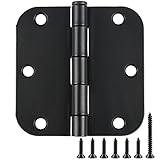
I remember staring at a pile of new door hinges, a rainbow of metal finishes, thinking, “How hard can this be?” Turns out, pretty darn hard if you grab the wrong ones. I’d bought a cheap set online for a closet door, figuring they were all the same. Big mistake.
The door sagged, wouldn’t close right, and squeaked like a banshee. It turns out, the simple question of ‘are door hinges standard’ is a lot more complex than you’d think. You can’t just grab any old thing off the shelf and expect perfection. Your doors deserve better.
Not All Hinges Are Created Equal: Size and Screw Patterns
The first thing you’ll notice when you start looking at door hinges is the sheer variety. And while many might look similar, there are key differences that make them NOT standard in the way you might assume. The most common misunderstanding is about the physical dimensions. For interior doors, you’re usually dealing with hinges that are 3.5 inches tall. That’s a pretty common size, and for good reason. It offers a good balance of strength and unobtrusiveness for most interior doors, like bedroom doors, bathroom doors, or closet doors that aren’t too heavy.
However, even within that 3.5-inch commonality, things diverge. The thickness of the hinge leaf matters. Most standard hinges for interior doors are 1/16th of an inch thick. Thicker hinges are generally for heavier doors, like exterior doors or those solid core interior doors that feel like they weigh a ton. If you put a flimsy hinge on a heavy door, you’re asking for trouble – sagging, binding, and premature wear. I learned this the hard way when I tried to hang a solid wood pantry door with what I thought were perfectly normal hinges. It ended up dragging on the floor within a month.
Then there are the screw holes. This is where the ‘standard’ concept really starts to fray. While the overall height and width might be common, the placement and number of screw holes can vary. Most 3.5-inch hinges will have three screw holes per leaf. But the distance between these holes, and the orientation (whether they are countersunk or not), can differ slightly between manufacturers. If you’re replacing an old hinge and the new one doesn’t line up perfectly with the old screw holes, you’re in for some patching and drilling. It’s not impossible, but it adds significant hassle.
For exterior doors, things get even less ‘standard.’ These hinges need to be more solid. They are often thicker, taller (4 inches is common), and wider. They also need to be more secure, often featuring security pins or non-removable pins to prevent the door from being lifted off its frame. So, while a casual glance might suggest uniformity, the reality is that ‘standard’ often refers to the most common configuration for a specific application, not a universal interchangeability. You really do need to measure your existing hinges or the space they fit into before you buy.
The Devil’s in the Details: Corner Radius and Pin Type
Beyond the basic dimensions and screw patterns, there are subtler, yet equally important, factors that differentiate door hinges. One of these is the corner radius. Hinges come with either a square corner or a rounded corner.
For most modern doors, you’ll see a rounded corner, typically a 1/4-inch radius. This is to match the rounded mortise (the cutout in the door frame and door) that’s most commonly cut by routers or chisels. If you have a square corner hinge and try to put it in a rounded mortise, it won’t sit flush, creating a gap and preventing the door from closing properly.
Conversely, a square-cornered hinge is designed for doors with a sharp, squared-off mortise. This was more common in older homes or with certain types of custom millwork. So, even if the hinge height and width are correct, the corner radius can be the dealbreaker.
I once spent an entire Saturday trying to figure out why a newly installed door felt “off.” It wasn’t binding, but it didn’t swing smoothly, and there was a slight but noticeable gap at the top. After much head-scratching, I realized the old hinges had square corners, and the new ones I’d bought, because they looked identical in size, had the more common rounded corners. The slight difference in how they sat in the mortise was just enough to throw everything off. It was a humbling reminder that you can’t just eyeball it. I ended up having to chisel out the mortises to fit the new hinges, a task I’d happily avoided by just checking the corner radius in the first place.
Another detail that often gets overlooked is the hinge pin. Most interior door hinges use a removable pin. (See Also: A Box Without Hinges Key )
This is handy for maintenance, like lubricating a squeaky hinge or removing the door for painting or access. You simply tap the bottom of the pin up with a nail and hammer. However, for security purposes, especially on exterior doors or in areas where security is a concern, you might find hinges with a non-removable pin (NRP) or a security stud.
NRP pins have a small cap on top that prevents them from being tapped out from the bottom. Security studs are little nubs on the side of the hinge that engage with the frame when the door is closed, making it impossible to remove the door even if the pins are somehow defeated. These features are definitely not ‘standard’ in the sense of being interchangeable with basic residential hinges.
The type of pin – whether it’s a standard fixed pin, a loose pin, or a security pin – also affects how the door can be removed. For most interior applications, a standard loose pin is perfectly fine and offers the most convenience. But if you’re looking for enhanced security, you’ll need to specifically seek out those NRP or security stud options. It’s a small detail, but it makes a big difference in the overall function and security of your door.
Finish and Material: More Than Just Looks
When people think about door hinges, the first thing they often notice is the finish. Satin nickel, oil-rubbed bronze, polished brass, black – the options seem endless. And while aesthetics are certainly a big part of choosing the right hinge, the material and the quality of the finish itself can actually impact durability and performance. You can’t just assume that a shiny chrome hinge will perform the same as a matte black one, even if they’re the same size and shape.
For residential use, most interior door hinges are made of steel, often with a zinc coating for rust resistance, and then plated or painted with the desired finish. Exterior hinges, however, need to be more solid and corrosion-resistant. They are often made of heavier gauge steel, solid brass, or even stainless steel. Brass is naturally resistant to corrosion, which is why it’s a popular choice for exterior hardware. Stainless steel offers excellent durability and is a great option in coastal areas or places with harsh weather. Using a lower-grade material on an exterior door will almost guarantee you a rusty, squeaky mess within a year or two.
The quality of the finish matters too. A cheap plating can wear off, chip, or scratch easily, revealing the base metal underneath and leading to rust. This is particularly noticeable on high-traffic doors where the hinges get a lot of use. I’ve had doorknobs and hinges with finishes that looked great for about six months, then started to peel and flake, making the whole door look cheap and neglected. It’s worth spending a little extra for a reputable brand known for durable finishes. I’ve found that brands that specialize in hardware tend to have better quality control than those that offer hardware as just one small part of a larger product line.
Even the pin itself can be made of different materials. While most are steel, some higher-end hinges might have stainless steel pins for added corrosion resistance.
This is especially important if you live in a humid environment. The internal mechanism, where the pin rotates within the hinge knuckles, also varies in quality. Better hinges will have smoother operation and less friction, leading to quieter and more effortless door movement. This is something you can often feel even when just handling the hinge in the store – it will feel more substantial and move more freely than a cheap, stiff one.
So, while the finish is important for matching your decor, don’t neglect the underlying material and construction quality. They are key to a hinge’s longevity and performance.
Weight Capacity and Load Bearing: The Unsung Heroes
This is where the ‘are door hinges standard’ question really bites people. Most people, myself included at one point, assume that all hinges are built to handle typical door weights. They’re not. Doors have weight, and hinges are tasked with supporting that weight, day in and day out. A standard interior door might weigh anywhere from 20 to 50 pounds. For these, your typical 3.5-inch, 1/16-inch thick hinges with three screws per leaf are usually sufficient. But what about those solid core doors, or exterior doors, or even large, heavy interior doors like pocket doors or barn doors? (See Also: Are Integrated Washing Machine Door Hinges Standard )
These doors can easily weigh 75, 100, or even 150 pounds or more. If you try to hang a heavy door on hinges that aren’t rated for that weight, you’re asking for disaster. The hinges will start to bend, the door will sag, the frame can get damaged, and the door might not close properly, if at all. I’ve seen this happen with heavy custom-made interior doors. The homeowner opted for what looked like standard hinges, and within a year, the door was practically unhinged. The solution was to replace the hinges with heavy-duty strap hinges or specialized door hinges designed for significant load-bearing capacity.
How do you know what weight capacity a hinge is rated for? This is where manufacturer specifications become important. While not always clearly marked on the packaging for basic hinges, reputable hardware manufacturers will provide this information. For standard interior doors, three hinges are usually the norm. For heavier doors, you might need four hinges, or even five, to distribute the weight more evenly and reduce stress on each individual hinge. The thickness of the hinge steel, the width of the knuckles, and the quality of the pin all contribute to a hinge’s load-bearing capability.
It’s not just about the weight of the door itself, but also the forces applied to it. A door that’s frequently slammed or yanked open can put extra strain on the hinges. This is why choosing hinges that are slightly over-engineered for your door’s weight is often a smart move. It’s better to have hinges that are more solid than you need than ones that fail prematurely. When in doubt, always check the manufacturer’s recommendations or consult with a hardware professional. It’s one of those things you don’t think about until it’s a problem, and then it’s a very visible, very annoying problem.
Common Mistakes and How to Avoid Them
So, we’ve covered dimensions, corner radii, materials, and weight. What are the biggest blunders people make when it comes to hinges? The most common one, I’d say, is assuming all hinges are interchangeable and buying the cheapest option available without checking specs. This leads to all the problems we’ve discussed: doors that sag, bind, don’t close, or look terrible because the finish has flaked off. It’s a false economy.
Another mistake is not considering the application. Someone might buy pretty decorative hinges for a heavy exterior door, or super-duty, industrial-looking hinges for a delicate interior closet door. Both look out of place and can perform poorly. You need to match the hinge to the door’s weight, frequency of use, and aesthetic. For example, I learned that for my workshop, where doors get a lot of heavy use and I’m often carrying tools, I need something more solid than what’s on my bedroom door. I ended up with some beefier, black industrial-style hinges that look the part and hold up beautifully.
People also often forget to check the “handing” of the door, though this is more for mortise locks and door knobs, it can sometimes affect hinge choice for very specific setups. For standard butt hinges, it’s not usually an issue. But if you’re buying specialized hinges, pay attention. A more common hinge-related error is not making sure the door and frame mortises are properly cut. If your existing mortises are too deep, too shallow, or not square, even the right hinge won’t sit correctly. This often requires a bit of wood filler, chiseling, or even routing to fix.
Here’s a quick table of common hinge types and their typical uses, along with my personal verdict on their suitability for the average homeowner:
| Hinge Type | Typical Use | My Verdict |
|---|---|---|
| Butt Hinge | Most interior and exterior doors | The go-to. Reliable and widely available. Stick to quality brands. |
| Ball Bearing Hinge | Heavy interior and exterior doors | Excellent for smooth, quiet operation on heavy doors. Worth the extra cost. |
| Gate Hinge (Strap Hinge) | Gates, large doors, rustic applications | Great for specific styles, but can be overkill for standard doors. Make sure proper support. |
| Continuous Hinge (Piano Hinge) | Cabinets, long doors, tight tolerances | Super useful for specific applications, but not for standard door hanging. |
| Spring Hinge | Self-closing doors (e.g., screen doors, utility rooms) | Can be a pain if you don’t need self-closing. Adjustability varies wildly. |
The biggest takeaway is: measure twice, buy once. Take a picture of your existing hinge, note its dimensions (height, width, thickness), check the corner radius, and count the screw holes. If you’re unsure, take the old hinge with you to the hardware store.
Are Door Hinges Standard? The Faq
What Size Are Standard Interior Door Hinges?
For most interior doors in residential settings, standard hinges are 3.5 inches tall. The thickness is typically 1/16th of an inch, and they have three screw holes per leaf. However, always measure your existing hinges or the door and frame opening to be sure, as slight variations can exist.
Can I Mix and Match Hinge Brands and Types on the Same Door?
Generally, no, you shouldn’t mix and match hinge brands or types on the same door unless they are specifically designed to be compatible or you’re only replacing one hinge due to damage. Different brands can have subtle variations in dimensions, screw hole placement, and leaf thickness, which can cause the door to hang unevenly. It’s best to replace all hinges on a door at once with matching ones for proper alignment and function. (See Also: Are Hinges Wheeels )
Do Exterior Door Hinges Have Different Standards?
Yes, exterior door hinges often have different standards. They are typically heavier duty, taller (e.g., 4 inches), and thicker to accommodate the weight and weather exposure of an exterior door. Security features like non-removable pins (NRP) or security studs are also more common on exterior hinges for added safety.
What Does the Radius on a Hinge Corner Mean?
The radius on a hinge corner refers to the shape of the end of the hinge leaf. Most modern hinges have a rounded corner (typically a 1/4-inch radius) to fit into the corresponding rounded mortise cut into the door and frame. Older homes or specific woodworking might use hinges with square corners, which fit into a sharp, squared-off mortise. Using the wrong corner radius will prevent the hinge from sitting flush.
How Many Hinges Do I Need for a Door?
For standard interior doors, three hinges are the most common configuration. For heavier doors, such as solid core interior doors or exterior doors, you might need four hinges, or even five, to properly support the weight and distribute the load, preventing sagging and making sure smooth operation.
Real-World Application: My Own Door Fiasco
Okay, let’s talk about a real-life screw-up that still makes me cringe a little. I was renovating a spare bedroom, and the door felt a bit flimsy. I decided to swap out the basic, hollow-core door for a solid-core one I’d found secondhand. It was a beautiful, heavy piece of wood. Naturally, I figured the hinges that came with the door were fine, or that any set of standard 3.5-inch hinges would do. I bought a new set in a nice matte black finish, excited about the upgrade.
The installation itself went okay. I got the door hung, and it swung. But it swung… badly. It scraped the carpet on one side and had a noticeable gap on the other. I adjusted the strike plate, I fiddled with the strike box, I even tried shimming the hinges. Nothing worked. The door just wouldn’t sit right. After about three frustrating hours, I finally pulled one of the old hinges off the original hollow-core door and compared it side-by-side with the new black ones.
The problem? The new hinges were a fraction of a millimeter thicker than the old ones. It wasn’t enough to be obvious unless you were looking for it, but with three hinges on a heavy door, that tiny difference added up.
It threw the entire door out of plumb. It was a classic case of assuming ‘standard’ meant ‘identical.’ The solution was to go back to the hardware store and find hinges that were specifically rated for heavier doors and had a slightly different construction, or to very carefully mortise out the frame and door to accommodate the new, thicker hinges. I ended up doing the latter, carefully chiseling out the recesses, but it was a painful lesson.
It hammered home the point that while there are common standards, the devil is truly in the tiny details when it comes to hardware.
My other big lesson came from a set of barn door hardware I installed. The company provided these massive, heavy-duty strap hinges. They looked impressive, but they were also incredibly stiff. My barn door would slam shut with alarming force. It turned out the ‘heavy-duty’ description was accurate for strength, but not necessarily for smooth operation in a residential setting. I ended up having to buy separate, lighter-duty, higher-quality roller hardware that provided a much more controlled and quieter movement. It’s a reminder that sometimes, the most visually imposing hardware isn’t the best for everyday use. You need to consider the actual function and how it will feel and sound in your home, not just how it looks.
Conclusion
So, to answer the question directly: no, door hinges are not entirely standard in a way that makes them universally interchangeable. While there are common sizes and configurations, especially for interior residential doors, subtle differences in thickness, corner radius, screw patterns, and weight ratings can mean the difference between a perfectly functioning door and a frustrating DIY disaster.
My advice? Stop assuming. Always take a moment to inspect the hinges you’re replacing. Measure them, photograph them, and note the details. If you’re buying new, compare them meticulously to what you have or to the door’s requirements. Don’t be swayed purely by price or by a finish you like if the underlying specs aren’t right for the job. Your doors will thank you for it, and you’ll save yourself a whole lot of headaches.
Next time you’re at the hardware store, or browsing online, remember that those little metal pieces are more complex than they appear. Are door hinges standard? Only if you’re talking about the most common, basic type for a specific job. For anything else, you need to do your homework.