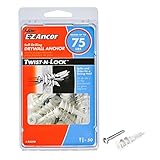
I remember the first time I hung a heavy mirror. The little plastic anchors that came with it felt… flimsy. So, I went to the big box store, saw these shiny metal things that promised the moon, and thought, ‘These must be the answer.’ I bought a pack, dutifully screwed them into the drywall without pre-drilling (that’s the whole point, right?), and hung my mirror. It held. For about three days. Then came a sickening creak, and down it came, taking a chunk of drywall with it. That was my introduction to the world of self-drilling drywall anchors and the question: are self drilling drywall anchors good?
Let me tell you, my initial experience left a bad taste in my mouth. I’ve spent years wrestling with different fasteners, from the simple nail-in anchors that barely hold a picture frame to the massive toggle bolts that look like they could hold up a bridge. Through trial and error, and a lot of wasted money, I’ve learned a thing or two about what actually works for hanging stuff on drywall without hitting a stud.
So, let’s cut through the marketing hype. Are self drilling drywall anchors good? It depends. They have their place, but they are far from the magic bullet some manufacturers would have you believe. I’m going to give you the real story, based on years of actually using these things on real walls in my house.
When Those Shiny Metal Bits Actually Work (and When They Don’t)
Look, I’m going to be blunt. If you’re trying to hang a lightweight piece of art, a small clock, or maybe a particularly thin mirror that weighs less than a bag of chips, those common threaded, metal self-drilling drywall anchors can work.
They’re designed to screw directly into the drywall without needing a pilot hole, which sounds great on paper. You just grab your screwdriver, give it a few turns, and boom – you’ve got a threaded hole ready for a screw. The threads bite into the gypsum and paper, creating a decent amount of grip for light loads.
I’ve used them for hanging posters in my workshop, and they’ve held up fine there. They’re quick, they’re easy, and for tasks where failure isn’t a catastrophe, they’re often good enough.
The problem arises when you start pushing their limits. The common advice you’ll find everywhere is that they’re great for ‘most household items.’ That’s where I disagree.
‘Most household items’ can cover a surprisingly wide range of weights and stresses. Think about shelving units, heavy mirrors, wall-mounted TVs, or even just a few books on a shelf. These anchors, especially the smaller ones, simply don’t have the holding power for anything substantial. The threads can strip out of the drywall if you overtighten them, or if the drywall itself is crumbly (which, let’s be honest, much of it is).
I once tried to hang a bathroom towel bar with a set of these, and it lasted about as long as my first attempt at making sourdough – a disaster. The bar sagged, the anchors pulled out slightly, and I was left with bigger holes than I started with.
The design itself is a limitation. They rely on the integrity of the drywall material for their grip. If your drywall is old, damp, or just poorly installed, these anchors are going to fail. They don’t distribute weight well across a larger area or into the wall cavity like some other anchors do.
It’s like trying to tie a knot in a piece of wet tissue paper – it just doesn’t have the strength. So, while they have a convenient application for the absolute lightest of loads, believing they’re a universal solution for hanging anything ‘heavy’ is a mistake I’ve seen plenty of people make, and one I made myself early on. You end up doing the job twice, and making it harder the second time. (See Also: Can Concrete Anchors Be Used In Brick )
What to Look for (and What to Ignore)
When you’re staring down the aisle at these things, it’s easy to get overwhelmed. They come in different materials – plastic, metal – and different sizes, often with a little screw already attached. The key thing to remember is that not all self-drilling anchors are created equal, and ‘self-drilling’ doesn’t automatically mean ‘heavy-duty.’ The most common type you’ll see are the pointy-ended metal ones with coarse threads. These are generally for the lightest loads. They often come pre-packaged with a screw. The screw head type (Phillips, flathead, Torx) is a minor consideration, mostly about what screwdriver you have handy.
What you should pay attention to is the weight rating. Manufacturers will often put a ‘maximum weight’ or ‘load capacity’ on the packaging. Here’s the catch: these ratings are usually for ‘shear’ load (hanging straight down) and often assume ideal drywall conditions. ‘Tension’ load (pulling straight out from the wall) is always much lower. I take these ratings with a grain of salt. If something says it can hold 50 lbs, I wouldn’t trust it with more than 10-15 lbs, maybe less, depending on the specific anchor and what I’m hanging. It’s better to be conservative. I’ve learned that if an anchor looks small and flimsy, it probably is.
On the flip side, ignore the marketing jargon that promises ‘instant,’ ‘easy,’ or ‘professional’ results with zero effort. While they are easy to install for what they are, calling them ‘professional’ is a stretch. Also, be wary of anchors that look like they have very shallow threads. Deeper, more aggressive threads will generally bite into the drywall better.
Some of the more solid-looking self-drilling anchors have a wider flange or collar at the base, which can sometimes help distribute a bit more weight, but they’re still fundamentally limited by the drywall itself. If you’re seeing a ton of them in a pack for under $5, they’re likely the basic, low-capacity kind. You might need to spend a bit more for something that offers even slightly better performance, though honestly, for anything beyond the absolute lightest duty, I’d be looking at other types of anchors anyway.
The Common Mistakes People Make
This is where I’ve seen the most DIY disasters happen. The biggest mistake, hands down, is using them for loads they’re simply not designed for. People see ‘self-drilling’ and ‘drywall anchor’ and assume it’s a catch-all solution for hanging anything. They’ll try to mount a TV, a heavy shelf, or a full medicine cabinet using these things, and then they wonder why it all comes crashing down. It’s like trying to build a house with toothpicks – it’s not what they’re made for.
Another common error is overtightening. These anchors rely on those threads biting into the gypsum and paper. If you keep screwing them in after they feel snug, you can strip the threads within the anchor itself or, worse, chew up the drywall so badly that the anchor spins freely. I’ve had anchors that just kept turning and turning, never getting tight. That’s a sign you’ve gone too far, and now you have a useless hole that’s bigger than you wanted and probably needs a patch. You need to feel for that point where it’s firm but not straining. It’s a delicate balance, and honestly, it’s one of the reasons I find them frustrating for anything where precision is needed.
Not checking what’s behind the wall is another classic blunder, though this applies to all anchors. While self-drilling anchors are often chosen for their speed and simplicity, assuming there’s nothing behind the drywall that could interfere with the anchor is a risk.
Electrical wires, plumbing pipes – these are all hidden dangers. While you’re unlikely to hit a stud (that’s the point, right?), you could still encounter unexpected obstructions or, more critically, electrical boxes or conduits. A quick tap test or a stud finder can at least give you some peace of mind, even if you’re not aiming for a stud.
My buddy once drilled into a junction box that way, and let’s just say the circuit breaker tripped with a spectacular shower of sparks. He learned to check behind the wall the hard way.
Finally, people often don’t consider the shear versus tension load. They hang something heavy that puts outward pull on the anchor, not just downward weight. For example, a towel bar that gets yanked on, or a shelf where books can slide forward. These forces exert much more stress than simple downward weight, and self-drilling anchors are notoriously weak in tension. They’re designed for shear loads, and even then, only for lighter ones. (See Also: Can Cords Be Used To Make Anchors Climbing )
Real-World Use Cases: When They Shine (and When to Just Say No)
So, where do these things actually shine? Honestly, it’s for the absolute lightest of duty. Think of hanging a single, lightweight picture frame that weighs maybe 2-3 pounds. Or a small, decorative wall hanging. I’ve used them in my kids’ rooms for hanging their own artwork that’s printed on cardstock – the kind of thing that would be a hassle to put a nail in, but is too light for anything more substantial. They are also handy for temporary fixes where you know you’ll be taking it down soon, like during a staging for a home sale, where you need things to look presentable quickly without making permanent holes.
Another area where they can be useful is when you’re working with a thicker or more solid type of drywall. Some commercial or specialty drywall boards have a denser core that can hold fasteners better. However, for standard residential drywall, their limitations become apparent quickly. I once tried to hang a pegboard on a wall that had some incredibly thick, heavy-duty drywall. The self-drilling anchors held surprisingly well there, probably because the material was so much stronger. But that’s an exception, not the rule.
Here’s a simple table to give you a clearer idea of what I mean. These are my general opinions based on years of banging my head against the wall (literally) trying to make them work:
| Item to Hang | Weight Class | My Verdict on Self-Drilling Anchors |
|---|---|---|
| Feather-light picture frame (under 5 lbs) | Very Light | Okay, if you’re careful. |
| Small mirror (under 10 lbs) | Light | Risky. I’d use something else. |
| Heavy mirror (over 10 lbs) | Medium-Heavy | Absolutely not. You’ll regret it. |
| Floating shelf with books | Heavy | Don’t even think about it. |
| Wall-mounted TV | Very Heavy | This is a joke, right? No. |
| Towel bar / Toilet paper holder | Light-Medium | Possible, but likely to sag or pull out over time. I’d avoid. |
| Light-duty cabinet | Medium | Forget it. |
When should you just say no? Any time you’re hanging something that’s valuable, heavy, or could cause damage if it falls. This includes anything you can’t afford to replace or repair if it drops. Always err on the side of caution. If you’re second-guessing, it’s a sign you should be using a more solid anchor, like a toggle bolt, a molly bolt, or even just finding a stud.
When to Upgrade: Better Anchors for Real Jobs
If you’ve tried those basic self-drilling anchors and found them wanting – which, let’s be honest, is most people’s experience beyond the lightest loads – it’s time to look at what else is out there. Thankfully, the world of drywall anchors is a bit more forgiving than the cheap metal screw-in types. The goal with better anchors is usually to either spread the load over a larger area, engage the wall cavity behind the drywall, or anchor directly into the studs (the wooden or metal framework behind the drywall).
For loads that are a step up from ‘feather-light’ but not ‘I’m hanging my entire collection of antique encyclopedias,’ I often reach for plastic expansion anchors. These require a pilot hole, which is a minor inconvenience compared to the security they offer. You drill a hole of the specified size, then tap the plastic anchor in. When you drive the screw into the anchor, it expands, pushing against the drywall from the inside.
These are significantly better than self-drilling anchors for anything over a few pounds. I’ve had good luck with them for hanging small shelves and bathroom accessories. Make sure you get the right size drill bit for the anchor, and don’t be afraid to give it a firm tap with a hammer to seat it properly.
Then you have the toggle bolts and molly bolts. These are the heavyweights of the drywall anchor world. Toggle bolts, in particular, are fantastic for heavy loads.
They have a spring-loaded ‘wing’ that folds up to go through a drilled hole, then opens up behind the drywall. You then tighten the screw, and the wing pulls against the back of the wall, creating a very strong hold. Molly bolts are similar but often have a metal sleeve that expands. These are the go-to for hanging TVs, heavy cabinets, or anything that needs serious holding power.
The downside is they require a larger hole to be drilled, and installation can be a bit more involved, but the peace of mind is worth it. I used molly bolts to hang a large, heavy mirror that I was terrified of falling, and it’s been solid as a rock for years. They feel… secure. (See Also: Can Anchors In Your Shoulder Break )
Like they’re actually holding onto something substantial.
Another option, and one that I consider the gold standard if it’s feasible, is hitting a stud. A stud finder is an invaluable tool for any DIYer. Once you locate a stud (those vertical supports are usually 16 or 24 inches apart), you can drive a long wood screw directly into it.
This is by far the strongest and most reliable method for hanging almost anything. Self-drilling anchors are designed precisely because people don’t want to find studs, or can’t. But if you can find one, use it. I once spent an hour trying to hang a shelf with anchors, only to realize I was one inch away from a stud.
A quick reposition and a couple of wood screws later, and it felt like it could support a small car. Don’t underestimate the power of the framing itself.
A Few Practical Tips and Final Thoughts
So, to wrap this up and give you some practical advice: When are self-drilling drywall anchors good? They’re good for what they are – a quick, easy fastener for the absolute lightest of loads where failure won’t cause damage or significant inconvenience. Think of them as a step up from a thumbtack, but not a replacement for proper hardware when the stakes are higher.
My first tip is to always buy more than you think you’ll need. Anchors can break, you might strip one out, or you might just decide to hang one more thing than you planned. It’s always better to have spares. My second tip is to understand the weight you’re trying to hang. Don’t guess. If it’s a mirror, weigh it. If it’s a shelf, estimate based on what you plan to put on it. Overestimating is always better than underestimating.
Third, if you’re unsure, always go for the stronger anchor. The extra few dollars for a good toggle bolt or molly bolt is well worth the peace of mind. I’ve learned this lesson the hard way, and the clean-up of a fallen object is always more expensive and time-consuming than buying the right fastener upfront. Fourth, practice on a scrap piece of drywall if you’re trying a new type of anchor, especially the expansion or toggle types. Get a feel for how they work, how tight they need to be, and what kind of hole they create. This will save you frustration on your actual project.
Finally, remember that drywall itself is not a structural material. It’s a covering. Anchors that rely solely on the gypsum and paper will always have limitations. For anything significant, your goal should be to engage the studs or use an anchor that distributes weight across a larger area of the wall. The ‘self-drilling’ aspect is convenient, but convenience shouldn’t outweigh security. For the record, I keep a small stash of the basic metal self-drilling ones for very specific, very light tasks, but they are not my go-to for anything important.
Final Verdict
So, the long and short of it: are self drilling drywall anchors good? For hanging a poster? Sure. For hanging that antique mirror your grandmother left you? Absolutely not. I’ve learned to be skeptical of anything that promises extreme ease and strength without any perceived effort or structural engagement. They have their niche, but it’s a very small one.
My advice is to understand their limitations and use them only where those limitations aren’t a problem. For everything else, invest a little more time and money into anchors that will actually hold, or better yet, find a stud. Your walls (and your belongings) will thank you.
If you’re still on the fence about what to use for your next project, a good rule of thumb is: if it weighs more than a loaf of bread, consider something other than a basic self-drilling anchor.