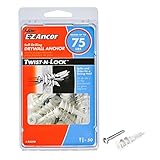
I remember standing in my new apartment, staring at a wall that felt more like a suggestion than solid structure. I wanted to hang a pretty heavy mirror, the kind that makes a statement. My buddy, bless his heart, grabbed a handful of those little plastic doodads and a screw. “Easy peasy,” he said. That mirror lasted about three days before gravity, and a poorly chosen anchor, won. It was a rude awakening that not all wall fasteners are created equal.
This brings us to a question that plagues DIYers and renters alike: are toggle bolts stronger than drywall anchors? The simple answer is usually yes, but it’s not just about the number printed on the package. It’s about understanding how they work, when to use them, and most importantly, when to avoid them like a bad roommate.
The Underwhelming Reality of Plastic Drywall Anchors
Let’s talk about the little guys first. You know them. Those tiny plastic cones or wings you jam into a pre-drilled hole in drywall. They’re cheap, ubiquitous, and often the go-to for hanging lightweight stuff like picture frames, small shelves, or that weird decorative plate you impulse-bought. The common advice is that these are fine for most things, but I’ve learned the hard way that ‘most things’ is a very slippery slope.
The basic idea behind a plastic drywall anchor, often called an expansion anchor, is pretty simple. You drill a hole, tap the anchor in, and then drive a screw into it. As the screw goes in, it expands the plastic, pushing it outwards against the drywall. This friction and outward pressure are supposed to hold the screw, and whatever it’s attached to, in place. The problem is, drywall itself is not a strong material. It’s basically gypsum plaster sandwiched between paper. When you’re relying on friction against something that crumbles easily, you’re on borrowed time for anything with a bit of heft.
I once tried to hang a modest-sized bookshelf – I’m talking maybe 30 pounds empty – using a half-dozen of these plastic anchors. It looked solid for a week. Then, one morning, I heard a sickening crunch. The shelf, along with about five books and a small ceramic cat, had detached itself from the wall, leaving a ragged hole and a scattering of plaster dust. The anchors themselves were bent and useless. It wasn’t just the weight; it was the sheer lack of grip on the drywall. The plastic anchors had simply ripped through the paper and gypsum.
The weight ratings you see on these anchors? They’re often optimistic, and they usually assume ideal conditions – perfect drywall, perfect installation, and a perfectly static load. Any vibration, any slight tug, or any uneven weight distribution can spell disaster. For anything that you wouldn’t want to fall and potentially break, or worse, cause injury, these basic plastic anchors are a gamble. I learned to treat them as strictly for things under five pounds, and even then, I’m often reaching for something more substantial. They’re convenient, sure, but convenience shouldn’t trump security when it comes to what’s holding your belongings to the wall.
Enter the Toggle Bolt: A Different Breed of Anchor
Now, let’s talk about toggle bolts. If you’re asking are toggle bolts stronger than drywall anchors, the answer is generally a resounding yes, and here’s why. Toggle bolts work on a completely different principle. Instead of relying on friction within the drywall, they distribute the load across a much larger surface area on the back side of the wall. This is where the real strength lies, especially in hollow walls like standard drywall.
A typical toggle bolt assembly consists of a bolt and a ‘toggle’ mechanism. The toggle is basically a metal bar with spring-loaded wings that fold flat to pass through a drilled hole. Once it’s on the other side of the drywall, these wings spring open, creating a much larger bearing surface. Think of it like a parachute opening up behind the wall. You then tighten the bolt, pulling the toggle mechanism flush against the back of the drywall. The bolt passes through this securely anchored toggle. This means the weight isn’t just resting on a small section of drywall; it’s distributed across the wings, which are effectively gripping the inside of the wall cavity.
I’ve used toggle bolts for hanging heavier items like large TV wall mounts, substantial shelving units, and even exterior light fixtures on brick walls where I needed a secure anchor point. One time, I had to mount a fairly heavy antique medicine cabinet in a bathroom with plaster and lath walls – notoriously tricky. The usual plastic anchors would have failed miserably. I opted for a medium-sized toggle bolt, and it held that cabinet like a rock. (See Also: Can Concrete Anchors Be Used In Brick )
I’ve yanked on it (gently, of course) and felt zero give. The difference in feel and security compared to a plastic anchor is night and day. The metal construction and the wide bearing surface of the opened wings provide a level of stability that plastic anchors simply cannot match.
The key advantage is that they bypass the inherent weakness of the drywall material itself. They anchor into the void behind the drywall, using the structural integrity of the wall cavity to support the load. This is why toggle bolts are often recommended for heavy-duty applications where a simple screw into drywall just won’t cut it. They offer a much higher weight rating because the load is transferred to a more solid system. It’s this fundamental difference in how they engage with the wall structure that makes them so much stronger.
When the Common Advice Gets It Wrong: Contrarian Views
Everyone says you can use basic plastic anchors for ‘light to medium duty’ things. I disagree. My experience shows that ‘medium duty’ is where they start to fail, and the definition of ‘medium duty’ is subjective and dangerous. What might be medium duty for a picture frame could be disastrous for a ceiling fan or a substantial light fixture. The common advice often understates the risk of drywall failure.
The problem is that the weight ratings provided by manufacturers for plastic anchors are often based on pulling straight down (shear strength) in a perfect scenario. They don’t always account for outward pull (tension strength), vibration, or the sheer brittle nature of drywall. I’ve seen plastic anchors rated for 50 pounds fail with less than 20 pounds attached. It’s a gamble I’m no longer willing to take.
My contrarian take is this: if you are in doubt about the weight, the longevity of the hold, or the potential for any sideways force or vibration, just skip the basic plastic anchors altogether. They are fine for that tiny, feather-light print, or perhaps a single poster. For anything else, you are investing in peace of mind by choosing a more solid solution. This is especially true if you’re renting and don’t want to be responsible for patching larger holes caused by failed anchors. It’s cheaper to buy a better anchor once than to repair drywall damage later.
The common wisdom also often fails to differentiate between different types of drywall and wall construction. A heavy-duty plastic anchor might perform better in thick, solid plaster walls than in thin, standard drywall. However, most people are dealing with standard 1/2-inch or 5/8-inch drywall. In these common scenarios, the limitations of the material are most important. The advice to “just use the right size plastic anchor” is insufficient because it ignores the fundamental weakness of the substrate.
A Practical Comparison: Toggle Bolts vs. Drywall Anchors
To really hammer home the difference, let’s look at how they stack up in real-world scenarios. When you’re deciding between a toggle bolt and a standard plastic drywall anchor, it’s not just about the weight rating. It’s about the application and the type of wall you’re dealing with.
Here’s a breakdown: (See Also: Can Cords Be Used To Make Anchors Climbing )
| Feature | Plastic Drywall Anchor (Expansion Type) | Toggle Bolt |
|---|---|---|
| How it Works | Expands against drywall via screw friction. | Wings open on the back of the wall, distributing load across cavity. |
| Wall Type Suitability | Best for hollow walls (drywall, plasterboard) for light loads. Can also work in solid walls, but less effective than lag screws. | Excellent for hollow walls (drywall, plasterboard) and plaster & lath. Requires a larger hole. |
| Typical Weight Capacity (per anchor, rough estimate) | 10-50 lbs (highly variable, manufacturer specific, very dependent on installation) | 50-150+ lbs (significantly higher and more reliable for hollow walls) |
| Installation Difficulty | Easy: Drill hole, tap in, insert screw. | Moderate: Drill a larger hole, insert toggle, pull through, tighten bolt. Can be fiddly. |
| Hole Size Required | Small, depends on anchor size. | Larger, depends on toggle size (can be up to 1 inch). |
| Best For | Very light items: small pictures, thin shelves, decorations. | Heavier items: TV mounts, large shelves, mirrors, cabinets, light fixtures. |
| My Verdict | Use only for absolute lightest loads. Often unreliable. | My go-to for anything with significant weight or potential for movement. Superior security. |
As you can see, the toggle bolt offers a significant advantage in holding power and reliability for hollow walls. The larger hole required is a small price to pay for the increased security. I’ve learned to keep a variety of toggle bolts on hand – from smaller ones for medium-duty shelves to heavy-duty ones for TV mounts. It’s the kind of small investment that saves you headaches and potential damage down the line. The common advice often pushes plastic anchors as a universal solution, but my experience paints a different picture, one where the toggle bolt is often the smarter, more secure choice.
When Toggle Bolts Might Not Be Your Hero
Okay, so I’ve been singing the praises of toggle bolts, but they aren’t a magic bullet for every situation. There are definitely times when you might want to look elsewhere, or at least reconsider their use. Understanding these limitations is just as important as knowing their strengths.
Firstly, they require a larger hole. This isn’t a huge deal if you’re hanging something substantial and a slightly bigger hole won’t be noticeable, or if you’re painting over it later. But if you’re trying to hang something very small where a large hole would be unsightly, or if you’re in a situation where minimizing wall damage is most important (like in a high-end rental with strict rules), you need to be aware of the size of the opening you’ll be creating. I’ve had to patch holes from toggle bolts that were bigger than I anticipated, especially with the larger, heavy-duty versions. It requires a bit more spackle and sanding than a tiny hole from a plastic anchor.
Secondly, toggle bolts are designed for hollow walls. If you’re drilling into solid wood, concrete, or brick, a toggle bolt is usually overkill and won’t even work as intended. For solid materials, you need lag screws, concrete anchors (like wedge anchors or sleeve anchors), or masonry screws. Trying to use a toggle bolt in solid material is like trying to parachute into a brick building – it just doesn’t make sense. I learned this the hard way when trying to mount a heavy outdoor planter bracket to a solid brick wall. I initially thought about toggle bolts, then remembered that brick requires specific masonry fasteners. Thankfully, I caught myself before drilling a bunch of large, useless holes.
Another consideration is the depth of your wall cavity. Most standard drywall walls have about 1/2 inch to 5/8 inch of drywall, leaving a cavity of roughly 3/4 inch. Standard toggle bolts are designed for this. However, if you have very thin drywall, or walls with odd framing or insulation that obstructs the toggle from opening fully, they might not seat properly. Some specialized toggle bolts are designed for shallower cavities, but it’s something to be mindful of. You can’t just assume the toggle will deploy perfectly every time without checking. Sometimes, you have to feel for that tell-tale ‘pop’ as the wings open, or even peek through the hole if you can.
Finally, there’s the sheer fiddliness of some toggle bolt installations. While generally straightforward, getting the bolt through the toggle can sometimes be a wrestling match, especially with the larger ones. Holding the toggle in place while tightening the bolt can also be awkward. It’s not rocket science, but it’s certainly more involved than screwing in a plastic anchor. For extremely light items where speed is of the essence and you’re absolutely sure of the weight, a plastic anchor might be faster, though I’d still lean towards a better anchor if given the choice.
Faq: Your Burning Questions Answered
Are Toggle Bolts Better Than Screw-in Drywall Anchors?
Yes, generally toggle bolts are significantly stronger and more reliable than basic screw-in plastic drywall anchors, especially for heavier items. Screw-in anchors rely on their threads gripping the drywall, which can still pull out under significant load. Toggle bolts, by deploying wings on the back of the wall, distribute the weight over a much larger area, providing a far more secure hold in hollow walls.
Can I Use Toggle Bolts for Mounting a TV?
Absolutely. For most standard drywall installations, toggle bolts are an excellent choice for mounting a TV, especially if the wall studs aren’t conveniently located where you need them. Use heavy-duty toggle bolts specifically rated for the weight of your TV and mount. Always check the weight capacity of the toggle bolts and compare it to your TV and mount’s combined weight. It’s better to be over-engineered than to have your TV fall. (See Also: Can Anchors In Your Shoulder Break )
What Is the Weight Limit for a Toggle Bolt?
The weight limit for a toggle bolt varies significantly depending on the size and type of the toggle bolt. Small toggle bolts might hold 50 pounds, while larger, heavy-duty versions can safely support 100-150 pounds or even more. Always check the manufacturer’s specifications for the specific toggle bolt you are using. Remember that these ratings are often for shear strength (pulling straight down); tension strength (pulling away from the wall) might be lower.
How Do I Install a Toggle Bolt?
Installation involves drilling a hole in the drywall (the size depends on the toggle bolt), then folding the toggle’s wings flat to push it through the hole. Once the toggle is behind the wall, the wings spring open. Pull the bolt back so the toggle is snug against the back of the drywall, then insert and tighten the bolt into the toggle. This secures the anchor to the wall. Make sure the toggle has fully deployed and is seated flat against the back of the wall before applying any load.
My Go-to Anchor for Peace of Mind
After years of trial and error, and more than a few drywall repairs, I’ve settled on a hierarchy for wall anchors. For anything that needs to hold more than a few pounds, or anything that I wouldn’t want to risk falling, toggle bolts are my go-to. They offer a level of security that plastic anchors just can’t match, especially when you’re dealing with the inherent limitations of drywall. They require a bit more effort to install, and a slightly larger hole, but the peace of mind is well worth it.
I’ve learned that the advertised weight limits on cheap anchors are often a suggestion at best. The real world, with its vibrations, slight tugs, and the sheer unpredictability of building materials, is a much harsher testing ground. Toggle bolts, with their mechanical advantage of deploying on the back of the wall, provide a genuinely reliable hold. They are a small investment that pays off in preventing damage, saving money on repairs, and making sure your decorations and fixtures stay exactly where you put them.
So, when you’re faced with a wall and a project, remember this: are toggle bolts stronger than drywall anchors? Almost always, and for good reason. Don’t be afraid to drill that slightly larger hole. Your walls (and your belongings) will thank you for it.
Final Verdict
So, to directly answer the question: are toggle bolts stronger than drywall anchors? In nearly every practical scenario involving hollow walls, yes, they are. The fundamental difference in how they work – distributing the load on the back of the wall versus relying on friction within the drywall itself – makes toggle bolts far superior for anything beyond the lightest loads.
I’ve learned to be skeptical of those little plastic anchors when anything weighs more than a framed photo. My advice? If you’re hanging anything substantial – shelves, mirrors, TV mounts, cabinetry – invest in toggle bolts. The extra few dollars and minutes spent on installation are insignificant compared to the potential cost of a failed anchor and damaged belongings, or worse.
Before you start drilling, assess the weight of what you’re hanging and the type of wall you have. If it’s standard drywall and there’s any doubt about the load, reach for the toggle bolts. It’s the honest, straightforward way to make sure your hard work stays put.