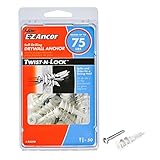
I remember staring at that ridiculously heavy mirror I wanted to hang in the hallway. It wasn’t just big; it was the kind of big that makes you question your life choices and the structural integrity of your drywall. I’d already messed up a few shelves that way, ending up with sad, sagging lines and holes that looked like a tiny woodpecker had a field day. So, when I wondered, ‘are there screw anchors 8 long?’, I was hoping for a magic bullet. A savior for those times when you need serious holding power but don’t want to go drilling into studs every single time.
The truth is, the world of anchors can feel like a maze. You see tons of options, and they all claim to be the best. But when you need something specific, like an anchor that’s actually, you know, long enough for real purchase, things get murky.
Why You Might Actually Need 8-Inch Screw Anchors
Look, most of the time when people talk about screw anchors, they’re thinking about those little plastic doodads you jam into drywall for a picture frame. And yeah, for a lot of light stuff, they work fine. But then you get into those projects where you’re hanging something substantial – a heavy mirror, a substantial shelf unit, maybe even a small cabinet or a television mount that isn’t directly into a stud. That’s when you start thinking, ‘What if I need more depth? Are there screw anchors 8 long?’
The simple answer is: yes, you can find anchors that are designed to accommodate screws of that length, but it’s not as straightforward as finding an ‘8-inch anchor’ pre-packaged with an 8-inch screw. Often, what you’re looking for are anchors that are long enough to accept an 8-inch screw, or you’re looking at specific types of anchors designed for substantial loads, which might coincidentally allow for longer screws. It’s more about the application and the material you’re anchoring into than a specific ‘8-inch anchor’ size that’s universally available.
Think about it. Drywall is usually only about half an inch thick. So, an 8-inch screw is going to go way past the drywall. This means you’re not just anchoring into drywall anymore; you’re anchoring into whatever is behind the drywall. That could be insulation, a void, or even a wall stud. If you’re using an anchor that’s designed for drywall only, an 8-inch screw is overkill and won’t necessarily give you better holding power than a shorter screw used correctly. The anchor itself needs to be designed to spread out or grab onto something substantial behind the surface material.
My first encounter with needing something more solid was when I decided to mount a large, antique cheval mirror. It probably weighed 50-60 pounds. My usual go-to anchors were laughably inadequate. I ended up having to find a way to locate studs, which, of course, were spaced perfectly not where I wanted to hang the mirror. That’s when I really started digging into what was out there for heavier loads. I learned that ‘long’ is relative, and the anchor’s design for gripping the material behind the surface is way more important than just the length of the screw you plan to use.
The key takeaway here is that if you’re contemplating using an 8-inch screw, you’re likely dealing with a heavy item or a situation where you need to bridge a significant gap behind the mounting surface. This means you need an anchor system that can capitalize on that length, not just accommodate it. It’s about the mechanics of how the anchor grips – whether it expands, wedges, or toggles behind the wall. An 8-inch screw alone in a standard plastic anchor is going to fail, spectacularly, and potentially take a chunk of your wall with it.
What to Actually Look for (hint: It’s Not Just Length)
So, you’ve got a heavy item, you’ve measured your wall, and you’re thinking, ‘are there screw anchors 8 long?’ The real question isn’t just about finding an anchor that fits an 8-inch screw, but one that works with it effectively. This means looking at the anchor’s type and how it interacts with the material behind your wall surface. Most of the time, if you’re contemplating an 8-inch screw for drywall, you’re probably going to end up needing a toggle bolt or a heavy-duty hollow wall anchor.
Toggle bolts are the old-school workhorses for this. They have two or four metal legs that fold up when you insert them into a hole, and then they spring open behind the wall. You then tighten the screw, and the toggle pulls against the back of the wall material, distributing the load over a wider area. The length of the anchor body itself, and the screw it uses, needs to be sufficient to allow that toggle to deploy and create a strong hold. An 8-inch screw will often be used with these because the anchor body might be several inches long, and you need the screw to pass through the wall, the anchor body, and then have enough thread engagement with the deployed toggle.
Then there are the newer, more advanced hollow wall anchors. Some of these use a plastic or metal mechanism that expands, wedges, or even spins behind the wall to create a secure point. Many of these are designed for significant weight ratings. While they might not always require an 8-inch screw, some of them have bodies that are long enough or are designed to accept longer screws to achieve their maximum load capacity, especially if you’re going through thicker materials or multiple layers. (See Also: Can Concrete Anchors Be Used In Brick )
Here’s where I learned a hard lesson: just because an anchor looks hefty doesn’t mean it’s right for your specific wall. I once bought some heavy-duty metal anchors that were rated for, like, 100 pounds. Great, I thought. Then I realized they were designed for solid walls, like concrete or plaster over lath, and were a nightmare to install in standard drywall. They weren’t designed to expand or toggle effectively behind the hollow space. The anchor itself needs to be compatible with the type of wall you have. For drywall, it’s generally about finding anchors that can span the hollow cavity.
When you’re looking, pay close attention to the manufacturer’s specifications. They’ll usually tell you the maximum weight capacity, the size of the hole you need to drill, and importantly, the type of wall material they’re designed for (drywall, plaster, concrete, etc.). If you see anchors that are several inches long and designed for hollow walls, they might be the candidates for use with an 8-inch screw. The screw length is important, but it’s the anchor’s ability to grip the back of the wall that provides the strength.
Comparing Common Heavy-Duty Anchors for Longer Screws
| Anchor Type | Typical Material | How it Holds | Opinion/Verdict |
|---|---|---|---|
| Toggle Bolt (Standard/Heavy Duty) | Drywall, Plaster | Legs spring open behind the wall, distributing load. | Reliable for heavy items. Can be fiddly to install, requires a larger hole. Excellent if you need that 8-inch screw’s reach. |
| Molly Bolt / Sleeve Anchor | Drywall, Plaster | Metal sleeve expands behind the wall as screw is tightened. | Good for medium-to-heavy loads. Can be easier to install than toggles, but the expansion needs a good grip. |
| Screw-In / Expansion Anchors (for hollow walls) | Drywall | Threads into the drywall, expanding mechanism or wing deploys behind. | Convenient for lighter-to-medium loads, fast installation. Longer versions can accept longer screws, but check weight ratings carefully. |
| Lag Shield Anchors (with Lag Screws) | Masonry, Wood Studs (sometimes used in plaster/lath) | Metal shield expands into a pre-drilled hole. Used with lag screws. | Primarily for masonry or direct wood, but can be used with specific techniques in older plaster. Less common for standard drywall scenarios with long screws. |
So, when you’re asking ‘are there screw anchors 8 long?’, you’re really asking about anchors that can handle significant weight in hollow walls, and that often means they are designed to be used with longer screws to achieve their full potential. Don’t just grab the longest screw you can find; make sure the anchor system is designed for the job.
Common Mistakes When Using Long Screws and Anchors
I’ve made enough mistakes with anchors and screws to write a book, and the ones involving trying to use overly long screws with the wrong anchors are some of the most frustrating. It’s not just about wasting time and making more holes; it’s about potential damage. One of the biggest blunders is assuming that an 8-inch screw automatically means you need an 8-inch anchor. That’s usually not how it works. The anchor’s length is about its body and its ability to grab behind the wall surface. The screw is what you drive through the anchor and into whatever it’s gripping.
Another common pitfall is drilling the wrong size hole. Too small, and you won’t get the anchor in. Too big, and it won’t have anything to grip onto, especially with anchors that rely on friction or expansion. For toggle bolts, you need a hole large enough for the collapsed toggle to pass through, but not so large that it falls out. For screw-in anchors, the pilot hole size is important for proper threading and expansion. I once drilled a hole too big for a set of heavy-duty hollow wall anchors, and when I tried to screw them in, they just spun uselessly. It was a mess.
Then there’s the issue of material compatibility. Just because an anchor is rated for 100 pounds doesn’t mean it will hold 100 pounds in your wall. If you have old, crumbling plaster, or very thin drywall, even the best anchor might struggle. Or, as I mentioned before, using an anchor designed for solid concrete in drywall. It’s a recipe for disaster. The anchor needs to be designed to deploy effectively in the space behind the wall surface. If there’s no void, a toggle bolt is useless.
Over-tightening is another classic move. You’re trying to get it snug, and you crank on that screw until the anchor spins, or worse, you strip the threads of the anchor itself. This renders the anchor useless. You want it tight and secure, but not so tight that you damage the anchor or the wall material around it. Sometimes, just a firm resistance is all you need. You’ll feel it seat properly.
And the most ironic mistake? Using an 8-inch screw when you don’t need to. If the item you’re hanging is relatively light, or if you can hit a stud with a shorter screw, an 8-inch screw is just asking for trouble. It’s more likely to bend, strip, or just not engage properly with the anchor if the anchor itself isn’t designed for that depth of engagement. My friend tried to hang a floating shelf with some really long screws into flimsy anchors, thinking longer was better. The shelf ended up pulling away from the wall, and the anchors just tore out a huge chunk of drywall.
Before you even start, always read the instructions that come with your anchors. They’ll tell you the recommended screw size, the hole size, and the weight rating for specific wall types. It sounds obvious, but in the heat of a DIY project, people (myself included) sometimes skip this step. And when you’re asking ‘are there screw anchors 8 long?’, remember that the ‘long’ part is only effective if the anchor is designed to use that length. It’s about the system, not just the screw. (See Also: Can Cords Be Used To Make Anchors Climbing )
Common Anchor Installation Blunders
- Wrong Hole Size: Too big = no grip; too small = won’t fit or anchor breaks.
- Material Mismatch: Using anchors for solid walls in hollow walls, or vice-versa.
- Over-Tightening: Strips anchor threads or damages wall material.
- Ignoring Load Ratings: Exceeding the anchor’s stated weight capacity.
- Not Engaging the Back of the Wall: Using anchors that require backing (like toggles) in thin material with no void.
- Using the Wrong Screw Length: A screw that’s too short won’t engage the anchor mechanism; too long can be problematic if not designed for it.
When an 8-Inch Screw might Be Your Friend
Okay, so we’ve established that just asking ‘are there screw anchors 8 long?’ isn’t the whole story. But there are specific scenarios where those long screws, paired with the right anchors, can genuinely save your bacon. The primary reason you’d reach for an 8-inch screw is when you need to bridge a significant void or when you’re trying to get purchase into something solid behind a weaker surface. This often comes up in older homes or in situations where standard stud placement doesn’t align with your mounting needs.
One situation is anchoring into plaster walls that have a significant air gap behind the lath. Plaster itself can be brittle, and the lath (wooden strips) isn’t always strong enough on its own for heavy items. In these cases, a long screw might be needed to pass through the plaster, the void, and then engage with the lath, or even better, with a toggle bolt that deploys behind the lath and plaster. The length of the screw makes sure it can reach and effectively deploy the anchor mechanism.
Another prime example is mounting something to a hollow-core door. These doors are basically two thin layers of wood or composite with a hollow space in between. A short screw will just pull out immediately. You need a long screw to go through the first layer, span the void, and engage the second layer securely, often using a specific type of anchor designed for hollow doors that will expand or toggle on the back side. An 8-inch screw might be overkill for many doors, but the principle of needing length to span the gap is the same.
Consider mounting electrical boxes or conduit supports on a surface where there’s a significant gap to a solid backing. Maybe you’re running conduit along a wall in a workshop, and there’s a slight imperfection or unevenness, or you need to clear some existing wiring. You’ll need long screws to keep the box or bracket firmly against the wall surface while still allowing the anchor to provide the holding power. Here, an 8-inch screw might not be for weight but for reach and stability.
I had a situation where I was building a custom storage unit in a garage. The studs were a bit wonky, and I wanted to make sure the main frame was perfectly plumb and securely attached. I ended up using some heavy-duty lag shields with lag screws that were fairly long (around 6 inches, not quite 8, but the principle applies). This allowed me to get past some unevenness in the wall surface and get a really solid bite into the framing behind it, making sure the entire unit was rock-solid. The length was key to bridging that gap and making sure the anchor could do its job effectively.
Finally, think about mounting items where you need to distribute weight over a larger area to avoid damaging a delicate surface. For instance, if you have a thin plywood backing that you’re mounting to a wall, and you need to hang something heavy on that plywood, using longer screws with appropriate anchors behind the plywood can help spread the load more effectively onto the wall. The 8-inch screw would pass through the plywood and then into the anchor system in the wall.
The key is always to match the screw length to the anchor’s requirements and the thickness of the materials you are going through, as well as the need to span a void or reach a solid substrate. If you’re dealing with an 8-inch screw, you’re usually dealing with a situation that demands more than just a basic plastic anchor. You’re looking for a solid anchoring system that can use that length for true holding power.
DIY vs. Pro: When to Just Find the Stud
Here’s the contrarian take: everyone is obsessed with finding the “perfect” anchor. They’ll spend hours researching toggle bolts, molly bolts, snap toggles, and a dozen other gizmos. And sure, for some applications, especially if you absolutely cannot hit a stud, these anchors are your best bet. But let’s be honest. If you’re asking ‘are there screw anchors 8 long?’ and contemplating using them, you’re probably trying to hang something pretty heavy or in a tricky spot. In many, many cases, the absolute best, strongest, and most reliable method is still finding a stud.
Why do I say this? Because anchors, even the heavy-duty ones, have limits. They rely on the integrity of the wall material around them and their ability to deploy effectively. A stud is a solid piece of wood or metal designed to bear significant weight. There’s no guesswork, no worry about the anchor spinning, no concern about the drywall crumbling around it. A screw driven directly into a 2×4 stud is almost always going to be stronger than any anchor you can put in drywall alone. (See Also: Can Anchors In Your Shoulder Break )
I learned this the hard way when I tried to hang a very heavy tool cabinet in my garage using only heavy-duty toggle bolts. I spent a fortune on the bolts and carefully installed them. For a while, it was fine. Then, one day, I heard a groan, and the cabinet started to sag. One of the toggles had started to pull out, likely due to vibration from using my impact driver nearby. I had to take everything down, patch the wall, and then find the studs, which, naturally, were not perfectly spaced for my cabinet. It was a frustrating day, filled with wasted money and extra work.
Now, I’m not saying anchors are useless. Far from it. For hanging a picture frame, a light shelf, or even a smaller TV mount, anchors are fantastic and often the only practical solution. But when you’re talking about significant weight – anything that could cause serious injury or damage if it falls – I become a stud-finder fanatic. My stud finder is probably one of my most trusted tools, and I will spend extra time hunting for those studs, even if it means shifting my mounting location a few inches. It’s usually worth the effort.
The allure of anchors, especially long ones, is that they offer a perceived flexibility – you can mount things anywhere. But that flexibility comes with a compromise in brute strength and long-term reliability compared to solid wood. If you can see your wall studs (either by looking for them, using a stud finder, or even carefully tapping to find the solid sound), I’d strongly recommend prioritizing them, especially for anything over, say, 20-30 pounds or anything that is valuable or dangerous if it falls.
So, while yes, there are screw anchors that can accommodate 8-inch screws and offer substantial holding power, always ask yourself: is this the best solution, or just the easiest solution for a moment? If you can locate and use studs, that’s generally the more solid and worry-free approach. Anchors are a great tool for when studs aren’t an option, but they are rarely the superior choice when studs are available. Your wall (and your sanity) will thank you.
Faqs About Long Screw Anchors
What Are the Strongest Anchors for Drywall?
For sheer holding power in drywall, heavy-duty toggle bolts are often considered the strongest, especially for static loads. Their ability to distribute weight across a large area of the back of the drywall makes them very secure. Newer, high-strength hollow wall anchors that use solid expanding or self-drilling mechanisms can also offer very high weight ratings, sometimes rivaling toggles.
Can I Use an 8-Inch Screw in Drywall Without a Stud?
Yes, you can use an 8-inch screw in drywall without a stud, but you absolutely must use an appropriate anchor system designed for hollow walls. A plain 8-inch screw driven into drywall alone will not hold any significant weight and will likely just tear out a large hole. You’ll need anchors like heavy-duty toggle bolts or solid hollow wall anchors that can deploy and grip the material behind the drywall.
How Do I Know If I Need a Long Screw Anchor?
You typically need a long screw anchor when you are mounting something heavy, or when you need to span a significant gap behind your mounting surface. This could be due to an uneven wall, a hollow-core door, or if you are trying to achieve maximum holding power by engaging as much of the wall material as possible. If you’re using a screw that’s much longer than the thickness of your surface material (like drywall), it’s a good indicator you’ll need an anchor that can use that length.
What Is the Difference Between a Screw Anchor and a Toggle Bolt?
A screw anchor is a broad term for any device inserted into a wall to allow a screw to be fixed. A toggle bolt is a specific type of screw anchor. Toggle bolts feature a spring-loaded “butterfly” or “toggle” that folds up to be inserted through a hole and then springs open behind the wall surface, providing a wide surface area to distribute the load. Other screw anchors might expand, wedge, or self-drill.
Conclusion
So, to answer the question directly: yes, there are screw anchors that are compatible with and designed to be used with 8-inch screws, often because the anchor itself has a long body or a mechanism that requires that length to deploy properly. These are typically heavy-duty options like toggle bolts or advanced hollow wall anchors, meant for situations where you need serious holding power and can’t hit a stud. It’s never as simple as just grabbing a long screw; the anchor is the key component that makes it work.
Remember, the length of the screw is only useful if the anchor can actually grip something substantial behind your wall. Always check the manufacturer’s ratings and make sure the anchor is designed for your specific wall type. If you’re not sure, or if the item is extremely heavy or important, take the extra time to find a stud. It’s usually the most reliable method.
Next time you’re staring at a heavy object and a blank wall, weigh your options carefully. Sometimes, the longest screw is just the beginning of the story.