I remember staring at that ridiculously heavy mirror, the one I snagged for a steal at a garage sale. The instructions were simple: two plastic anchors, screw them in, hang the mirror. Easy, right? Famous last words. About 3 AM the next morning, I was jolted awake by a sickening CRACK. The mirror, along with a good chunk of my wall, decided gravity was more important than my DIY dreams. That night taught me a brutal lesson about relying on the bare minimum when it comes to hanging things.
It’s a question many of us have mumbled under our breath while staring at a wall and a heavy object: are two plastic drywall anchors stronger than one? It sounds logical, two is more than one, so it must be better. But the real answer isn’t as straightforward as you might think, and frankly, it depends on more than just the number of anchors.
The Myth of the Double Anchor
Look, on the surface, the idea that two plastic drywall anchors are stronger than one seems like basic math. More is more, right?
But when you’re talking about load-bearing capacity in drywall, it’s less about simple addition and more about distribution and the type of stress you’re putting on the wall. A single plastic anchor, especially those cheap, tapered ones that flare out behind the drywall, has a specific weight rating. You double that number, and you’re not necessarily doubling the actual holding power. Why?
Because drywall itself is the weak link. It’s basically compressed gypsum dust and paper. It crumbles. It cracks.
And if the load isn’t perfectly distributed between those two anchors, one will take the brunt of the force and fail, which then puts all the stress on the other, leading to a spectacular wall collapse. I learned this the hard way with that mirror I mentioned earlier.
I thought two anchors would be fine; they were spaced about 18 inches apart, and the mirror wasn’t that heavy. But the uneven pull and the slight flex in the drywall meant one anchor started to give, and the whole thing went south. It was a mess, and I ended up having to patch a hole the size of a dinner plate.
The common advice you’ll find is that for heavier items, you should always use more anchors. And while that’s generally true, the type of anchor and the way you install them is far more important than just saying ‘two is better than one’. For instance, a single, heavy-duty toggle bolt anchor can often hold significantly more weight than two or even three of those flimsy plastic ones.
The physics of it are that the toggle bolt spreads its load across a much larger area of the wall’s backside, basically turning your drywall into a slightly more solid structure. Those little plastic ones? They rely on friction and that small flared section behind the gypsum.
If that area isn’t perfectly clean or if the drywall is a bit crumbly, you’re already starting with a compromised hold. So, while technically two might offer a bit more than one, it’s a fragile alliance that often fails under real-world pressure. It’s like putting two skinny toddlers on a seesaw; if one leans too far, the other goes flying. You need something more substantial, more stable.
The real problem with the ‘two is better than one’ mentality for basic plastic anchors is that it encourages a false sense of security. People see two holes, two anchors, and they think ‘bulletproof’. But the reality is that the weakest point in any hanging scenario is often the material you’re screwing into. Drywall is notorious for its low shear strength and its tendency to break under pressure.
So, while adding a second anchor might distribute the load slightly, it doesn’t fundamentally change the fact that you’re still relying on fragile gypsum board to hold your precious possessions. It’s a bit like wearing two band-aids instead of one on a deep cut – it feels better, but it’s not going to stop the bleeding.
For anything more than a very lightweight picture frame, you should be looking at anchors designed for heavier loads, or ideally, finding a wall stud. That’s where true strength lies.
When I talk about load-bearing capacity, I’m not just pulling numbers out of thin air. Manufacturers usually provide a weight rating for their anchors. For those basic plastic ones, you might see ratings of, say, 20-50 pounds.
But that’s often in ideal conditions, into solid wood behind the drywall. In hollow drywall, that number plummets.
So, if your mirror weighs 30 pounds, and you use two anchors rated at 25 pounds each (in drywall), you’re theoretically at 50 pounds. But that doesn’t account for dynamic loads – like someone bumping the wall, or the weight shifting slightly. It’s a gamble.
The real answer to whether two plastic anchors are stronger than one is usually a disappointing ‘not reliably enough for anything important’.
When Two Might Not Be Enough (or Even Helpful)
Let’s get one thing straight: those cheap plastic anchors, the ones that look like little ribbed tubes, are fine for hanging a lightweight poster or a small, unframed picture. They work by expanding behind the drywall when you screw them in. That expansion creates a small, localized grip.
Now, if you use two of these side-by-side, roughly 4-6 inches apart, you might get a little more holding power. But the important factor here is how the weight is applied. If it’s a perfectly balanced, static load, like a framed picture hanging straight down, then yes, the load is shared.
However, most things we hang aren’t perfectly static or balanced. Think about a shelf with books on it, or a coat rack. The weight isn’t just pulling straight down; it’s often creating a use effect, pulling away from the wall. In this scenario, the two anchors are still fighting against the same weak drywall material, and the anchor closest to the edge of the load or the point of use will take most of the strain. (See Also: Can Concrete Anchors Be Used In Brick )
I learned this lesson the hard way when I tried to hang a relatively modest set of wall-mounted spice racks in my kitchen. I used four of the cheap plastic anchors, figuring two per rack would be more than enough. The racks themselves were probably only 5 pounds each. Within a week, one of the anchors started to pull out, causing the whole rack to sag.
Then another followed. I ended up having to rip out a section of drywall and install a proper mounting board because the repeated stress had simply pulverized the gypsum around those plastic anchors. The real kicker? The weight rating on those anchors said 40 pounds each.
Apparently, that’s in a perfect world, screwed into a solid oak beam, not into crumbly drywall that’s seen better days. It’s this kind of firsthand experience that makes you question the simplistic ‘more is better’ approach.
The problem is also about shear strength versus pull-out strength. Plastic anchors are usually decent at resisting a direct pull-out force if installed correctly. But they’re often not great at resisting shear forces – the sideways forces that happen when weight is trying to pull the anchor down and away from the wall.
If you’re hanging something that experiences any kind of dynamic load or use, like a towel bar where people might lean on it, or a shelf that’s loaded unevenly, those two plastic anchors are basically duking it out with gravity and the limited integrity of the drywall. One will likely start to fail, and then the second one is left with the entire load, which it probably wasn’t designed to handle on its own. The common advice to just ‘use more anchors’ often ignores the fundamental weakness of the wall material itself.
It’s like putting more nails into a rotten fence post – it might hold for a bit, but it’s ultimately doomed.
When Is It Okay to Use Two Plastic Anchors?
Honestly, for anything you could hang with a single nail or a small picture hook. Think lightweight, framed photos, small decorative items, or even string lights. If the item weighs under, say, 5 pounds and is unlikely to experience any significant tugging or leaning, then two of those cheap plastic anchors, spaced a few inches apart, will probably hold it fine. It gives you a slightly larger contact area with the wall and distributes the minimal load a bit better. But even then, I’d still lean towards a better quality anchor if I had one handy.
Beyond Plastic: What Actually Works
If you’re looking for real holding power in drywall, you need to move beyond the basic plastic expansion anchors. My go-to, for anything that needs to hold more than a feather, is the toggle bolt. These things are a big deal.
They have a spring-loaded “wing” that flips open behind the drywall once you’ve pushed it through the hole. This wing then distributes the weight over a much larger surface area of the wall’s backside. It’s like replacing a single, narrow point of contact with a broad, supportive shelf. I used a set of toggle bolts to hang a ridiculously heavy antique mirror in my hallway, and they held like a rock.
The mirror probably weighed close to 50 pounds, and I used just two toggle bolts, spaced about 2 feet apart. No sagging, no creaking, just solid as can be. The initial cost is higher than a pack of plastic anchors, maybe $10-$15 for a box of a dozen, but the peace of mind and the security they offer are worth every penny.
Another excellent option is the molly bolt, which is similar in principle to the toggle bolt but has a metal sleeve that expands. You drill a hole, insert the molly bolt, and then tighten a screw. As you tighten, the metal sleeve behind the drywall expands and grips it. These are fantastic for medium to heavy items. I used molly bolts to mount a solid wood shelving unit in my garage that holds all my power tools. The unit itself is probably 30 pounds, and with tools, it’s easily 80-100 pounds. Four molly bolts, and it hasn’t budged in three years. They look a bit more professional, too, with a clean metal finish on the wall.
Then there are the screw-in anchors, often made of metal or a very dense plastic. These are great for medium-duty loads. You just screw them directly into the drywall with a screwdriver or a drill. They create their own threads in the drywall, providing a much stronger grip than a simple push-in anchor.
For hanging things like curtain rods or smaller cabinets, I’ve found these to be very effective. They’re quick to install, and they offer a good balance of holding power and ease of use.
I recently installed a few of these to hold up a heavy collection of cookbooks on a floating shelf. The shelf was about 3 feet long, and I probably had close to 40 pounds of books on it.
Those screw-in anchors handled it with ease, no signs of strain at all. They’re typically priced around $0.50 to $1.00 each, which is still more affordable than toggle or molly bolts but significantly better than basic plastic.
Anchor Comparison Table
| Anchor Type | Best For | Holding Power (Approximate in Drywall) | Ease of Installation | My Verdict |
|---|---|---|---|---|
| Basic Plastic (e.g., ribbed, tapered) | Lightweight items (posters, small frames) | < 20 lbs | Very Easy | Only if you have no other choice. Use two for minimal gain. |
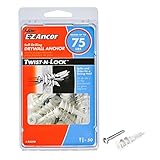
| Screw-in (e.g., E-Z Ancor) | Medium-duty items (curtain rods, small shelves, cabinets) | 20-75 lbs | Easy | Great balance of strength and ease for most home projects. |
| Toggle Bolt | Heavy-duty items (large mirrors, heavy shelves, TVs) | 50-150+ lbs | Moderate (requires larger hole) | The go-to for serious weight. Trustworthy and solid. |
| Molly Bolt | Medium to Heavy-duty items (cabinets, sturdy shelves) | 50-100+ lbs | Moderate | Excellent for a clean, strong finish. Solid performance. |
Finding Wall Studs: The Gold Standard
Let’s be brutally honest. As much as I’ve experimented with different types of drywall anchors, and believe me, I’ve spent my fair share of money trying to find the magic bullet, nothing beats screwing directly into a wall stud. It’s the tried-and-true method for a reason: it works. Studs are the wooden or metal framework behind your drywall that provide structural support for the entire wall.
When you hit a stud with a screw, you’re basically anchoring your item directly to the building’s skeleton. The holding power is immense. I’ve hung heavy bookshelves, large flat-screen TVs, and even a workbench directly into studs, and I’ve never had a single worry about them coming loose. It’s the most secure way to hang anything of substance.
The trick, of course, is finding those studs. Stud finders are your friend here.
I’ve used a few different types over the years, from the simple magnetic ones that detect the nails or screws holding the drywall to the electronic ones that sense density changes. My current favorite is an electronic one that actually shows you the edge of the stud on a little screen. It cost me about $30 and has saved me countless hours of guesswork and unnecessary patching. (See Also: Can Cords Be Used To Make Anchors Climbing )
You run it along the wall, mark where it indicates a stud, and then you can screw directly into it. It’s not foolproof; sometimes you might get a false reading, or the stud might be slightly off-center. That’s why I always recommend making a small pilot hole with a thin drill bit first to confirm you’ve actually hit solid wood before committing with a larger screw or bolt. It’s a extra step, but it prevents a lot of headaches.
I remember a time I was trying to hang a heavy, antique grandfather clock in my living room. It was a beast, probably 150 pounds. I spent an hour trying to find studs with a cheap magnetic stud finder, and I was convinced there were none in the right place.
Frustrated, I was about to give up and buy the most heavy-duty anchors I could find. Then I remembered a tip from an old handyman: tap the wall gently with a hammer. The sound changes when you hit a stud – it becomes duller and more solid. So, I started tapping, and sure enough, I found a stud exactly where I needed it.
It wasn’t perfectly centered, but it was close enough. I used a lag bolt directly into the stud, and that clock has been ticking away without a single worry for five years now. That experience taught me that sometimes, the old-school methods are just as effective, if not more so, than fancy gadgets. But for general purposes, a good electronic stud finder is a worthwhile investment, probably around $20-$40.
When you’re attaching something to a stud, the type of screw you use is also important. For most applications, a good quality wood screw, about 1.5 to 2 inches long, will do the job perfectly. If you’re hanging something extremely heavy, like a very large TV mount, you might need to use lag bolts, which are heavier-duty screws that require a pilot hole drilled with a specific size bit.
The key is that the screw or bolt should penetrate at least 1 inch into the stud for a secure hold. So, if your drywall is half an inch thick, you’ll want a screw that’s at least 1.5 inches long. It’s not just about the anchor; it’s about the fastener and the material it’s going into.
Why Finding Studs Is Superior
Imagine your drywall as a piece of bread. Now, imagine trying to hang something heavy by sticking the hanger into the bread itself. It might hold for a bit, but eventually, the bread will tear. A wall stud is like a piece of solid wood you’re screwing into. It’s designed to bear weight. When you use anchors in drywall, you’re basically relying on friction and the limited strength of the gypsum and paper. Even the best anchors are a compromise. Studs offer a direct, structural connection to your home’s framing, providing the most reliable and strongest possible attachment point. For any item where failure would be catastrophic or dangerous, finding a stud is the only sensible option.
Common Mistakes That Lead to Wall Damage
One of the most common mistakes I see people make, myself included in the past, is not checking the weight rating of the anchors and the item being hung. It sounds obvious, but people get blinded by the “easy-to-use” factor of plastic anchors and assume they’ll hold.
They see that little anchor, they screw it in, and they hang their item, often without a second thought. Then, weeks or months later, disaster strikes. I’ve had friends try to hang heavy mirrors or even small TV mounts with nothing but those basic plastic anchors.
It’s like playing Russian roulette with your wall. The manufacturer’s weight rating is usually a guideline under ideal conditions, and in hollow drywall, those conditions are rarely met.
It’s always better to overestimate the weight and use an anchor rated for significantly more than you think you need.
Another huge mistake is not using the right tool for the job. Using a drill bit that’s too large for the anchor means the anchor won’t have anything to grip behind the drywall. The hole becomes too loose, and the anchor will just spin or pull out. Conversely, if the drill bit is too small, you might struggle to get the anchor in, or worse, you could crack the drywall around the hole.
It’s important to follow the anchor manufacturer’s recommendations for drill bit size. Most anchor packaging will clearly state the required drill bit diameter.
I learned this the hard way when I tried to force a ribbed plastic anchor into a hole I’d drilled slightly too large. It just wouldn’t grip, and I ended up with a useless hole and a sagging shelf. It took a good patch job to fix it.
Over-tightening is another sneaky culprit. With plastic anchors, especially the softer ones, it’s easy to over-tighten the screw.
This can strip the anchor’s threads or, more commonly, cause the anchor to crack or crumble behind the drywall. Once that happens, the anchor is useless, and you’re left with a damaged wall.
It’s a delicate balance: you want the anchor to be snug and secure, but you don’t want to crank on it so hard that you damage it. For toggle and molly bolts, over-tightening can actually damage the mechanism that’s supposed to be holding the weight. I’ve seen molly bolts deform behind the wall because someone went a little too crazy with the screwdriver.
Always go for ‘snug’ rather than ‘super tight’ if you’re unsure.
Finally, and this is a big one that ties back to the original question, people often underestimate the importance of load distribution and dynamic forces. Just because two anchors are there doesn’t mean they’re sharing the load equally. If you’re hanging something that will be bumped, jostled, or has an uneven weight distribution (like a shelf with heavy books on one end), those anchors are under much more stress than a simple static pull-down. (See Also: Can Anchors In Your Shoulder Break )
My first attempt at hanging a towel rack in my bathroom with two plastic anchors failed spectacularly because the towels would create a lever effect, pulling unevenly. The anchors couldn’t handle the constant tugging and eventually gave way. This is why finding studs or using anchors designed for heavier, more dynamic loads is so important. It’s not just about the anchor’s static weight rating; it’s about how it performs under real-world stress.
Common Mistakes Summary
- Ignoring weight ratings for both anchors and items.
- Using the wrong drill bit size for the anchor.
- Over-tightening screws, leading to anchor or drywall damage.
- Underestimating dynamic loads and uneven weight distribution.
- Relying solely on basic plastic anchors for anything substantial.
Practical Tips for Secure Hanging
When you’re faced with hanging something, the first thing you should do, before even picking up an anchor, is assess the weight of the item. Seriously, get a scale if you have to.
If it’s over 5 pounds, I’d start thinking beyond basic plastic anchors. If it’s over 20 pounds, you’re definitely in stud-finder or heavy-duty anchor territory.
Don’t guess. Guessing is how you end up with holes in your wall and a broken item.
I learned this the hard way when I tried to hang a fairly weighty piece of artwork using what I thought was a reasonable estimate of its weight. It turned out to be about 10 pounds heavier than I’d guessed, and the cheap anchor I used started to pull out after about a month. A digital kitchen scale is your best friend for this. They’re cheap, usually under $20, and incredibly accurate.
Secondly, always, always try to locate a wall stud. I cannot stress this enough.
My stud finder, a simple electronic one that cost me about $25, has become one of the most valuable tools in my DIY arsenal. If you can hit a stud, your job is exponentially easier and your hanging is exponentially more secure. Even for lighter items, securing one end into a stud and using a good quality anchor on the other side will provide much more stability than two anchors in hollow drywall. It creates a much more rigid and dependable connection.
I’ve even used the ‘tap test’ method – the dull thud sound when you hit a stud – when I couldn’t find my stud finder, and it’s surprisingly effective. Just make sure you confirm with a tiny pilot hole before you commit.
When you do have to use drywall anchors, choose wisely. For anything more than a very light picture, I’d recommend screw-in anchors (like E-Z Ancor) or, for heavier items, toggle bolts or molly bolts. They cost a bit more, maybe $0.50-$2.00 per anchor compared to $0.10 for plastic, but the security they offer is incomparable. I recently installed a small bathroom vanity with molly bolts, and the difference in stability compared to what plastic anchors would have offered was night and day. They spread the load, they grip better, and they make you feel confident that your item isn’t going to fall. It’s about investing in quality fasteners that protect your walls and your belongings.
Finally, pay attention to the installation instructions. Every anchor is slightly different.
Some require a specific drill bit size, some need to be tapped in gently, and others need to be screwed in with a specific torque. Following the manufacturer’s guidance will make sure the anchor performs as intended.
For instance, toggle bolts require a larger hole, but that large hole is necessary for the toggle to pass through and deploy. Trying to force them through a smaller hole defeats the purpose. I’ve also found that pre-drilling pilot holes, even when not strictly required for some anchors, can make installation smoother and prevent damage to the drywall.
It’s a small step that can make a big difference in the overall success of your hanging project.
My Go-to Hanging Strategy
- Assess the Item’s Weight: Use a scale. Don’t guess.
- Locate a Stud: Use an electronic stud finder or the tap test.
- If Stud is Available: Screw directly into it with an appropriate screw (1.5-2 inches for typical drywall/stud). If the item is large and needs multiple attachment points, aim for at least one stud, using a heavy-duty anchor for the other points if necessary.
- If No Stud: Choose an anchor appropriate for the weight and type of item (screw-in, toggle, or molly bolt). Avoid basic plastic anchors for anything over 5-10 lbs.
- Follow Instructions: Use the correct drill bit size and don’t over-tighten.
Are Two Plastic Drywall Anchors Stronger Than One?
While two plastic drywall anchors can offer marginally more holding power than one, it’s rarely a doubling of strength and often not enough to justify the effort for anything beyond very light items. The primary issue is that drywall itself is weak, and the anchors rely on its integrity. If the load isn’t perfectly distributed or if there’s any dynamic stress, one anchor will fail, and the other will likely follow. They are generally not a reliable solution for medium to heavy items, regardless of how many you use.
Can I Hang a TV with Plastic Drywall Anchors?
Absolutely not. Never, under any circumstances, should you attempt to hang a TV with basic plastic drywall anchors. TVs are heavy, and they create significant dynamic loads. You need to attach TV mounts directly into wall studs or use very substantial heavy-duty anchors like toggle bolts specifically rated for the TV’s weight and then some. Failure to do so will result in significant damage to your wall and a potentially dangerous situation.
What Is the Weight Limit for a Plastic Drywall Anchor?
The weight limit for a plastic drywall anchor varies greatly depending on the specific type, size, and the condition of your drywall. However, most common plastic anchors are rated for between 10 and 50 pounds. This rating is often for ‘shear’ or ‘pull-out’ strength in ideal conditions. In reality, for hollow drywall, you should significantly reduce that number and consider it only suitable for very lightweight items like small picture frames or posters.
How Far Apart Should Two Drywall Anchors Be?
If you are using two plastic drywall anchors for a very light item, spacing them about 4 to 8 inches apart is typical. However, the exact spacing isn’t as important as the overall load distribution and the integrity of the drywall. For heavier items where you’re using better anchors, the manufacturer’s instructions will usually specify the optimal spacing based on the item being hung and the anchor’s design. The goal is always to distribute the weight as evenly as possible.
Conclusion
So, to finally put this to bed: are two plastic drywall anchors stronger than one? Yes, technically, but it’s a weak improvement and rarely the solution you actually need for anything substantial. I’ve learned through countless hours of trial and error, and a few embarrassing wall repairs, that relying on those flimsy plastic things is a gamble. They have their place, sure, for that unframed poster you’ve had since college, but anything with real weight or importance deserves better.
My advice? Invest in a decent stud finder and a few quality anchors like toggle bolts or screw-in types. It might cost a few extra bucks upfront, but it’ll save you the headache, the frustration, and the inevitable patching work down the line. Don’t let your walls become the weakest link in your decorating plans. Do it right the first time.
Next time you’re staring at a blank wall with something heavy to hang, take a moment. Grab that stud finder. Pick the right anchor. Your walls, and your belongings, will thank you for it.