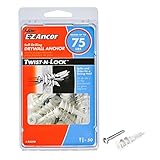
I remember staring at a pile of lag shields and wedge anchors after trying to hang a heavy shelf. My buddy swore they were the ‘best’ for anything, even that old shed wall.
Turns out, he was dead wrong. Wasting money on the wrong fasteners is a hobby I’ve perfected over the years, and I’m here to save you the trouble. So, can concrete anchors be used in wood? Let’s get straight to it.
Why You Should Probably Not Use Concrete Anchors in Wood
Look, I get it. You’ve got a heavy thing to hang, and you’ve got a box of concrete anchors sitting around. Maybe you just finished a concrete project, or perhaps you bought them on sale.
The temptation to just grab one, drill a hole, and bang it in is strong. I’ve been there. I once tried to use a couple of sleeve anchors to attach a workbench leg to a thick, old barn beam.
Seemed solid enough at first. The bolt went in, the sleeve expanded, and I felt pretty smug about my ingenuity. But after a few weeks of using that bench, things started to wobble.
That sleeve anchor, designed to grip rough concrete by friction and expansion, had just sort of chewed up the wood fibers. It wasn’t gripping anything anymore.
It was a loose, wobbly mess, and I had to take it all apart to do it right. That little experiment cost me about $30 in anchors and a whole afternoon of frustration.
The fundamental problem is this: concrete anchors are built to work with the unique properties of concrete – its porosity, its ability to be chipped and expanded into, and its inherent hardness. Wood, on the other hand, is a living, fibrous material. It compresses, it splinters, and it can rot. Forcing a concrete anchor into wood is like trying to fit a square peg in a round hole, except the round hole is made of something that can easily deform and tear.
Most concrete anchors rely on expansion. A wedge anchor, for instance, has a cone that gets pulled up into an expanding sleeve. This sleeve is supposed to press outwards against the concrete walls of the hole. In wood, this expansion doesn’t create a secure grip. Instead, it’s more likely to crush the wood fibers, creating a larger, weaker hole. The anchor then just sits there, loosely. A lag shield anchor, which is designed to be expanded by a screw, also relies on the anchor splitting and gripping the material. In wood, this splitting action can just tear the wood apart, making the hole too big for the anchor to ever get a good hold.
Some folks might say, ‘But what about a small tapcon screw?’ And yes, Tapcon is a brand that makes screws specifically designed for masonry, but they also have versions that look like regular screws. Those are not concrete anchors. They are masonry screws. Trying to use a true concrete anchor, like a sleeve anchor or a wedge anchor, in wood is asking for trouble. It’s not just a bad idea; it’s a recipe for something falling down, breaking, or worse.
There are so many fasteners out there designed specifically for wood, engineered to hold securely without damaging the material. Why would you even consider using something designed for an entirely different material? It’s like trying to hammer a nail with a screwdriver – it might work for a second, but it’s not what either tool is meant for, and you’ll likely end up frustrated and with a shoddy result.
The Real Deal: What Anchors are for Wood
Okay, so if concrete anchors are a no-go for wood, what should you be using? This is where you need to think about what you’re attaching and how much weight it’s going to hold. For most standard wood-to-wood or wood-to-structural-framing connections, you’re looking at screws or bolts. And not just any screws – you need the right kind for the job. (See Also: Can Concrete Anchors Be Used In Brick )
For general-purpose wood connections, like attaching furring strips, building a simple shelf bracket, or assembling basic furniture, wood screws are your bread and butter. They have coarse threads that bite into the wood fibers, pulling the pieces together tightly. You’ve got different types: drywall screws (which are brittle and not ideal for structural loads), deck screws (designed for outdoor use and usually coated for corrosion resistance), and general-purpose wood screws. A good quality wood screw, driven into a pilot hole (especially in hardwoods or near the edge of a board), will give you a strong, reliable connection.
When you’re dealing with heavier loads, like attaching a sturdy ledger board for a deck, hanging a substantial cabinet, or connecting larger lumber pieces, you’ll step up to lag screws (also called lag bolts). These are beefy screws with a hex head that you drive with a wrench or socket. They have deep, coarse threads and are designed to go into pre-drilled pilot holes in wood.
The pilot hole is important here; it needs to be the correct size – usually about 60-70% of the shank diameter. If it’s too small, you’ll split the wood.
Too big, and it won’t hold. I learned this the hard way trying to attach some heavy-duty shelving to my garage wall studs. I skipped the pilot hole on one of them, and the lag screw just spun in place.
Had to back it out, drill the proper hole, and then it held like a champ.
For really heavy-duty applications, like framing a house or attaching a structural beam, you’re likely looking at through-bolts. These are bolts that go all the way through the wood pieces and are secured with a nut and washer on the other side. They provide an incredibly strong connection, distributing the load across both pieces of wood. You’ll often see carriage bolts used too, which have a smooth, domed head that sits flush and a square neck that bites into the wood to prevent it from spinning while you tighten the nut. These are fantastic for anything where you want a clean, snag-free finish on one side.
It’s also worth mentioning specialized fasteners. For instance, structural screws are becoming increasingly popular. Brands like GRK Fasteners make heavy-duty screws that are often designed to replace lag screws and even through-bolts in certain applications. They have clever thread designs and often don’t require pre-drilling in many cases, making them faster and easier to install while still providing immense holding power. They are pricier than standard screws, but for important connections, they’re worth every penny.
When ‘good Enough’ Is Actually Dangerous: Common Mistakes
People often make the mistake of thinking that a fastener that looks like it’s holding is actually holding. This is especially true when you’re dealing with wood because it can be deceptive. You can drive a lag screw into a piece of rotten wood, and it might feel tight initially. But as soon as you put any real load on it, the wood fibers can crumble, and that ‘tight’ connection becomes dangerously loose.
One of the biggest blunders I see people make is using the wrong size screw or bolt. For example, using tiny screws to hang something that’s meant to hold a significant amount of weight. Or, conversely, using a bolt that’s too large for the piece of wood it’s going into. If you’re attaching a shelf cleat to a stud, and you use a lag screw that’s almost as thick as the cleat itself, you’re effectively weakening the cleat. You’re leaving very little material to hold the shelf. It’s about balance and proportion.
Another classic error is not accounting for the type of wood. Softwoods like pine and fir are much more forgiving and easier to drive fasteners into, but they also have less holding power. Hardwoods like oak or maple are much stronger and can hold fasteners more securely, but they are also more prone to splitting if you don’t pre-drill properly. If you’re trying to get a strong hold in softwood, you might need a longer fastener or a fastener with a wider thread pitch to get more surface area contact.
The pilot hole is a point of contention for many. Some people think it’s optional, especially with softer woods or when using self-tapping screws. While some modern structural screws are designed to go in without a pilot hole in many applications, for traditional wood screws, lag screws, and definitely for anything structural, a pilot hole is your best friend. Skipping it, especially in hardwoods or near the edge of a board, is a fast track to a split piece of wood. And a split piece of wood is a weak piece of wood. (See Also: Can Cords Be Used To Make Anchors Climbing )
Then there’s the issue of corrosion. If you’re working on anything that will be exposed to the elements, even a damp garage, using plain steel screws or bolts is a recipe for rust. Rust weakens fasteners over time and looks terrible. You need galvanized or stainless steel fasteners for outdoor or high-moisture environments. I once used regular deck screws to build a small outdoor planter box, and after just one winter, they were showing significant rust. The box itself was fine, but the fasteners looked like they were a decade old. It wasn’t structural, but it looked awful and I ended up replacing them sooner than I should have.
Finally, there’s the ‘it feels tight’ fallacy. Just because you can’t wiggle it with your hand doesn’t mean it’s secure under load. Things settle, wood can flex, and vibrations can loosen fasteners over time. Always err on the side of caution. If in doubt, use a larger or longer fastener, or add more fasteners. It’s far better to have a connection that’s over-engineered than one that fails when you need it most.
Real-World Scenarios: When Wood Meets Fancy Fasteners
Let’s talk about situations where you might think about using a concrete anchor in wood, and why you shouldn’t. Imagine you’re building a heavy-duty workbench. You’ve got thick 4×4 legs and a solid butcher block top.
You want to attach the legs to the top or to a frame. Someone might look at a heavy-duty steel bracket and think, ‘This bracket has holes for wedge anchors, so I’ll use those in the wood legs.’ That’s a trap. The bracket is designed for concrete, and its mounting holes are meant for concrete anchors.
When you try to put a wedge anchor into the wood leg, you’ll likely just crush and tear the wood. Instead, you should be using lag screws or through-bolts to attach that bracket to the wood.
Another common one is hanging a heavy piece of equipment, like a large generator or a hefty tool cabinet, in a workshop that has both concrete floors and wooden walls or support structures. You might be tempted to use the same type of anchor for everything.
For the floor, yes, wedge anchors or sleeve anchors are probably a good choice, assuming the floor is solid concrete. But for attaching anything to the wooden studs or framing of the wall? You absolutely need to find the studs and use long wood screws, lag screws, or even lag bolts that go deep into the studs.
If you can’t find a stud, you’ll need a heavy-duty toggle bolt or a molly bolt designed for hollow walls, but even those have limitations and aren’t meant for the kind of sustained, heavy loads a concrete anchor is designed for in concrete.
What about a fence post? You’ve got concrete footings, but the fence itself is wood. You might have metal fence post brackets that are designed to sit in concrete and then have holes for attaching wood. These brackets typically have holes for bolts or screws that go into the wood. You would use lag screws or through-bolts to attach the wooden fence rails or posts to these brackets. You would never use a concrete anchor to try and attach wood directly to the concrete footing itself. The connection needs to be designed for the materials involved.
Think about outdoor furniture or structures. A pergola, for example. The posts might sit in concrete footings, and you’ll use concrete anchors to secure the post brackets. But where the wooden beams and rafters connect to each other, or to the posts, you’re using large lag screws, structural screws, or through-bolts. The connection points are entirely different. The concrete anchors are only for the interface between the concrete and the bracket. Everything else is wood-to-wood, and that requires wood fasteners.
Even something as simple as a heavy mirror or artwork. If you’re hanging it on a wall with wood studs, you want to go directly into the studs with appropriate screws. If you have a plaster-and-lath wall or drywall, and you can’t find studs, you’d use drywall anchors – but these are not concrete anchors. They are designed for hollow wall materials and have different expansion mechanisms. The key takeaway is always to match the fastener to the material you are fastening into and the material you are fastening with. (See Also: Can Anchors In Your Shoulder Break )
A Quick Comparison: Wood vs. Concrete Anchors
To really drive this home, let’s lay out a simple comparison. This isn’t a complete engineering spec sheet, but it’ll show you the fundamental differences in how these fasteners work.
| Feature | Concrete Anchors (e.g., Wedge, Sleeve) | Wood Fasteners (e.g., Lag Screws, Wood Screws) | Verdict on Using Concrete Anchors in Wood |
|---|---|---|---|
| Primary Material Designed For | Concrete, Masonry, Brick | Wood, Engineered Wood Products | No. Fundamentally Mismatched. |
| Mechanism of Holding Power | Expansion, Friction, Interlocking threads (in some types) | Thread engagement with wood fibers, Compression, Shear strength | Expansion crushes/tears wood; friction is minimal; thread engagement is poor. |
| Holding Strength in Target Material | High (when installed correctly) | High (when installed correctly) | Extremely Low, Unreliable, and Dangerous. |
| Risk of Material Damage | Minimal in concrete; High risk of splitting/crushing in wood. | Low to moderate (risk of splitting if pilot hole is incorrect or too close to edge) | Guaranteed to damage wood, leading to failure. |
| Typical Installation Tool | Hammer, Wrench, Socket, Drill (for pilot hole) | Wrench, Socket, Drill (with screw bit), Impact Driver | Hammering can damage wood. Expansion in wood is counterproductive. |
| Cost-Effectiveness for Wood | Very Poor. Overpriced and ineffective. | Excellent. Widely available and cost-effective. | Complete waste of money and effort. |
Everyone says you can sometimes get away with it, especially for light loads. I disagree. ‘Getting away with it’ means it hasn’t failed yet. The forces acting on fasteners can be subtle and cumulative. A bit of vibration from a washing machine, a heavy gust of wind, or just the weight of stored items can be enough to cause a connection that ‘seems okay’ to fail catastrophically. The physics are just against you. Wood needs to be gripped by threads that bite into its fibers or by bolts that clamp it down. Concrete needs to be expanded into or wedged against.
Faq: Your Burning Questions Answered
Can I Use a Concrete Anchor to Hang a Light Fixture in Wood?
While it might seem like a light fixture won’t put much strain on a fastener, I’d still strongly advise against it. Concrete anchors work by expanding and can easily crush or split the wood fibers, creating a weak point. Even a light fixture, especially if it’s in a high-traffic area or subject to vibrations, can fail if the anchor isn’t properly seated. Use a screw specifically designed for wood, or a toggle bolt if you can’t hit a stud.
What If I Drill a Really Small Hole for the Concrete Anchor in Wood?
Drilling a smaller hole might make it seem tighter initially, but it doesn’t change the fundamental problem. The anchor is still designed to expand, and that expansion will still damage the wood fibers. It might even cause more stress as you force it in. You’re not tricking the anchor into working; you’re just setting yourself up for failure with a compromised connection. It’s better to use a fastener designed for wood and drill the correct pilot hole.
Are There Any Exceptions at All for Using Concrete Anchors in Wood?
Honestly, and this is my blunt opinion, no. There are no practical, safe, or reliable exceptions. The design and material properties are just too different. You might find anecdotal stories online of someone using a concrete anchor in wood for something trivial and it not failing immediately, but that’s not a recommendation. It’s a gamble. Why take that gamble when there are perfectly good, inexpensive fasteners made specifically for wood?
What’s the Difference Between a Masonry Screw and a Concrete Anchor?
A masonry screw, like a Tapcon, is a screw designed with threads that can cut into and grip hard materials like concrete or brick. It’s still a screw that relies on threading. A concrete anchor, like a wedge anchor or sleeve anchor, typically uses an expansion mechanism. You drill a hole, insert the anchor, and then when you tighten a bolt or screw, a part of the anchor expands outwards, wedging itself against the sides of the hole. They are fundamentally different in how they achieve holding power and are suited for different materials.
Can I Use Concrete Anchors in Plywood or Particle Board?
No, the same principles apply, and arguably, it’s even worse. Plywood and particle board are even less forgiving than solid wood. Particle board, in particular, is made of wood fibers and glue and can crumble very easily. Forcing a concrete anchor into these materials will almost certainly destroy the integrity of the material around the hole, leading to a connection that will fail quickly and unexpectedly. Stick to fasteners designed for those specific materials.
Final Verdict
So, to put it plainly: can concrete anchors be used in wood? The answer is a resounding no. I’ve seen firsthand how this little shortcut leads to wobbly shelves and, frankly, a lot of wasted money and time. There’s no magic bullet or clever workaround that makes a concrete anchor suitable for wood.
Always use fasteners designed for the material you’re working with. For wood, that means wood screws, lag screws, or bolts. They’re readily available, affordable, and most importantly, they’re engineered to give you a strong, safe connection.
Next time you’re faced with a fastening job involving wood, resist the urge to grab those concrete anchors. Take a quick trip to the hardware store or rummage through your toolbox for the right wood fastener. Your project, and your peace of mind, will thank you for it.